
UNITED STATES
SECURITIES AND EXCHANGE COMMISSION
Washington, D. C. 20549
______________________________________________________
FORM 10-K
______________________________________________________
(Mark One)
| ANNUAL REPORT PURSUANT TO SECTION 13 OR 15(d) OF THE SECURITIES EXCHANGE ACT OF 1934 | |||||
For the fiscal year ended January 31 , 2026
OR
| TRANSITION REPORT PURSUANT TO SECTION 13 OR 15(d) OF THE SECURITIES EXCHANGE ACT OF 1934 [NO FEE REQUIRED] | |||||
For the transition period from to
Commission file number 1-8344
______________________________________________________
(Exact name of registrant as specified in its charter)
_________________________________________________
| (State or other jurisdiction of incorporation or organization) | (I.R.S. Employer Identification No.) | ||||||||||
| (Address of principal executive offices) | (Zip Code) | ||||||||||
Registrant’s telephone number, including area code (614 ) 415-7000
______________________________________________________
Securities registered pursuant to Section 12(b) of the Act:
| Title of each class | Trading Symbol(s) | Name of each exchange on which registered | ||||||
Securities registered pursuant to Section 12(g) of the Act: None.
Indicate by check mark if the registrant is a well-known seasoned issuer, as defined in Rule 405 of the Securities Act. Yes ☒ No ☐
Indicate by check mark if the registrant is not required to file reports pursuant to Section 13 or Section 15(d) of the Act. Yes ☐ No ☒
Indicate by check mark whether the registrant (1) has filed all reports required to be filed by Section 13 or 15(d) of the Securities Exchange Act of 1934 during the preceding 12 months (or for such shorter period that the registrant was required to file such reports), and (2) has been subject to such filing requirements for the past 90 days. Yes ☒ No ☐
Indicate by check mark whether the registrant has submitted electronically every Interactive Data File required to be submitted pursuant to Rule 405 of Regulation S-T during the preceding 12 months (or for such shorter period that the registrant was required to submit such files). Yes ☒ No ☐
Indicate by check mark whether the registrant is a large accelerated filer, an accelerated filer, a non-accelerated filer, a smaller reporting company, or an emerging growth company. See the definitions of “large accelerated filer,” “accelerated filer,” “smaller reporting company” and “emerging growth company” in Rule 12b-2 of the Exchange Act.
If an emerging growth company, indicate by check mark if the registrant has elected not to use the extended transition period for complying with any new or revised financial accounting standards provided pursuant to Section 13(a) of the Exchange Act. ☐
Indicate by check mark whether the registrant has filed a report on and attestation to its management’s assessment of the effectiveness of its internal control over financial reporting under Section 404(b) of the Sarbanes-Oxley Act (15 U.S.C. 7262(b)) by the registered public accounting firm that prepared or issued its audit report. ☒
If securities are registered pursuant to Section 12(b) of the Act, indicate by check mark whether the financial statements of the registrant included in the filing reflect the correction of an error to previously issued financial statements. ☐
Indicate by check mark whether any of those error corrections are restatements that required a recovery analysis of incentive-based compensation received by any of the registrant’s executive officers during the relevant recovery period pursuant to §240.10D-1(b). ☐
Indicate by check mark whether the registrant is a shell company (as defined in Rule 12b-2 of the Act). Yes ☐ No ☒
The aggregate market value of the registrant’s Common Stock held by non-affiliates of the registrant as of the last business day of the registrant’s most recently completed second fiscal quarter was approximately $5.8 billion.
Number of shares outstanding of the registrant’s Common Stock as of March 6, 2026: 201,134,265 .
DOCUMENTS INCORPORATED BY REFERENCE
Portions of the Registrant’s Proxy Statement for the Registrant’s 2026 Annual Meeting of Stockholders are incorporated by reference into Part III.
Table of Contents
| Page No. | ||||||||
| Part I | ||||||||
| Item 1. | ||||||||
| Item 1A. | ||||||||
| Item 1B. | ||||||||
| Item 1C. | ||||||||
| Item 2. | ||||||||
| Item 3. | ||||||||
| Item 4. | ||||||||
| Part II | ||||||||
| Item 5. | ||||||||
| Item 6. | ||||||||
| Item 7. | ||||||||
| Item 7A. | ||||||||
| Item 8. | ||||||||
| Item 9. | ||||||||
| Item 9A. | ||||||||
| Item 9B. | ||||||||
| Item 9C. | ||||||||
| Part III | ||||||||
| Item 10. | ||||||||
| Item 11. | ||||||||
| Item 12. | ||||||||
| Item 13. | ||||||||
| Item 14. | ||||||||
| Part IV | ||||||||
| Item 15. | ||||||||
| Item 16. | ||||||||
PART I
ITEM 1. BUSINESS.
General
Bath & Body Works is a global leader in personal care and home fragrance, driven by the belief that everybody deserves to feel good.
For over 35 years, the brand’s beloved and iconic scents have been expertly crafted for exceptional performance and a luxury fragrance experience. Formulated with thoughtfully chosen ingredients, Bath & Body Works’ body care products are available in multiple forms including fine fragrance mist, body cream, lotion, eau de parfum, body wash, hand soap, sanitizer and more, and home to our famous 3-wick candles. Consumers can shop Bath & Body Works anytime and anywhere they choose, from welcoming, in-store experiences at 1,927 company-operated stores in the United States of America (“U.S”) and Canada, our e-commerce sites in the U.S. and Canada, 573 international stores and 34 e-commerce sites in more than 45 other countries, as well as Amazon.
Throughout this Annual Report on Form 10-K, we refer to Bath & Body Works, Inc. as “we” and the “Company.”
Fiscal Year
We utilize the retail calendar for reporting and our fiscal year ends on the Saturday nearest to January 31. As a result, “2025” refers to the 52-week period ended January 31, 2026, “2024” refers to the 52-week period ended February 1, 2025 and “2023” refers to the 53-week period ended February 3, 2024.
Strategy
Our strategy is rooted in the Consumer First Formula, launched in the third quarter of 2025, which puts the consumer at the center of everything we do. The Consumer First Formula is a multi-year, comprehensive transformation plan to revitalize Bath & Body Works across brand, product and marketplace. We are focused on our four largest revenue driving opportunities to try to attract new, younger consumers to the brand, which we expect will help us unlock our next era of sustainable growth:
•Creating Disruptive and Innovative Products: We intend to reestablish best in class product leadership in our hero categories.
•Reigniting the Brand: We expect to invest in marketing to build a brand with cultural currency, showing up in culture through creators, in store visuals and bigger storytelling, creating meaningful emotional connections with consumers.
•Winning in the Marketplace: We plan to expand access and ease of discovery through an enhanced digital experience, third-party channels and refreshed in-store merchandising to acquire new and lapsed consumers.
•Operating with Speed and Efficiency: We are working to transform Bath & Body Works to be a faster and more efficient organization by empowering teams, working with focus and agility to prioritize what customers care about most.
As we move forward under the Consumer First Formula, we believe the following competitive advantages endure and will help enable our return to sustainable growth:
•We are a market leader in attractive, growing categories;
•We are an iconic brand with global recognition;
•We have a global store footprint with 2,500 locations employing a community of exceptional store associates;
•We have a customer loyalty program with 40 million active members; and
•We benefit from a fast, predominantly domestic, vertically-integrated supply chain.
We are investing in new capabilities and talent, focusing our teams on the highest-value work and moving at the speed of the consumer, while optimizing expenses to fuel innovation and long-term performance. Since Daniel Heaf joined as our new Chief Executive Officer, he has put leaders in roles for accountability to drive the priorities of the Consumer First Formula, with responsibilities across our marketplace channels, product merchandizing and human resources.
Company-operated Stores
We are a predominantly off-mall retailer with 60% of our North American store fleet located in off-mall locations as of January 31, 2026. We are continuing our off-mall expansion to limit our exposure to vulnerable mall locations, with a target mix of 75% off-mall over time given continued consumer preference. We proactively manage our stores and adjust our investment levels based on individual store and fleet performance.
1
The following table provides the number of our Company-operated retail stores as of January 31, 2026 and February 1, 2025:
| January 31, 2026 | February 1, 2025 | ||||||||||
| United States | 1,814 | 1,782 | |||||||||
| Canada | 113 | 113 | |||||||||
| Total | 1,927 | 1,895 | |||||||||
The following table provides the changes in the number of our Company-operated retail stores for the past three fiscal years:
| Beginning of Year | Opened | Closed | End of Year | ||||||||||||||||||||
| 2025 | 1,895 | 94 | (62) | 1,927 | |||||||||||||||||||
| 2024 | 1,850 | 106 | (61) | 1,895 | |||||||||||||||||||
| 2023 | 1,802 | 95 | (47) | 1,850 | |||||||||||||||||||
During 2025, we opened 94 new North American stores, nearly all in off-mall locations, and permanently closed 62 stores, predominantly in malls, which, when combined with store remodel activity, resulted in net square footage growth of 2%. In 2026, we expect North American square footage growth of approximately 1%.
Franchise, License and Wholesale Arrangements
In addition to our Company-operated stores, our products are sold at partner-operated locations and e-commerce sites in more than 45 countries through franchise, license and wholesale arrangements. Our international partner-based, asset-light business model allows us to establish operating standards by owning assortment, pricing architecture, promotions, store designs and real estate approval while our partners make investments and contribute as experts in local real estate, people and practices.
The following table provides the number of international stores operated by our partners as of January 31, 2026 and February 1, 2025:
________________
| January 31, 2026 | February 1, 2025 | ||||||||||
| International | 536 | 494 | |||||||||
| International - Travel Retail | 37 | 35 | |||||||||
| Total (a) | 573 | 529 | |||||||||
(a)Includes store locations only and does not include kiosks, shop-in-shops, gondola or beauty counter locations.
Additionally, our partners operated 34 international e-commerce sites as of January 31, 2026, compared to 31 as of February 1, 2025.
As part of the Consumer First Formula, we launched on Amazon in the U.S. in February 2026, allowing more consumers to discover and shop the brand’s iconic fragrances and most loved products.
Additional Information
Merchandise Vendors
During 2025, we purchased merchandise from approximately 90 vendors, primarily located in the U.S. Our largest vendor supplied approximately 12% of our total merchandise purchases (on a dollar basis) during 2025, while no other single vendor accounted for more than 10% of our merchandise purchases (on a dollar basis). Our five largest vendors supplied approximately 40% of our total merchandise purchases (on a dollar basis) on a combined basis during 2025.
Information Systems
We have undertaken a multi-year project to modernize and significantly upgrade our digital and information technology (“IT”) systems, capabilities and organization to, among other things, advance our data analytics capabilities, enhance our in-store and online customer experience, enable us to more effectively personalize our marketing, shopping, and promotional experiences, streamline our IT and digital operations and enable us to work more efficiently (the “IT Transformation Project”). We believe successful execution of the IT Transformation Project will enhance our omnichannel capabilities and support the growth and profitability of our business while also enhancing the security of, and otherwise reducing risks associated with, our IT systems. Our technology roadmap remains on-track, as we enhance our systems and put in place foundational tools to enable more personalization and seamless customer engagement to drive sustainable growth.
2
Seasonal Business
Our operations are seasonal in nature and the fourth quarter, including the holiday selling season, typically accounts for approximately 40% of our Net Sales and is our most profitable quarter.
Working Capital
We fund our business operations through a combination of available cash and cash equivalents and cash flows generated from operations. In addition, our credit facility is available for additional working capital needs and investment opportunities.
Regulation
We and our products are subject to regulation by various federal, state, local and foreign regulatory authorities. We are subject to a variety of tax and customs regulations and international trade agreements.
Intellectual Property
Our trademarks, copyrights and patents, which constitute our primary intellectual property, have been registered or are the subject of pending applications in the U.S. Patent and Trademark Office and with the registries of many foreign countries and/or are protected by common law. We believe our products are identified by our intellectual property and our intellectual property is an integral tool in protecting innovation. Thus, we believe our intellectual property is of significant value. Accordingly, we intend to maintain our intellectual property and related registrations and vigorously protect our intellectual property assets against infringement.
Competition
The sale of body care, home fragrance and soap and sanitizer products is a highly competitive business with numerous competitors, including individual and chain specialty stores, department stores, online retailers and discount retailers. Brand image, presentation, marketing, design, price, service, fulfillment, assortment and quality are the principal competitive factors.
Other Information
For additional information about our business, see “Management’s Discussion and Analysis of Financial Condition and Results of Operations,” included under Item 7. of this Annual Report on Form 10-K.
Human Capital Management
Human Capital
At Bath & Body Works, our purpose goes beyond selling product. We strive to be an employer of choice, make a difference in our communities and foster a safe and empowering environment where all associates, customers and suppliers are valued. We believe everyone belongs at Bath & Body Works.
We work to create a culture where all associates can contribute their strengths, skills and abilities and where unique perspectives, and experiences, are valued, recognized and celebrated. The Human Capital & Compensation Committee of our Board oversees, among other things, the Company’s programs, policies, practices and strategies relating to culture, talent, equal employment opportunities and the Company’s executive compensation programs. In addition, our Board oversees the talent review and succession planning process for our Chief Executive Officer and other critical, senior level roles.
Workforce Demographics
As of January 31, 2026, we employed over 60,700 associates, none of whom were covered by a collective bargaining agreement. Approximately 94% of our associates work in our stores, with the remainder working in our home office or distribution and fulfillment centers. The following table includes the number of associates in full-time status or part-time status (which are associates who work less than 40 hours per week) as of January 31, 2026:
| Work Status | Number of Associates | |||||||
| Full-time | 9,071 | |||||||
| Part-time | 51,664 | |||||||
| Total | 60,735 | |||||||
Focus on Culture
We champion a supportive work environment that prioritizes attracting, engaging, developing and promoting talent. By fostering a healthy workplace culture where every individual feels valued, we believe we can better serve our customers while attracting and retaining highly talented associates. We are committed to ensuring all team members have access to opportunities, including career advancement pathways and competitive wages.
3
Commitment to Competitive Wages
Our compensation programs are designed to link annual changes in compensation to overall Company performance, as well as each individual’s contribution to the results achieved. Our pay for performance philosophy includes participation of all salaried associates in home office and distribution and fulfillment centers in our short-term cash incentive compensation program. In addition, our store leaders are eligible to earn monthly bonuses based on performance. The emphasis on overall Company performance is intended to align the associates’ financial interests with the interests of the Company and our stockholders.
Commitment to Providing Quality Benefits
We offer competitive, performance-based compensation; a company-matched 401(k) retirement plan; and flexible and affordable health, wellness and lifestyle benefits. Subject to certain eligibility requirements, associates can choose benefits and resources that fit their lifestyle, including, but not limited to, 14 weeks paid maternity leave, six weeks paid parental leave, mental health benefits, family planning benefits including fertility, adoption and surrogacy, expanded bereavement leave time, military leave, tuition-free access to education, tuition assistance, no co-pays for insulin and other critical prescriptions, commuter benefits, a tobacco cessation program, an associate stock purchase plan that allows associates to purchase Company stock at a discount, an associate assistance program for all full-time and seasonal associates and a generous merchandise discount.
In 2025, we continued our focus on ensuring associate well-being by rolling out medical, dental and vision offerings for our part-time associates and promoting our wellness center in our Columbus, Ohio headquarters, which provides accessible, low-cost medical care, physical therapy, mental health services and an on-site pharmacy to our associates. We continue to offer DailyPay (earned income wage access as needed) to our associates in our distribution and fulfillment centers and in stores.
As part of our caring culture, our associates help fellow associates going through extreme personal hardships through the Bath & Body Works Associates for Associates Emergency Fund (“A4A”). Administered by the Columbus Foundation with funds donated by associates and matched by the Bath & Body Works Foundation, A4A provides monetary aid and/or makes community resources available to associates facing crisis, such as fire destruction, a serious medical condition or a natural disaster. During 2025, the A4A fund awarded over $527,000 in grants to approximately 300 associates. In addition, we launched a Dream Bright scholarship fund for associates and their dependents, which is also administered by the Columbus Foundation with funds from the Bath & Body Works Foundation. We distributed $185,000 for Dream Bright scholarships in 2025.
Safety Is a Priority
We are committed to providing all of our associates a healthy and safe working environment and for protecting the safety of our customers. Our health and safety programs (including safety training for associate onboarding, developmental e-learning and on-the-job training) are designed to meet or exceed regulatory requirements for the various industry sectors of our business and in the jurisdictions in which we operate.
Code of Conduct
We have a written Code of Conduct that is based on our values and is a resource which establishes standards for associate conduct that reinforce the Company’s commitment to integrity and ethical conduct. All associates are required to complete a Code of Conduct training course and certify their compliance annually.
We maintain an Ethics Hotline, operated by a third-party, 24 hours a day, seven days a week, where any individual may anonymously report concerns, including potential instances of unethical conduct and potential violations of law or Company policies.
Available Information
We are subject to the reporting requirements of the Securities Exchange Act of 1934, as amended (the “Exchange Act”), and its rules and regulations. The Exchange Act requires us to file reports, proxy statements and other information with the U.S. Securities and Exchange Commission (“SEC”). The SEC maintains a website that contains reports, proxy statements and other information regarding issuers that file electronically with the SEC. These materials may be obtained electronically by accessing the SEC’s website at www.sec.gov.
Our Annual Reports on Form 10-K, Quarterly Reports on Form 10-Q, Current Reports on Form 8-K and amendments to these reports filed or furnished pursuant to Section 13(a) or 15(d) of the Exchange Act are available, free of charge, on our website at www.bbwinc.com. Our website and information included in or linked to our website are not part of this Annual Report on Form 10-K.
Copies of any of the above-referenced documents will also be made available, free of charge, upon written request to:
Bath & Body Works, Inc.
4
Investor Relations Department
Three Limited Parkway
Columbus, Ohio 43230
5
ITEM 1A. RISK FACTORS.
We caution that any forward-looking statements (as such term is defined in the Private Securities Litigation Reform Act of 1995) contained in this report or made by our Company or our management involve risks and uncertainties and are subject to change based on various factors, many of which are beyond our control. Accordingly, our future performance and financial results may differ materially from those expressed or implied in any such forward-looking statements. Words such as “estimate,” “project,” “plan,” “believe,” “expect,” “anticipate,” “intend,” “potential,” “target,” “goal” and any similar expressions may identify forward-looking statements. Risks associated with the following factors, among others, in some cases have affected and, in the future, could affect our financial performance and actual results and could cause actual results to differ materially from those expressed or implied in any forward-looking statements included in this report or otherwise made by the Company or our management:
•general economic conditions, inflation, tariffs, consumer confidence, consumer spending patterns and market disruptions including pandemics or significant health hazards, severe weather conditions, natural disasters, terrorist activities, financial crises, political crises, government shutdowns or other major events, or the prospect of these events;
•the seasonality of our business;
•our ability to successfully execute on our Consumer First Formula strategic transformation;
•our ability to attract, develop and retain qualified associates and manage labor-related costs;
•difficulties arising from turnover in Company leadership or other key positions;
•the dependence on store traffic and the availability of suitable store locations on appropriate terms;
•our continued growth in part through new store openings and existing store remodels and expansions;
•our ability to successfully operate and expand internationally and related risks;
•our independent franchise, license, wholesale and other distribution-related partners;
•our direct channel business;
•our ability to protect our reputation and our brand image;
•our ability to attract customers with marketing, advertising, promotional programs and our loyalty program;
•our ability to maintain, enforce and protect our trade names, trademarks and patents;
•the highly competitive nature of the retail industry and the segments in which we operate;
•new and current consumer acceptance of our products and our ability to manage the life cycle of our brand and launch our strategic transformation successfully;
•our ability to innovate and produce high quality products and attract new and retain current consumers;
•our ability to source, distribute and sell goods and materials on a global basis, including risks related to:
•political instability, wars and other armed conflicts, environmental hazards or natural disasters;
•significant health hazards or pandemics, which could result in closed factories and/or stores, reduced workforces, scarcity of raw materials, and scrutiny or embargoing of goods produced in impacted areas;
•duties, taxes, tariffs and other charges;
•legal and regulatory matters;
•volatility in currency exchange rates;
•local business practices and political issues;
•delays or disruptions in shipping and transportation and related pricing impacts;
•disruption due to labor disputes; or
•changing expectations regarding product safety due to new legislation;
•our ability to successfully complete sustainability initiatives, and associated costs thereof;
•the geographic concentration of third-party manufacturing facilities and our distribution facilities in central Ohio;
•our reliance on a limited number of suppliers to support a substantial portion of our inventory purchasing needs;
•the ability of our vendors to deliver products in a timely manner, meet quality standards and comply with applicable laws and regulations;
•fluctuations in foreign currency exchange rates;
•fluctuations in product input costs;
•fluctuations in energy costs;
•our ability to adequately protect our assets from loss and theft;
•claims arising from our self-insurance;
•our and our third-party service providers’ ability to implement and maintain information technology systems and to protect associated data;
•our ability to maintain the security of customer, associate, third-party and Company information;
•stock price volatility;
•our ability to pay dividends and make share repurchases under share repurchase authorizations;
•shareholder activism matters;
•our ability to maintain our credit ratings;
6
•our ability to service or refinance our debt and maintain compliance with our restrictive covenants;
•our ability to comply with laws, regulations, standards, technology platform rules or other requirements related to data privacy and cybersecurity;
•our ability to comply with regulatory requirements;
•legal and compliance matters; and
•tax, trade and other regulatory matters.
We are not under any obligation and do not intend to make publicly available any update or other revisions to any of the forward-looking statements contained in this report to reflect circumstances existing after the date of this report or to reflect the occurrence of future events even if experience or future events make it clear that any expected results expressed or implied by those forward-looking statements will not be realized.
We announce material financial and operational information using our investor relations website, press releases, SEC filings and public conference calls and webcasts. Information about the Company, our business and our results of operations may also be announced by posts on our accounts on social media channels, including the following: Facebook, Instagram, X, LinkedIn, Pinterest, TikTok and YouTube. The information contained on, or that can be accessed through, our social media channels and our website is deemed not to be incorporated in this Annual Report on Form 10-K or to be a part of this Annual Report on Form 10-K. The information that we post through these social media channels and on our website may be deemed material. As a result, we encourage investors, the media and others interested in the Company to monitor these social media channels in addition to following our investor relations website, press releases, SEC filings and public conference calls and webcasts. The list of social media channels we use may be updated from time to time on our investor relations website.
The following discussion of risk factors contains “forward-looking statements.” These risk factors may be important to understanding any statement in this Annual Report on Form 10-K, other filings or in any other discussions of our business. The following information should be read in conjunction with Item 7. Management’s Discussion and Analysis of Financial Condition and Results of Operation and Item 8. Financial Statements and Supplementary Data.
In addition to the other information set forth in this report, the reader should carefully consider the following factors which could materially affect our business, results of operations, financial condition and/or cash flows. The risks described below are not our only risks. Additional risks and uncertainties not currently known or that are currently deemed to be immaterial may also adversely affect our business, results of operations, financial condition and/or cash flows in a material way.
Risks related to our business:
Our net sales, results of operations and cash flows are sensitive to, have been affected by and may in the future be further impacted by, general economic conditions, inflation, tariffs, consumer confidence, consumer spending patterns, significant health hazards or pandemics, severe weather or other market disruptions.
Our net sales, results of operations, cash flows and future growth may be affected by local, regional, national or international political or economic trends or developments that can reduce consumers’ ability or willingness to spend or alter consumer behavior and spending patterns. These trends and developments (including tariffs and government shutdowns), which can vary substantially by country, include political, financial or social instability or conditions, geopolitical events, corruption, anti-American sentiment, social and ethnic unrest, military conflicts and terrorism, as well as changes in general economic conditions (including unemployment levels, inflation and market volatility). For example, in recent years, the global economy was negatively impacted by high inflation rates, which has resulted in higher prices that have negatively impacted and may continue to negatively impact consumer demand. In addition, market disruptions due to natural disasters, significant health hazards or pandemics or other major events or the prospect of these events could also impact or shift consumer spending and sentiment. Extreme weather conditions in the areas in which our stores are located, particularly in markets where we have multiple stores, or in the central Ohio region where most of our third-party manufacturers and our distribution centers are located, have adversely affected and could in the future adversely affect our business. During periods when economic or market conditions are unsettled or weak, or during events such as government shutdowns, which impact discretionary spending, purchases of our products have declined, and may in the future further decline. In such circumstances, we have increased, and may in the future continue to increase, the number of promotional sales which, when combined with inflationary cost pressures, have negatively affected our merchandise margin rates and, in the future, could have a material adverse effect on our results of operations, financial condition and cash flows.
Our net sales, operating income, cash and inventory levels fluctuate on a seasonal basis.
We experience major seasonal fluctuations in our net sales and operating income, with a significant portion of our operating income and cash flows typically realized during the fourth quarter holiday season. Any decrease in sales or margins during this critical period could have a material adverse effect on our results of operations, financial condition and cash flows.
7
Seasonal fluctuations also affect our cash and inventory levels since we usually order merchandise in advance of peak selling periods and sometimes before new trends are confirmed by customer purchases. We must carry a significant amount of inventory, especially before the holiday season selling period. If we are not successful in selling inventory, we may have to sell the inventory at significantly reduced prices or may not be able to sell the inventory at all, which could have a material adverse effect on our results of operations, financial condition and cash flows.
We cannot guarantee the successful implementation of our strategic transformation.
We launched a multi-year “Consumer First Formula” strategic transformation in the third quarter of 2025, as outlined in item I – “Business – Strategy”. Our ability to successfully execute this transformation is subject to various risks and uncertainties, such as our ability to successfully execute our plan, changes in consumer demands and trends, general economic conditions, and other risks. Achievement of sustainable growth may require significant investment and, therefore, may be dilutive to our earnings in the short term. In addition, at times the attention of our senior management team may be focused on the Consumer First Formula and be diverted from day-to-day business operations, which may disrupt our business. There can be no guarantee regarding the timing of or extent to which we will realize the anticipated benefits of these investments and other costs, if at all, and these factors could have a material adverse effect on our results of operations, financial condition and cash flows.
We may be impacted by our ability to attract, develop and retain qualified associates and manage labor-related costs.
We believe one of our competitive advantages is providing positive, engaging and satisfying experiences for our diverse customer base, which requires us to have highly trained, engaged and diverse associates. Our success depends in part upon our ability to attract, develop and retain a sufficient number of qualified associates, including, but not limited to, store personnel, associates in our home office, distribution and fulfillment centers and key product and support talent. The turnover rate in the retail industry is generally high, and qualified individuals of the requisite caliber and number needed to fill these positions have been in short supply in some areas. Competition for such qualified individuals and shifts in the labor market, including availability of skilled talent, and continued changes and complexity in labor and healthcare laws have caused us to incur higher labor costs, and such increases in labor costs could continue in the future. Our inability to recruit a sufficient number of qualified individuals in the future may, among other things, delay planned openings of new stores, affect the speed with which we expand, or negatively impact our ability to timely and efficiently fulfill orders, to develop new merchandise and to launch new product lines. Delayed store openings, significant increases in associate turnover rates or significant increases in labor-related costs could have a material adverse effect on our results of operations, financial condition and cash flows.
If we are subject to a unionization campaign from our associates, we would incur significant expenses in the form of legal and consulting fees and potentially be subject to negative publicity that could significantly disrupt our operations and have an adverse effect on our results of operations, financial condition and cash flows.
An increase in the costs of associate wages, benefits and insurance (including workers’ compensation, general liability, property and health) has adversely affected, and could continue to adversely affect, our operating results. In particular, labor shortages and the current competitive labor market have increased competition for qualified associates, which has compelled, and may continue to compel, us to pay higher wages to attract or retain qualified associates. Such increases in costs may result from general economic or competitive conditions or from government imposition of higher minimum wages at the federal, state or local level, including in connection with the increases in state minimum wages that have been enacted by various states. Moreover, there may be a long-term trend toward higher wages in developing markets. Any increase in such operating expenses could have a material adverse effect on our results of operations, financial condition and cash flows.
Turnover in Company leadership or other key positions, and our ability to attract and retain new talent, may have an adverse impact on Company performance.
We have in the past and may in future experience changes in key leadership or key positions in the future. The departure of key personnel can result in the loss of significant knowledge and experience. This loss of knowledge, expertise and experience can be mitigated through successful internal succession planning or external hiring and transition, but there can be no assurance that we will be successful in such efforts. Attracting and retaining qualified senior leadership may be more challenging during business transformations (including organizational changes or workforce reductions) or under adverse business conditions. Failure to attract and retain the right talent or to smoothly manage the transition of responsibilities resulting from such turnover could affect our ability to meet our goals and may cause us to miss performance objectives or financial targets or disrupt our relationships with our customers, vendors or other third parties.
Our net sales depend on a volume of traffic to our stores and the availability of suitable lease space.
More than half of our stores are located in off-mall retail shopping areas with the remainder located in malls and other types of retail centers. Sales at these stores are derived, in part, from the volume of consumer traffic in those retail areas. Our stores benefit from the ability of the retail center and other attractions in an area, including “destination” retail stores, to generate consumer traffic in the vicinity of our stores. Sales volume and retail traffic may be adversely affected by factors that we cannot control, such as economic downturns, including due to inflationary or tariff pressures, or changes in consumer
8
demographics in a particular area, consumer trends away from brick-and-mortar retail toward online shopping, competition from digital and other retailers and other retail areas where we do not have stores, significant health hazards or pandemics, the closing of other stores or the decline in popularity or safety in the shopping areas where our stores are located and the deterioration in the financial condition of the operators or developers of the shopping areas in which our stores are located.
Part of our future growth is significantly dependent on our ability to operate stores in desirable locations with capital investment and lease costs providing the opportunity to earn a reasonable return. We cannot be sure as to when or whether such desirable locations will become available at reasonable costs. Additionally, we are dependent upon the suitability of the lease spaces that we currently use. The leases that we enter into are generally noncancelable leases with initial terms of ten years. If we determine that it is no longer economical to operate a store and decide to close it, we may remain obligated under the applicable lease for, among other things, payment of the base rent for the balance of the lease term.
These risks could have a material adverse effect on our ability to grow and our results of operations, financial condition and cash flows.
Our continued growth and success depend in part on new store openings and existing store remodels and expansions.
Our continued growth and success depend in part on our ability to open and operate new, primarily off-mall stores and expand and remodel existing stores on a timely and profitable basis. Accomplishing our new and existing store expansion goals will depend upon a number of factors, including the ability to partner with developers and landlords to obtain suitable sites for new and expanded stores at acceptable costs and on acceptable timelines, the hiring and training of qualified personnel and the integration of new stores into existing operations. There can be no assurance we will be able to achieve our store expansion goals, manage our growth effectively, successfully integrate the planned new stores into our operations or operate our new, remodeled and expanded stores profitably. These risks could have a material adverse effect on our ability to grow and our results of operations, financial condition and cash flows.
Our international operations and our plans for international expansion include risks that could impact our results and reputation.
We intend to continue to operate internationally and further expand in our existing markets and into new international markets, including through franchise and other distribution-related partner arrangements. The risks associated with international markets include, among others, difficulties in attracting customers due to a lack of customer familiarity with our brand, our ability to comply with international laws and regulations, our lack of familiarity with local customer preferences, cultures or religious norms and seasonal differences in the international markets. Any of these difficulties may lead to disruption in the overall timing of our international expansion efforts, lower sales than we anticipate and increased costs. Further, entry into other markets may bring us into competition with new competitors or with existing competitors with an established presence in such markets. Such expansions will also have upfront investment costs, some of which may be significant, that may not be accompanied by sufficient revenues to achieve expected operational and financial performance. Other risks include general economic conditions in specific countries or markets, reliance on franchise partners, service providers and other distribution-related partners that we do not control, volatility in the geopolitical landscape (including social and ethnic unrest, military conflicts and terrorism), anti-American sentiment, foreign governmental regulation and enforcement (including the risks of local tariffs and operating in markets in which there are uncertainties regarding the interpretation and enforceability of legal requirements and the enforceability of contract rights and intellectual property rights), legal actions, disruptions or delays in shipments, restrictions on the repatriation of funds held internationally, occurrence of significant health hazards or pandemics, changes in diplomatic and trade relationships and political instability. For example, the conflict in the Middle East had resulted in unpredictable conditions in the region and around the world, and may continue to affect, our business and operations as a result of, among other things, the economic consequences and disruptions from such conflict, supply chain availability, consumer boycotts of Western brands, and consumer reaction to perceived acts or failures to act by us or our franchise partners including commencing and/or maintaining operations in countries or regions that are linked to such conflicts.
Further, our results of operations and financial condition may be adversely affected by fluctuations in currency exchange rates. See “Fluctuations in foreign currency exchange rates could impact our results of operations, financial condition and cash flows” below.
All of the above risks could have a material adverse effect on our results of operations, financial condition and cash flows.
Our results could be impacted by our relationships with our licensees, franchisees, wholesalers and other distribution-related partners, including by such partners taking actions that could harm our business or brand images.
Our results are partially dependent on our franchise partners, wholesalers and other distribution-related partners. Although we believe that our business relationships with these partners are positive, we cannot guarantee that these relationships will generate sales in line with expectations. We may also face challenges in launching new third-party distribution channels and ensuring consistent execution across our franchise partners, wholesalers and other distribution-related partners, with increased organizational and operational complexity as our footprint grows. Managing a multi-market, multi-partner, multi-channel
9
organization could strain management systems, internal controls and decision-making speed. Failing to scale our operational infrastructure, governance or technology in line with potential growth could impact execution and financial performance.
Further, we have global brand exposure through digital sites and stores independently owned and/or operated by our franchise partners, wholesalers and other distribution-related partners. Although we have criteria to evaluate and select prospective partners, the level of control we can exercise over our partners is limited, and the quality and success of their operations may be diminished by any number of factors beyond our control. For example, despite our due diligence and vetting efforts, our partners may not have the business acumen or financial resources necessary to successfully operate stores in a manner consistent with our standards and may not hire and train qualified store managers and other personnel. Further, we primarily rely on our partners to comply with applicable laws and regulations in the international markets in which they operate. Our brand image and reputation may suffer materially, and our sales could decline, if our partners do not operate successfully, including operating in compliance with applicable laws and regulations. These risks could have an adverse effect on our results of operations, financial condition and cash flows.
Our direct channel business includes risks that could have a material adverse effect on our results.
Our direct channel (also referred to as digital or e-commerce) is subject to numerous risks that could have a material adverse effect on our results of operations, financial condition and cash flows. Such risks include, but are not limited to, domestic or international large scale buyers and resellers purchasing merchandise and reselling it outside our control; resellers competing against us on domestic or international platforms where we legitimately sell our goods, or competition on marketplaces; our other alternative distribution channels competing with our direct channel business; our ability to address unauthorized distributions and related impact on results; our ability to anticipate and implement innovations in technology and logistics in order to appeal to existing and potential customers who increasingly rely on multiple channels to meet their shopping needs; legal and regulatory developments associated with digital, data, analytics, artificial intelligence (“AI”), communications and ad-targeting practices (including, without limitation, the use of technologies and third-party services to personalize or create concierge-like customer experiences); risks associated with increases in order fulfillment logistics costs; risks associated with the level of support provided by third party partners’ web infrastructure, websites and related support systems; and the failure of and risks related to the resources that underlay and support the operation of our and our third-party partners’ web infrastructure, websites and the related support systems, including computer viruses, malware (including, without limitation, ransomware), unauthorized access to and theft of customer information, privacy violations, fraudulent branded phishing sites impersonating our direct channel, ad scams causing customer confusion, information technology and vendor system failures, deepfakes and other malicious uses of AI, disruption of critical services caused by threat actors and similar disruptions.
Our failure to maintain efficient and uninterrupted order-taking and fulfillment operations could also have a material adverse effect on our results of operations, financial condition and cash flows. We utilize third-party service providers for order management and for a majority of our fulfillment services. If these third-party service providers do not maintain efficient and uninterrupted service, we have experienced, and may in the future experience, merchandise delivery delays, loss of sales, stranded inventory, cancellation charges or excessive promotional activity to clear inventory. Further, we may have difficulty replacing these third-party service providers, or transitioning from one third-party service provider to another, and there can be no assurance we can do so in a timely manner, without logistical difficulties or on terms favorable to us. The satisfaction of our direct channel customers also depends on their timely receipt of merchandise. If we encounter difficulties with the distribution and fulfillment facilities, or if the facilities were to shut down for any reason, including as a result of a pandemic, fire, severe weather, natural disaster or work stoppage, we could face shortages of inventory; we could incur significantly higher costs and longer lead times associated with distributing our products to our customers; we could face scrutiny by regulators and litigants; and our customers may be dissatisfied.
Any of these issues could have a material adverse effect on our results of operations, financial condition and cash flows.
Our ability to protect our reputation could have a material adverse effect on our brand image.
Our ability to maintain our reputation is critical to our brand image. Our reputation could be jeopardized if we fail to maintain high standards for merchandise quality and integrity of the consumer’s experience in stores and online. If third parties with which we have a business relationship, including our influencer network, celebrity endorsements and collaboration partners, fail to represent our brand in a manner consistent with our brand image, it could harm our reputation. In addition, ineffective marketing, product diversion and unauthorized distribution channels, product defects, counterfeit products and failure to maintain, protect and enforce the intellectual property rights in our brand may threaten the strength of our brand, and those and other factors could diminish consumer confidence in us. Any negative publicity, including information publicized through traditional or social media platforms and similar venues such as websites, blogs and other forums, may affect our reputation and brand and, consequently, reduce demand for our merchandise and negatively impact our reputation, even if such publicity is unverified or inaccurate.
Failure to comply with or the perception that we have failed to comply with ethical, social, product, labor, privacy, systems and data security and environmental standards, or related political considerations, or that we have failed to ensure the safety of our
10
stores and products, could also jeopardize our reputation and potentially lead to various adverse consumer actions, including boycotts. Failure to comply with applicable laws and regulations, to maintain an effective system of internal controls, to maintain the security of customer, associate, third-party and company information or to provide accurate and timely financial statement information could also hurt our reputation. Damage to our reputation or loss of consumer confidence for any of these or other reasons could have a material adverse effect on our results of operations, financial condition and cash flows, as well as require additional resources to rebuild our reputation.
If our marketing, advertising, promotional programs or loyalty program are unsuccessful, or if our competitors are more effective with their programs than we are, our results of operations, financial condition and cash flows may be adversely affected.
Customer traffic and demand for our merchandise are influenced by our advertising, marketing and promotional activities, the effectiveness of our loyalty program, the name recognition and reputation of our brand and the location of and service offered in our stores and through our direct business. Although we use marketing, advertising and promotional programs and our loyalty program to attract customers through various media, including social media, websites, mobile applications, email and print, and we continue to invest to improve the online and mobile user experience for our customers, some of our competitors may expend more for their programs than we do or use different or more efficient approaches than we do, which may provide them with a competitive advantage. Our financial forecasts are dependent on our marketing, advertising and promotional programs and our loyalty program enhancements driving customer acquisition and stronger customer retention. Our recent investment in a new brand strategy and programs may not be effective or could require increased expenditures, which could have a material adverse effect on our results of operations, financial condition and cash flows.
Our ability to adequately maintain, enforce and protect our trade names, trademarks and patents could have an impact on our brand image and ability to penetrate new markets.
We believe that our trade names, trademarks and patents are important assets and an essential element of our strategy. We have obtained or applied for federal registration of these trade names, trademarks and patents and have applied for or obtained registrations in many foreign countries. There can be no assurance that we will obtain such applied for registrations or that the registrations we obtain will prevent the imitation of our products or infringement or other violation of our intellectual property rights by others. In particular, the laws of certain foreign countries may not protect proprietary rights to the same extent as the laws of the U.S. If any third party copies our products, our or our partners’ websites or our or our partners’ stores in a manner that projects lesser quality or carries a negative connotation, it could have a material adverse effect on our brand image and reputation as well as our results of operations, financial condition and cash flows.
Third parties may assert rights in or ownership of our trademarks and other intellectual property rights, or trademarks that are similar to our trademarks, or claim that we are infringing, misappropriating or otherwise violating their intellectual property rights. We may be unable to successfully resolve these types of conflicts to our satisfaction and may be required to enter into costly license agreements, be required to pay significant royalties, settlement costs or damages, be required to rebrand our products and/or be prevented from selling some of our products.
Our ability to compete favorably in our highly competitive segments of the consumer goods and retail industry could impact our results of operations, financial condition and cash flows.
The consumer goods and retail industry is highly competitive. We compete for sales with a broad range of other retailers, including individual and chain specialty stores, department stores and discount retailers. In addition to the traditional store-based retailers, we also compete with direct marketers or retailers that sell similar lines of merchandise and who target customers through online channels. Brand image, marketing, design, price, service, assortment, quality, innovation, image presentation and fulfillment are all competitive factors in both the store-based and online channels.
Some of our competitors may have greater financial, marketing and other resources available and trends across our product categories may favor our competitors. We rely to a greater degree than some of our competitors on physical locations in retail centers. Therefore, declines in traffic to such locations may affect us more significantly than our competitors. Some of our competitors sell their products in stores that are located in the same retail centers as our stores. In addition to competing for sales, we compete for favorable site locations and lease terms in retail centers.
Increased competition, combined with declines in store and/or direct channel traffic, could result in price reductions, increased marketing expenditures and loss of pricing power and market share, any of which could have a material adverse effect on our results of operations, financial condition and cash flows.
Our ability to manage the life cycles of our brand and to remain current with trends and launch our strategic transformation successfully could impact the image and relevance of our brand.
Our success depends in part on management’s ability to effectively manage the life cycles of our brand, to anticipate and respond to changing preferences and consumer demands and to translate market trends into appropriate, saleable product
11
offerings in advance of the actual time of sale to the customer. We are dependent on certain product categories and declines in customer demand in these product categories have negatively impacted, and may in the future impact, our results of operations, financial condition and cash flows. Our financial forecasts are dependent on our ability to drive growth through our Consumer First Formula by creating new and innovative products in our hero product categories, including body care, home fragrance and soaps and sanitizers, while streamlining our product assortment and attracting new consumers. Customer demands and trends change rapidly. If we are unable to successfully anticipate, identify or react to changing preferences or trends, we misjudge the market for our products or any new product lines, or our launches or expansions of new product lines are unsuccessful, we may not be able to achieve the growth in our business that we currently anticipate. In response, we may be forced to increase our marketing, promotions or price markdowns and potentially discontinue a product line. These risks are particularly acute for us as we launch our new Consumer First Formula strategic transformation to engage new and existing customers and could have a material adverse effect on our brand image and reputation as well as our results of operations, financial condition and cash flows.
We rely on innovation and high-quality products to compete in the market for our products.
Innovation and quality management in our design and manufacturing processes are essential to the commercial success of our products and development of new products. We must continue to invest in research and development in connection with the innovation and design of our products in order to attract new and retain current consumers. If we are unable to anticipate consumer preferences or industry changes, or if we are unable to introduce new products or modify our existing products on a timely basis, we may lose channel partners and consumers or become subject to greater pricing pressures. Our operating results would also suffer if our innovations and designs do not respond to the needs and demands of our channel partners and consumers, are not appropriately timed with market opportunities or are not effectively brought to market. Any failure on our part to innovate and design new products or modify existing products may harm our brand image and consumer demand for our products could decline and could result in a decrease in our revenue and an increase in our inventory levels.
We may be impacted by the ability to adequately source, distribute and sell merchandise and other materials on a global basis.
We source merchandise and other materials directly in domestic and international markets. We distribute merchandise and other materials globally to our franchise and other distribution-related partners in international locations and to our stores. Many of our imports and exports are subject to a variety of customs regulations and international trade agreements, including existing or potential duties, tariffs or safeguard quotas. We also compete with other companies for manufacturing facilities.
We also face a variety of other risks generally associated with doing business on a global basis. For example:
•political instability, geopolitical conflict, including the war between Russia and Ukraine and the conflict in the Middle East, environmental hazards or natural disasters, which could negatively affect international economies, financial markets and business activity;
•significant health hazards or pandemics, which could result in closed factories, distribution and fulfillment centers and/or stores, reduced workforces, scarcity of raw materials and scrutiny or embargoing of goods produced in impacted areas;
•imposition of new or retaliatory trade duties, sanctions, tariffs or taxes and other charges on imports or exports;
•evolving, new or complex legal and regulatory matters;
•volatility in currency exchange rates;
•local business practices and political issues (including issues relating to compliance with domestic or international labor standards) and anti-American sentiment, which may result in adverse publicity or threatened or actual adverse consumer actions, including boycotts;
•delays or disruptions in shipping and transportation and related pricing impacts;
•disruption due to labor disputes; and
•changing expectations regarding product safety due to new laws or regulations or other factors.
On February 20, 2026, the U.S. Supreme Court invalidated tariffs imposed under the International Emergency Economic Power Act (the “IEEPA Decision”). There remains significant uncertainty regarding the implementation of the IEEPA Decision, including the process that will govern refund claims, the timing of any potential refunds, and the ultimate amounts, if any, that we recover. In addition, immediately following the IEEPA Decision, the U.S. government initiated new tariffs under alternative authorities, resulting in continued tariff exposure.
Certain goods that we import are sourced from third-party suppliers in China. Our ability to successfully import such materials may be adversely affected by U.S. and Canadian laws and changes in those laws. The Uyghur Forced Labor Prevention Act (“UFLPA”) imposes a presumptive ban on the import of goods to the U.S. that are made, wholly or in part, in the Xinjiang Uyghur Autonomous Region of China (“XUAR”) or by persons that participate in certain programs in the XUAR that entail the use of forced labor. U.S. Customs and Border Protection (“CBP”) has published both a list of entities that are known to utilize forced labor, and a list of commodities that are most at risk, such as poly-vinyl chloride, cotton, tomatoes and silica-based
12
products. Although none of our Chinese suppliers are located in the XUAR, we do not currently have full visibility to the entirety of each supplier’s separate sub-tier supply chains to be able to ensure that the raw materials or other inputs they use to manufacture their goods are not produced in the XUAR. Materials we import into the U.S. could be held by the CBP based on a suspicion that inputs used in such materials originated from the XUAR or that they may have been produced by Chinese suppliers accused of participating in forced labor, pending our providing satisfactory evidence to the contrary. Among other consequences, such an outcome could result in negative publicity that harms our brand and reputation and could result in a delay or complete inability to import such materials, which could result in inventory shortages and an increase in supply chain compliance costs.
We also rely upon third-party transportation providers for substantially all of our product shipments, including shipments to and from our distribution centers to our stores and fulfillment centers, and to our customers. Our utilization of these delivery services for shipments is subject to risks, including increases in labor costs and fuel prices, which would increase our shipping costs, and associate strikes and inclement weather, which may impact our transportation providers’ ability to provide delivery services that adequately meet our shipping needs.
Our ability, or perceived inability, to complete sustainability, community impact and human capital initiatives may have a material adverse effect on our reputation.
Investors, other stakeholders, the general public and U.S. and foreign governmental and nongovernmental organizations have been focused on sustainability initiatives, including with respect to climate change, greenhouse gas emissions, packaging and waste, culture and belonging, worker pay and benefits, human rights, sustainable supply chain practices, animal health and welfare, deforestation and land, energy and water use. We maintain a sustainability function to provide direction and coordinate sustainability work throughout the Company. Increased sustainability reporting requirements and scrutiny of sustainability initiatives by public, regulatory, investor and other stakeholders, including U.S. and foreign governmental agencies, may put pressure on us to adjust our disclosures in these areas, and make adjustments to our commitments, targets, or goals and take actions to meet or address such adjustments, which could expose us to market, operational, regulatory, legal and execution costs or risks. Our business may also face increased scrutiny related to sustainability activities, including from U.S. and foreign governmental agencies, and potentially lead to enforcement actions and litigation. Setting these targets and goals or expanding or adjusting our disclosure or our failure, or perceived failure, to meet or properly adjust such targets and goals could adversely affect our reputation and, as a result, our business, financial performance and growth.
We rely on a number of manufacturing and distribution facilities located in the same vicinity, making our business susceptible to local and regional disruptions or adverse conditions.
To achieve the necessary speed and agility in supply of our inventory, we rely heavily on third-party manufacturing facilities and our distribution facilities in close proximity to our headquarters in central Ohio. As a result of the geographic concentration of many of the manufacturing and distribution facilities that we rely upon, our operations are susceptible to local and regional factors, such as accidents, system failures, economic and weather conditions, natural disasters (including as may be exacerbated by climate change), demographic and population changes and other unforeseen events and circumstances. Any significant interruption in the operations of these facilities could lead to inventory issues, increased costs or interruptions to our operations, which could have a material adverse effect on our results of operations, financial condition and cash flows.
A change in the relationship with our key vendors could have a material effect on our business.
We rely on a limited number of vendors (including manufacturers) to supply our inventory. In 2025, our largest vendor supplied approximately 12% of our total merchandise purchases (on a dollar basis) and our largest five vendors in the aggregate supplied approximately 40% of our total merchandise purchases (on a dollar basis). Our business depends on developing and maintaining close relationships with our vendors and on our vendors’ ability or willingness to sell quality products to us at competitive prices and on other favorable terms. Many factors outside of our control may impact these relationships and the ability or willingness of these vendors to sell us products on favorable terms. For example, financial or operational difficulties that our vendors may face could increase the cost of the products we purchase from them or our ability to source products from them.
We may be impacted by our vendors’ ability to manufacture and deliver products in a timely manner, meet quality standards and comply with applicable laws and regulations.
We purchase products from third-party vendors. Factors outside our control, such as production issues, shipping delays, quality problems, geopolitical conflicts and wars, outbreaks of disease, or natural disasters, could disrupt merchandise deliveries and result in lost sales, cancellation charges or excessive markdowns.
In addition, quality problems could result in product liability judgments or widespread product recalls that may negatively impact our sales and profitability for a period of time depending on product availability, reaction of competitors and consumer attitudes. Even if product liability claims are unfounded, unsuccessful or are not fully pursued, the negative publicity surrounding any assertions could adversely impact our reputation with existing and potential customers and our brand image.
13
Our business could also suffer if our third-party vendors fail to comply with applicable laws and regulations. While our internal and vendor operating guidelines promote ethical business practices and our associates and third-party compliance auditors visit and monitor the operations of our third-party vendors, we do not control these vendors or their practices. Violations of labor, environmental or other laws by third-party vendors used by us or the divergence of a third-party vendor’s or partner’s labor or environmental practices from those generally accepted as ethical or appropriate could interrupt or otherwise disrupt the shipment of finished products to us or damage our reputation.
These risks could have a material adverse effect on our results of operations, financial condition and cash flows.
Fluctuations in foreign currency exchange rates could impact our results of operations, financial condition and cash flows.
We are exposed to foreign currency exchange rate risk with respect to our sales, profits, assets and liabilities denominated in currencies other than the U.S. dollar. In addition, our royalty arrangements are calculated based on sales in local currency and, as such, we are exposed to foreign currency exchange rate fluctuations. Although we use foreign currency forward contracts to hedge certain foreign currency risks, these measures may not succeed in offsetting all of the short-term negative impacts of foreign currency rate movements on our business and results of operations, financial condition and cash flows. Hedging would generally not be effective in offsetting the long-term impact of sustained shifts in foreign exchange rates on our business results. As a result, the fluctuation in the value of the U.S. dollar against other currencies could have a material adverse effect on our results of operations, financial condition and cash flows.
Our results may be affected by fluctuations in product input costs.
Product input costs, including freight, labor and raw materials, fluctuate subject to price volatility caused by any fluctuation in aggregate supply and demand or other external conditions, such as inflationary conditions, weather and climate conditions, geopolitical conflicts and wars, energy costs, natural events or disasters, taxes and tariffs (including as a result of trade disputes), industry demand, labor shortages, transportation issues, fuel costs, product recalls, governmental regulation and other factors, all of which are beyond our control and in many instances are unpredictable. These factors may result in an increase in our product input costs. We may not be able to, or may elect not to, fully pass these increases on to our customers which may adversely impact our profit margins. These risks could have a material adverse effect on our results of operations, financial condition and cash flows.
Our results may be affected by fluctuations in energy costs.
Energy costs have fluctuated in the past and may fluctuate in the future due to changes in factors beyond our control, such as weather and climate conditions or natural events or disasters, taxes and tariffs (including as a result of trade disputes), industry demand, high demand for renewable energy, inflationary conditions, labor shortages, transportation issues, fuel costs, geopolitical conflicts and wars, governmental regulation and other factors. These fluctuations may result in an increase in our transportation costs for distribution, utility costs for our retail stores, distribution and fulfillment centers and other Company locations and costs to purchase products from third-party manufacturers. A continual rise in energy costs could adversely affect consumer spending and demand for our products and increase our operating costs, both of which could have a material adverse effect on our results of operations, financial condition and cash flows.
Our results may be impacted by our ability to adequately protect our assets from loss and theft.
Our assets are subject to loss, including those caused by illegal or unethical conduct by associates, customers, vendors, partners or unaffiliated third parties (including from organized retail crime). We experience events that cause inventory shrinkage. Our inventory shrinkage rates have fluctuated in recent years and may continue to fluctuate, and we cannot assure that incidences of loss and theft will decrease in the future or that the measures we are taking will effectively reduce these losses. Higher rates of loss or increased security costs to combat theft could have a material adverse effect on our results of operations, financial condition and cash flows.
We self-insure certain risks and may be impacted by unfavorable claims experience.
We are self-insured for various types of insurable risks including associate medical benefits, workers’ compensation, property, general liability and automobile, up to certain stop-loss limits in certain cases. Claims are difficult to predict and may be volatile, and recently we have seen an increase in healthcare and medical costs, as well as broader loss cost trends across certain property and casualty lines. Any adverse claims experience could have a material adverse effect on our results of operations, financial condition and cash flows.
14
We have undertaken a multi-year initiative to upgrade our digital and information technology systems and capabilities. We significantly rely on our, and our third-party service providers’, ability to successfully implement, upgrade and sustain information technology systems and to protect associated data and system availability.
We have undertaken the IT Transformation Project, a multi-year project to modernize our digital and information technology systems and capabilities to, among other things, advance our data analytics capabilities, deploy AI applications, enhance our in-store and online customer experience, enable us to more effectively personalize our marketing, shopping and promotional experiences, enhance the security of and otherwise reduce risks associated with our IT systems, streamline our information technology operations and enable us to work more efficiently. We, together with our third-party service providers and vendors, maintain a complex ecosystem of information technology systems and environments that will be impacted by the IT Transformation Project. As with any information technology upgrade, the IT Transformation Project increases the risk of interruption of service, data loss and vulnerabilities, corruption of data, breach, failure and degradation of AI applications leading to unpredictability and untrustworthiness, failure of information technology systems to effectively communicate and other disruptions to our operations. Moreover, the IT Transformation Project could result in expenses and capital expenditures that substantially exceed the expenses and capital expenditures that we currently anticipate.
The success of our business depends, in part, on the secure and uninterrupted performance of our, and our third-party service providers’ and vendors’, information technology systems. Our information technology systems, as well as those of our service providers and vendors, are vulnerable to damage, interruption, degradation, “data poisoning,” service availability or breach from a variety of sources, including cyberattacks, cyber extortion, ransomware attacks, deepfakes and other malicious uses of AI, telecommunication and/or technology failures, malicious human acts, human errors and natural disasters. Moreover, despite maintaining comprehensive measures, some of our systems, e-commerce environments and servers and those of our service providers and vendors are potentially vulnerable to physical or electronic break-ins, malware (including, without limitation, ransomware), computer viruses and similar disruptive problems. Such incidents have disrupted, and could in the future further disrupt, our operations (whether directly or due to disruptions of our service providers’ and vendors’ operations) including our ability to timely ship and track product orders and project inventory requirements and lead to interruptions or delays in our supply chain. Additionally, these types of problems could result in an actual or perceived breach of confidential customer, merchandise, financial, associate or other important information (including personal information), which could result in damage to our reputation, costly litigation, customer complaints, negative publicity, breach and other notification obligations, regulatory or administrative sanctions, inquiries, orders or investigations, indemnity obligations, damages for contract breach or penalties for violations of applicable laws or regulations. The proliferation of mobile devices and data applications and services may heighten these and other operational risks. Despite the precautions we have taken, unanticipated problems or events may nevertheless cause failures in, or unauthorized access to, our and our third-party service providers’ and vendors’ information technology systems. Sustained or repeated system disruptions that interrupt our ability to process orders and deliver products to the stores or directly to our customers, impact our ability to process transactions in our stores, impact our customers’ ability to access our websites and mobile applications in a timely manner or expose confidential customer, merchandise, financial, associate or other important information (including personal information), the risks of which may be heightened as we execute on the IT Transformation Project, could have a material adverse effect on our results of operations, financial condition and cash flows.
We use third-party service providers and vendors to store, transmit and otherwise process certain confidential customer, merchandise, financial, associate or other important information (including personal information) on our behalf, and our third-party service providers and vendors are subject to cybersecurity and privacy risks similar to us. Due to applicable laws and regulations or contractual obligations, we may be held responsible for any cybersecurity incidents or privacy violations attributed to our service providers or vendors as they relate to the information we share with them, information to which they are granted access, or information that they process for us to deliver services to our customers. Although we strive to contractually require these service providers and vendors to implement and maintain controls and a standard of security (such as implementing reasonable safeguards) and to comply with applicable law, we cannot control third parties and cannot guarantee that a security breach or privacy violation will not occur in connection with their systems and practices.
Any significant compromise or breach of our data security, including the security of customer, associate, third-party or Company information, could have a material adverse effect on our reputation, results of operations, financial condition and cash flows.
In the operation of our business, we collect, use, transmit and otherwise process a large volume of personal and other confidential, proprietary and sensitive information. Information systems are susceptible to an increasing threat of continually evolving cybersecurity risks. Breaches or failures of security involving our information systems, including those provided, managed and supported by any of our third-party service providers, have occurred, and in the future may occur. Any significant compromise or breach of our data security, media reports about such an incident, whether accurate or not, or our failure to make adequate or timely disclosures to the public, regulatory agencies or law enforcement agencies following any such event, whether due to delayed discovery or a failure to follow existing protocols or regulations, could significantly damage
15
our reputation with our customers, associates, investors and other third parties, cause the disclosure of personal, confidential, proprietary or sensitive customer, associate, third-party or Company information, cause interruptions to our operations and distraction to our management, cause our customers to stop shopping with us, inhibit our ability to attract new customers and result in significant legal, regulatory and financial liabilities and lost revenues. Compounding these risks is the complexity of our information systems, which are a collection of our and our third-party service providers’ systems.
While we train our associates, have implemented systems, processes and security measures to protect our physical facilities and information technology systems against unauthorized access and prevent data loss, and have vetted our third-party service providers’ systems, processes and security measures, there is no guarantee that these procedures are adequate to safeguard against all data security threats to us or our third-party service providers. Despite these measures, we have been and may in the future be vulnerable to targeted or random attacks on our systems that could lead to security breaches, extortion, denial of service, vandalism, computer viruses, malware, ransomware, misplaced, corrupted or lost data, programming and/or human errors or similar events. Our systems and facilities (and the systems and facilities of our third-party service providers) are also subject to compromise from internal threats, such as theft, misuse, unauthorized access or other improper actions by associates, contractors and third-party service providers with otherwise legitimate access to our (or such third-party service providers’) systems, websites, mobile applications or facilities (which risks may be heightened as a result of our (or their) associates working from home). Furthermore, because the methods of cyberattack and deception change frequently, are increasingly complex and sophisticated (including through the use of AI and deepfakes to carry out cyber intrusions) and can originate from a wide variety of sources, including nation-state actors, despite our efforts to ensure the confidentiality, availability and integrity of our systems, websites and mobile applications, it is possible that we may not be able to anticipate, detect, appropriately react and respond to or implement effective preventative measures against all cybersecurity threats, and our third-party service providers may be subject to the same risks.
We have and may in the future be required to expend significant capital and other resources to protect against, respond to and recover from any potential, attempted or existing cybersecurity incidents. As cybersecurity incidents continue to evolve, we may be required to expend significant additional resources to continue to modify or enhance our protective measures or to investigate and remediate any information security vulnerabilities. In addition, our remediation efforts may not be successful or may not be completed in a timely manner. The inability to implement, maintain and upgrade adequate safeguards could have a material adverse effect on our results of operations, financial condition and cash flows. Moreover, there could be public announcements regarding cybersecurity incidents and any steps we take to respond to or remediate such incidents, and if securities analysts or investors perceive these announcements to be negative, it could, among other things, have a substantial adverse effect on the price of our common stock.
While we currently maintain cybersecurity insurance, such insurance may not be sufficient in type or amount to cover us against claims related to breaches, violations of law, failures or other data security-related incidents, and we cannot be certain that cybersecurity insurance will continue to be available to us on economically reasonable terms, or at all, or that any insurer will not deny coverage as to any future claim. The successful assertion of one or more large claims against us that exceed available insurance coverage or the occurrence of changes in our insurance policies, including premium increases or the imposition of large deductible or co-insurance requirements, could have a material adverse effect on our results of operations, financial condition and cash flows.
Risks related to our common stock:
Our stock price may be volatile.
Our stock price has fluctuated and may continue to fluctuate substantially as a result of variations in our actual or projected performance or the financial performance of other companies in the retail or consumer product industries. Any guidance that we provide is based on goals that we believe are reasonably attainable at the time guidance is given. If, or when, we announce actual results that differ from those that have been forecasted by us, outside investment analysts or others, our stock price could be adversely affected. Investors who rely on these forecasts when making investment decisions with respect to our securities do so at their own risk.
The stock market in general has experienced extreme price and volume fluctuations that have often been unrelated or disproportionate to the operating performance of listed companies. In particular, our common stock currently is and may in the future be traded by short sellers which may put pressure on the supply and demand for our common stock, further influencing volatility in its market price. Public perception and other factors outside of our control may additionally impact the stock price of companies like us that garner a disproportionate degree of public attention, regardless of actual operating performance.
16
If we are unable to pay quarterly dividends or repurchase our shares at intended levels, our reputation and stock price may be impacted.
Quarterly cash dividends and share repurchase programs have historically been part of our capital allocation strategy. We are not required to declare dividends or make any share repurchases under our share repurchase programs in the future. For example, in 2020, we did not repurchase any of our shares, and we suspended our quarterly cash dividends due to the anticipated impact of the COVID-19 pandemic. Our Board will determine our future levels of dividend payments and share repurchase authorizations, if any, giving consideration to our levels of profit and cash flow, capital requirements, capital allocation strategy, current and forecasted liquidity and the restrictions placed upon us by our borrowing arrangements, as well as financial and other conditions which may be beyond our control. Any reduction, or failure, to pay dividends or repurchase our shares after we have announced our intention to do so, or any change to our capital allocation strategy, may negatively impact our reputation, investor confidence in us and our stock price.
Shareholder activism could cause us to incur significant expense, impact the execution of our business strategy and have an adverse effect on our business.
Shareholder activism, which can take many forms and arise in a variety of situations, could result in substantial costs and divert our attention and resources from our business and our ability to execute our strategic plans. Additionally, such shareholder activism could give rise to perceived uncertainties as to our future, adversely affect our relationships with our associates, customers, service providers or other vendors and make it more difficult to attract and retain qualified personnel. Also, we may be required to incur significant fees and other expenses related to activist shareholder matters, including for third-party advisors. Our stock price could be subject to significant fluctuation or otherwise be adversely affected by the events, risks and uncertainties of any shareholder activism.
Risks related to our indebtedness:
Our ability to maintain our credit ratings could affect our ability to access capital and could increase our interest expense.
The credit rating agencies periodically review our capital structure and the quality and stability of our earnings. A deterioration in our capital structure or the quality and stability of our earnings could result in a downgrade of our credit ratings. Any negative ratings actions could constrain the capital available to us or our industry and could limit our access to funding for our operations. We are dependent upon our ability to access capital at rates and on terms we determine to be attractive. If our ability to access capital becomes constrained, our interest costs may increase, we may not be able to fund future growth or we may not be able to meet some or all of our financial obligations, which could have a material adverse effect on our results of operations, financial condition and cash flows.
We may be unable to service or refinance our debt or maintain compliance with restrictive covenants in our debt instruments, including our asset-backed revolving credit facility.
We currently have substantial indebtedness. Our asset-backed revolving credit facility (the “ABL Facility”) contains a covenant and negative covenants that under certain circumstances require maintenance of a certain financial ratio and also, under certain conditions, restrict our ability to pay dividends, repurchase shares of our common stock and make other restricted payments as defined in the agreement. Our cash flow from operations provides the primary source of funds for our debt service payments. If our cash flow from operations declines, we may be unable to service or refinance our current debt. If we fail to comply with any covenant, including our financial covenant, it could result in an event of default and our lenders could terminate the commitments under our ABL Facility and make the entire debt incurred thereunder immediately due and payable, or we may be forced to sell assets, restructure our indebtedness or seek additional equity capital, which would dilute our stockholders’ interests.
Risks related to laws and regulations:
Changes in laws, regulations, standards, technology platform rules or other requirements relating to privacy, cybersecurity and AI, or any actual or perceived failure by us to comply with such laws, regulations, rules or contractual or other obligations relating to data privacy, cybersecurity and AI, could have a material adverse effect on our reputation, results of operations, financial condition and cash flows.
We are, and may increasingly become, subject to various laws, directives, industry standards, rules and regulations, as well as contractual obligations, relating to data privacy and cybersecurity (including the use of AI) in the jurisdictions in which we operate and may in the future operate. The legal and regulatory environment related to data privacy and cybersecurity is increasingly rigorous and rapidly evolving, with new requirements, constantly changing requirements, and new or novel interpretations of existing requirements applicable to our business, and enforcement actions and litigation are likely to remain uncertain for the foreseeable future. These laws and regulations may be interpreted and applied differently over time and from
17
jurisdiction to jurisdiction, and it is possible that the laws and regulations will be interpreted and applied in ways that may have a material adverse effect on our results of operations, financial condition and cash flows.
In the U.S., data privacy and protection are regulated at federal, state and local levels, and the use of AI is now regulated at state and local levels. Various federal and state regulators, including governmental agencies like the SEC and the Federal Trade Commission, have adopted, or are considering adopting, laws and regulations concerning data privacy and cybersecurity and have prioritized data privacy and cybersecurity-related violations for enforcement actions. Certain state laws are, and in the future may continue to be, more stringent or broader in scope, or offer greater individual rights, with respect to personal information than federal, international or other state laws, and such laws may differ from each other, all of which complicates compliance efforts and increases risks to our business.
Privacy laws and regulations range from the “sectoral” variety (i.e., laws that govern specific practices, services or technologies) to omnibus laws (i.e., laws that comprehensively seek to govern all aspects of data processing practices). As an omnichannel retailer, we are subject to both.
In North America, we are subject to sectoral privacy laws that impose different enforcement regimes, whether enforced by government agencies or class action and/or mass arbitration litigants, with fines and statutory damages that can result in significant exposure when applied to large customer segments. Illustrative of the sectoral variety are laws that govern telephonic communications (e.g., the Federal Telephone Consumer Protection Act), email communications (e.g., the Federal Controlling the Assault of Non-Solicited Pornography and Marketing Act and Canada’s Anti-Spam Legislation), the use of biometric technology (e.g., the Illinois Biometric Information Privacy Act), the printing of payment card numbers on certain transaction receipts (e.g., the Federal Fair and Accurate Credit Transactions Act), the use of call recordings (e.g., federal and state laws governing unlawful surveillance and consent for recordings), the collection of consumer information at retail point of sale (e.g., the California Song-Beverly Act), and the collection of driver’s license information (e.g., state laws governing the scanning of government identification).
We are further subject to omnibus data privacy and protection laws. For example, the California Consumer Privacy Act, as amended by the California Privacy Rights Act (collectively, the “CCPA”), broadly governs data privacy practices, increases privacy rights for California residents and imposes obligations on companies that process their personal information, including certain sensitive personal information. Among other things, the CCPA requires covered companies to provide disclosures to California consumers and provide such consumers data protection and privacy rights, including the ability to opt out of certain disclosures of their personal information and the ability to access and delete personal information. The CCPA provides for civil penalties for violations, as well as a private right of action for certain data breaches that result in the loss of certain classifications of personal information. This private right of action may increase the likelihood of, and risks associated with, data breach litigation. Other states and countries have passed omnibus data privacy laws that are similar to the CCPA, further complicating the legal landscape, and similar bills are making their way through several state legislatures. In addition, laws in all 50 U.S. states require businesses to provide notice to consumers (and, in some cases, to regulators) of data breaches, which are when certain types of personal information have been accessed, impacted or acquired without authorization. State laws are changing rapidly, and there have been deliberations in the U.S. Congress regarding a new comprehensive federal data privacy law to which we would become subject if one were to be enacted. Such a law could add complexity, variation in requirements, restrictions and potential legal risk. Moreover, it could require additional investment of resources in compliance programs, impact strategies and the availability of previously useful data and result in increased compliance costs or changes in business practices and policies.
While most of our international operations are conducted through franchise, license, wholesale and other distribution-related arrangements, we are also subject to certain international laws, regulations, rules and standards in certain international jurisdictions and may be subject to additional international laws, regulations, rules and standards, whether existing or enacted in the future, that apply broadly to the collection, use, retention, security, disclosure, handling transfer and other processing of personal information. In Canada, we are subject to the Personal Information Protection and Electronic Documents Act (“PIPEDA”) as well as substantially similar provincial privacy laws (e.g., Quebec’s Law 25). These data privacy laws broadly govern the entire lifecycle of personal information, enumerating principles that govern accountability; purpose; consent; assessment; privacy by default; limitations on collection, use, disclosure and retention; accuracy; safeguards; transparency; data rights of access, correction and deletion; and complaint-handling. Certain of the laws also contain a mandatory breach notification regime. Canadian federal and provincial authorities and litigants enforce these laws. Privacy regulators have an express obligation to investigate complaints and have the authority to initiate investigations. Under PIPEDA, the Office of the Privacy Commissioner of Canada has the power to require an organization to enter into a compliance agreement and failure to comply may result in a court order or court proceedings. A complainant may also appeal to Federal Court, and the court has broad authority including awarding damages. Similarly, the European Union’s (“EU”) General Data Protection Regulation (“GDPR”) imposes strict data privacy and cybersecurity requirements for handling personal data. Further, the GDPR was transposed into U.K. law (“U.K. GDPR”) as supplemented by the U.K.’s Data Protection Act of 2018, which currently imposes the same obligations as the GDPR in most material respects. Additionally, under the GDPR, EU member states have enacted
18
certain implementing legislation that adds to and/or further interprets the GDPR requirements and, depending on the extent and degree to which we conduct business in the European Economic Area (“EEA”) and the U.K., potentially extends our obligations and potential liability for failing to meet such obligations. The GDPR, together with national legislation, regulations and guidelines of the EEA states and the U.K. GDPR governing the processing of personal data, impose strict obligations and restrictions on the ability to collect, use, retain, protect, disclose, handle, transfer and otherwise process personal data, and other international jurisdictions are expected to pass similar laws that may include even more stringent requirements. Changes in such international laws or changes in our business strategy such as direct expansions into additional jurisdictions may cause us to incur additional compliance costs, increase our risks of being subject to lawsuits, complaints and/or regulatory investigations or fines, or restrict our ability to transfer personal data between and among countries and regions in which we operate or may in the future operate. Such international laws, and our compliance with such laws, could impact the manner in which we do business and the geographical location or segregation of our relevant operations and could adversely affect our results of operations, financial condition and cash flows.
Use of emerging and new technologies, including AI, could also expose us to liability or actual or alleged violations of applicable laws, rules and regulations, including third-party claims of intellectual property infringement, misappropriations or other violations, as it is possible that our employees using such tools for development purposes may overly rely on results generated via these tools and may not conduct sufficient checks, verifications or investigations of pre-existing design or other intellectual property rights with respect to the outputs generated by these tools. Further, we may jeopardize our own intellectual property rights via over-zealous use of such new technologies by, for example, inputting our proprietary materials into a tool that collects data for further development or provision of its services to third parties. Similarly, intellectual property ownership and license rights surrounding AI has not been fully addressed by international and U.S. courts or the laws, rules or regulations of U.S. and foreign jurisdictions. Any materials created by us using AI may not be subject to intellectual property protection, which may affect our ability to commercialize such materials. While we do monitor and provide guidance to our employees on the use of AI in our business operations and development, risk to our intellectual property rights is hard to completely mitigate as employees may not follow proper internal processes or such tools' service providers may utilize data and materials included in their tools in ways contrary to what they claim.
AI regulation is nascent but rapidly evolving. Several U.S. states have adopted, or are considering, AI specific or adjacent laws addressing issues such as high-risk AI uses, bias and discrimination, algorithmic decision making, pricing practices, and transparency. For example, Colorado has enacted a comprehensive, risk-based AI law that will require governance programs, risk and impact assessments, disclosures, and human-oversight mechanisms for certain uses of AI. Other states, including California, New York, Texas, and Utah, have adopted or proposed a range of targeted laws addressing aspects of AI and automated decision making, including transparency, consumer disclosures, pricing practices, and the use of AI in connection with personal information. Similar to the evolving privacy law landscape, this patchwork of existing and anticipated AI laws could increase regulatory complexity, elevate legal and compliance risk, and require additional investment of resources as our use of AI continues to grow.
All of these evolving compliance and operational requirements impose significant costs, such as costs related to organizational changes, investing in and implementing additional data protection technologies and other safeguards and training associates and engaging third-party service providers, which are likely to increase over time. In addition, such requirements may require us to modify our data processing or cybersecurity practices and policies and distract management or divert resources from other initiatives and projects, all of which could have a material adverse effect on our results of operations, financial condition and cash flows. Any failure or perceived failure by us or our partners to comply with any applicable federal, state or similar foreign laws, regulations, standards or rules relating to data privacy, cybersecurity and AI could result in damage to our reputation and our relationship with our customers, as well as proceedings or litigation by governmental agencies or customers, including class action litigation in certain jurisdictions, which could subject us to significant fines, sanctions, awards, penalties or judgments, any of which could have a material adverse effect on our results of operations, financial condition and cash flows.
We may be impacted by our ability to comply with legal and regulatory requirements.
We are subject to numerous legal and regulatory requirements. Our policies, procedures and internal controls are designed to comply with all applicable foreign and domestic laws and regulations, including those required by the Sarbanes-Oxley Act of 2002, the U.S. Foreign Corrupt Practices Act, the U.K. Bribery Act, the SEC and the New York Stock Exchange (“NYSE”), among others. Although we have put in place policies and procedures aimed at ensuring legal and regulatory compliance, our associates, subcontractors, manufacturers, other vendors, licensees, franchisees and other third parties could take actions that violate these laws and regulations. Any violations of such laws or regulations could have an adverse effect on our reputation, the market price of our common stock and our results of operations, financial condition and cash flows.
It can be difficult to comply with sometimes conflicting statutes or regulations in local, national or foreign jurisdictions as well as new or changing laws and regulations. Also, changes in such laws and regulations could make operating our business more expensive or require us to change the way we do business. For example, changes in product safety or other consumer protection laws could lead to increased costs for certain merchandise, increased research and development costs associated with
19
product reformulations or new product lines, additional labor costs, or other costs associated with readying merchandise for sale. We operate stores in all 50 states, Canada and Puerto Rico, which requires us to comply with a myriad of provincial, state and local laws pertaining to all aspects of our business, including our associates and consumers. The trend for states and localities in the U.S. to legislate in the absence of national laws passed by the U.S. Congress has greatly increased the complexity of legal compliance for us. In addition, future domestic and international legislative and regulatory efforts to combat climate change or other environmental considerations could result in increased regulation and additional taxes and other expenses in a manner that adversely affects our business, financial performance and growth. It may be difficult for us to comply with these laws, compliance may be costly and compliance and associated costs may negatively impact our operations.
We may be adversely impacted by certain compliance or legal matters.
We, along with third parties we do business with, are subject to complex compliance and litigation risks. Actions filed against us from time to time include commercial, tort, intellectual property, product liability, tax, customer, employment, wage and hour, data privacy, securities, anti-corruption and other claims, including purported class action lawsuits and mass arbitration claims. The cost of defending against these types of claims against us or the ultimate resolution of such claims, whether by settlement or adverse court decision, may harm our business. Further, potential claimants may be encouraged to bring suits based on a settlement from us or adverse court decisions against us. We cannot currently assess the likely outcome of such suits, but if the outcome were negative, it could have a material adverse effect on our reputation, results of operations, financial condition and cash flows.
In addition, we may be impacted by litigation trends, including class action lawsuits involving consumers and stockholders, that could have a material adverse effect on our reputation, the market price of our common stock and our results of operations, financial condition and cash flows.
We may be impacted by changes in taxation, trade and other regulatory requirements.
We are subject to income tax in local, national and international jurisdictions. In addition, our products are subject to import and excise duties and/or sales or value-added taxes in many jurisdictions. We are also subject to the examination of our tax returns and other tax matters by the IRS and other tax authorities and governmental bodies. We regularly assess the likelihood of an adverse outcome resulting from these examinations to determine the adequacy of our provision for taxes. There can be no assurance as to the outcome of these examinations. Fluctuations in tax rates and duties, changes in tax legislation or regulation or adverse outcomes of these examinations could have a material adverse effect on our results of operations, financial condition and cash flows.
There is increased uncertainty with respect to international tax policy and trade relations between the U.S. and other countries. The uncertainty results from, among other things, executive actions or legislative priorities taken, set or under consideration, by the current U.S. presidential administration, major developments in tax policy or trade relations (including the imposition of unilateral tariffs on imported products), and Organization for Economic Cooperation and Development actions adopted in certain jurisdictions. These actions, legislation and developments and the response by foreign governments to these actions could have a material adverse effect on our results of operations, financial condition and cash flows.
ITEM 1B. UNRESOLVED STAFF COMMENTS.
None.
ITEM 1C. CYBERSECURITY
Program & Risk Management
20
The Company’s information security program currently includes the following security measures and controls, which are deployed as the Company deems applicable:
•endpoint threat detection and response;
•identity and access management;
•privileged access management;
•logging and monitoring involving the use of security information and event management;
•multi-factor authentication;
•firewalls and intrusion detection and prevention;
•security testing;
•web application firewalls and bot security tools; and
•vulnerability and patch management.
All of the Company’s office-based associates and certain distribution and fulfillment center associates undergo mandatory security awareness training at the time of hiring and on an annual basis thereafter. The Company’s store-based associates receive ad hoc awareness communications and are provided with cybersecurity awareness materials as part of the store operating manual.
As part of the Company’s ERM program, the Company has developed business continuity and disaster recovery plans, which include measures designed to respond to potential disruptions to its information technology systems (or information technology systems of third parties on which it relies). The Company also maintains a written information security incident response plan and conducts tabletop exercises to enhance incident response preparedness. The Company is also a member of an industry cybersecurity intelligence and risk sharing organization.
The Company (or third parties on which it relies) may not be able to fully, continuously and effectively implement security measures and controls as designed or intended. As described above, the Company utilizes a risk-based approach and judgment to determine the security measures and controls to implement, and it is possible that the Company may not implement appropriate security measures and controls if management does not recognize, or underestimates, a particular risk. In addition, security measures and controls, no matter how well designed or implemented, may only partially mitigate, but not fully eliminate, risks. Cybersecurity threats and incidents, even when detected or foreseeable, may not always be immediately understood or acted upon by the Company (or by third parties on which it relies).
The Company, like many retailers, relies upon third-party service providers, such as payment processors, network providers and application providers, that have faced risks from threat actors and cybercriminal groups that seek to steal payment card data, consumer data, and other sensitive information; disrupt critical information technology systems; and/or demand ransom payments. Although the Company has implemented security measures and controls designed to address these risks, if these risks were to materialize, such as in the event of a cybersecurity incident causing the networks of a third-party payment processor to not be operational, the impact to the Company could be material.
21
Governance
At the Board level, the Audit Committee assists the Board with overseeing the Company’s information security program. The Audit Committee, which is composed entirely of independent members of the Board, receives reports directly from the Company’s Chief Information Security Officer (“CISO”) at least three times per year. These reports address, among other things, cybersecurity policies and practices, program resources, third-party assessments, key risks, security measures and controls, and incident-response planning. The Company’s information security program is led by the CISO: a member of the management team with primary responsibility for the development, operation and maintenance of the program. The CISO holds a master of science degree in information assurance and has over 25 years of cybersecurity experience with Fortune 500 financial, defense, consulting and retail companies.
The Company’s executive management team oversees enterprise risk management, including cybersecurity risk, and regularly reviews the Company’s ERM program and information security program. The ERM team oversees the identification, prioritization and mitigation of enterprise risks, including cybersecurity, privacy and AI risks.
To support data stewardship and responsible technology use, the CISO, Chief Information Officer (“CIO”), and Chief Privacy Officer (“CPO”) co‑chair or participate in the Company’s Data Governance and Artificial Intelligence committees. These committees oversee and guide programs addressing data management, security, privacy and AI through unified frameworks that include monitoring, vendor management, assessment, testing, remediation and incident response. While the Data Governance and Artificial Intelligence committees address distinct subject matters, they are interrelated with the Company's information security program and inform each other on matters of shared concern. The executive management team regularly reviews matters addressed through these programs as part of the Company’s ERM oversight.
Incident Response
As described above, the Company maintains an information security incident response plan that includes processes and procedures for evaluating and escalating cybersecurity threats and incidents to, as determined to be appropriate, the Company’s executive management team and members of the Board. The initial impact level of each cybersecurity threat or incident is evaluated by a designated team of information security specialists using risk criteria that have been defined and approved by the Company’s executive management team and reviewed with the Audit Committee. If escalated, the threat or incident is evaluated by a cross-functional core and extended team, as applicable, of managers that includes the CISO, CIO and CPO, as well as identified associates from across the Company’s business and functions, as applicable. Cybersecurity threats and incidents are assigned incident impact levels based on the core team’s determination of potential impact to the Company. The core team employs defined risk criteria to classify incidents and escalate incidents accordingly. Based on the severity classification assigned by the core team, incidents may be escalated to, as applicable, representatives of the Company’s executive management team (which includes the Disclosure Committee), the Chairs of the Board and the Audit Committee, other members of the Audit Committee and/or the full Board.
The incident response plan is tested regularly. During 2025, the core team conducted four tabletop exercises across different areas and levels of the Company to test protocols for communication, decision making, remediation, escalation and reporting. One tabletop exercise focused on the senior management team. The results of all 2025 exercises were shared with, and reviewed by, the Audit Committee.
ITEM 2. PROPERTIES.
Company-operated
The following table provides the location, use and size of our Company-operated distribution, fulfillment, office and product development facilities as of January 31, 2026:
| Location | Use | Approximate Square Footage (in thousands) | ||||||||||||
| Columbus, Ohio area | Office, distribution and fulfillment centers and shipping facilities | 5,000 | ||||||||||||
| Other North America | Office and product development/design | 80 | ||||||||||||
We own five office, distribution center and shipping facilities located in the Columbus, Ohio area comprising approximately 4 million square feet. In addition, we operate an approximately 1 million square foot leased direct channel fulfillment center located near Columbus, Ohio.
We also lease various other office and product development/design locations in North America, primarily in New York.
22
As of January 31, 2026, we operated 1,814 and 113 retail stores located in leased facilities throughout the U.S. and Canada, respectively. A substantial portion of our U.S. store leases generally have an initial term of ten years, while our Canadian store leases generally have initial terms of five to ten years. A majority of our store leases expire at various dates between fiscal 2026 and fiscal 2036.
Third-party Operated Fulfillment and Distribution Centers
As of January 31, 2026, we leased and utilized four third-party operated direct channel fulfillment centers in North America, comprising approximately 2 million square feet.
We also utilize six third-party operated regional distribution centers in North America, comprising approximately 1 million square feet, that enable us to position inventory geographically closer to our customers.
International Partner-operated Stores
As of January 31, 2026, our partners operated 573 retail stores in more than 45 international countries.
ITEM 3. LEGAL PROCEEDINGS.
We are a defendant in a variety of lawsuits arising in the ordinary course of business. Actions filed against the Company from time to time may include commercial, tort, intellectual property, tax, customer, employment, wage and hour, data privacy, securities, anti-corruption and other claims, including purported class action lawsuits. Although it is not possible to predict with certainty the eventual outcome of any litigation, in the opinion of management, our current legal proceedings are not expected to have a material adverse effect on our results of operations, financial condition or cash flows.
ITEM 4. MINE SAFETY DISCLOSURES.
Not applicable.
23
PART II
ITEM 5. MARKET FOR REGISTRANT’S COMMON EQUITY, RELATED STOCKHOLDER MATTERS AND ISSUER PURCHASES OF EQUITY SECURITIES.
Market Information
Our common stock is traded on the New York Stock Exchange under the symbol “BBWI.” As of January 31, 2026, the Company had approximately 25,000 stockholders of record. This number excludes persons whose stock is held in nominee or street name by brokers.
Dividend Policy
We paid a quarterly dividend of $0.20 per share during each quarter of 2025. Our Board will determine future dividends after giving consideration to our levels of profit and cash flow, capital requirements, current and forecasted liquidity, the restrictions placed upon us by our borrowing arrangements, the macroeconomic environment as well as financial and other conditions existing at the time. We use cash flow generated from operating and financing activities to fund our dividends. For additional discussion regarding our dividends, see “Liquidity and Capital Resources” included under Item 7. of this Annual Report on Form 10-K.
Performance Graph
The following graph shows the changes, over the past five-year period, in the value of $100 invested at the closing stock price on January 30, 2021, including the reinvestment of dividends, in our common stock, the Standard & Poor’s (“S&P”) 500 Composite Stock Price Index, the S&P 500 Consumer Discretionary Distribution & Retail Index, the S&P MidCap 400 Index and the S&P 400 Consumer Discretionary Sector Index. During 2025, we became a member of the S&P MidCap 400 Index. As a result, we have elected to replace the S&P 500 Index with the S&P MidCap 400 Index, and related Consumer Discretionary indices, in the graph below. In future years, we will no longer provide a comparison to the S&P 500 indices. The Company’s stock prices prior to August 3, 2021 have been adjusted to give effect to the Victoria’s Secret spin-off.
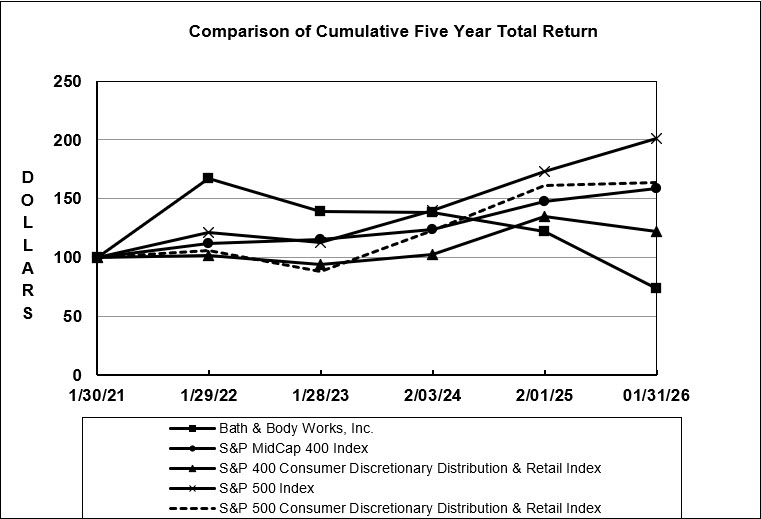
24
Common Stock Repurchases
The following table provides our repurchases of our common stock during the fourth quarter of 2025:
| Fiscal Period | Total Number of Shares Purchased (a) | Average Price Paid per Share (b) | Total Number of Shares Purchased as Part of Publicly Announced Programs (c) | Maximum Dollar Value of Shares that May Yet be Purchased Under the Programs (c) | ||||||||||||||||||||||
| (in thousands) | (in thousands) | |||||||||||||||||||||||||
| November 2025 | 3,638 | $ | 15.74 | 3,622 | $ | 117,341 | ||||||||||||||||||||
| December 2025 | — | 20.24 | — | 117,341 | ||||||||||||||||||||||
| January 2026 | — | 21.49 | — | 117,341 | ||||||||||||||||||||||
| Total | 3,638 | 3,622 | ||||||||||||||||||||||||
(a)The total number of shares repurchased includes shares repurchased as part of publicly announced programs, with the remainder relating to shares in connection with tax payments due upon vesting of associate restricted share and performance share unit awards and the use of our stock to pay the exercise price on associate stock options.
(b)The average price paid per share includes any broker commissions.
(c)For additional share repurchase program information, see Note 13 to the Consolidated Financial Statements included in Item 8. Financial Statements and Supplementary Data.
ITEM 6. [Reserved]
ITEM 7. MANAGEMENT’S DISCUSSION AND ANALYSIS OF FINANCIAL CONDITION AND RESULTS OF OPERATIONS.
The following discussion and analysis of financial condition and results of operations is based upon our Consolidated Financial Statements, which have been prepared in accordance with accounting principles generally accepted in the United States of America (“GAAP”) as codified in the Accounting Standards Codification (“ASC”). The following information should be read in conjunction with our financial statements and the related notes included in Item 8. Financial Statements and Supplementary Data.
Our operating results are generally impacted by economic changes and, therefore, we monitor the retail environment using, among other things, certain key industry performance indicators including competitor performance and traffic data. These indicators can provide insight into consumer spending patterns and shopping behavior in the current retail environment and assist us in assessing our performance as well as the potential impact of industry trends on our future operating results. Additionally, we evaluate a number of key performance indicators including net sales, gross profit, operating income and other performance metrics, such as sales per average selling square foot and sales per average store, in assessing our performance.
A discussion regarding our financial condition and results of operations for 2025 compared to 2024 is presented below. A discussion regarding our financial condition and results of operations for 2024 compared to 2023 can be found under Item 7. of our Annual Report on Form 10-K for the year ended February 1, 2025, filed with the SEC on March 14, 2025.
Executive Overview
Our 2025 performance did not meet our expectations. While we believe macroeconomic pressures impacted consumer sentiment throughout the year, we also underperformed in our sector. Accordingly, we took actions to help return the Company to sustainable growth. During the second quarter, we welcomed our new Chief Executive Officer, Daniel Heaf, to the business and, in the third quarter, launched the Consumer First Formula, our multi-year, comprehensive transformation plan to revitalize Bath & Body Works across brand, product and marketplace. The Consumer First Formula invests behind our four largest revenue driving opportunities to try to attract new, younger consumers to the brand, which we expect will help us unlock our next era of sustainable growth:
•Creating Disruptive and Innovative Products: We intend to reestablish best in class product leadership in our hero categories.
•Reigniting the Brand: We expect to invest in marketing to build a brand with cultural currency, showing up in culture through creators, in store visuals and bigger storytelling, creating meaningful emotional connections with consumers.
•Winning in the Marketplace: We plan to expand access and ease of discovery through an enhanced digital experience, third party channels and refreshed in-store merchandising to acquire new and lapsed consumers.
25
•Operating with Speed and Efficiency: We are working to transform Bath & Body Works to be a faster and more efficient organization by empowering teams, working with focus and agility to prioritize what customers care about most. We have plans to deliver $250 million in cost savings over the next two years, with $175 million expected in fiscal 2026. We expect that these savings will be used to invest in revenue-generating initiatives across product and brand.
Fiscal 2025 Overview
For 2025, total Net Sales were $7,291 million, which decreased $16 million, or 0.2%, compared to 2024. Total North American Net Sales decreased $31 million compared to 2024, due to a decline in transactions mostly offset by increased order size, and International Net Sales increased $15 million. For 2025, Operating Income was $1,126 million, which decreased $140 million, or 11%, compared to 2024, and our Operating Income rate (expressed as a percentage of Net Sales) decreased to 15.4% from 17.3%. The Operating Income results were impacted by an increase in General, Administrative and Store Operating Expenses and a decline in our Gross Profit rate.
For additional information related to our 2025 financial performance, see “Results of Operations – 2025 Compared to 2024.”
Fiscal 2026 Outlook
We expect 2026 to be a year of disciplined investment behind the Consumer First Formula, balancing rigorous cost control with targeted reinvestment intended to position the business for sustainable long-term growth. We are confident in our strategy and our ability to reposition the Company as a premier, global brand. While we anticipate a macroeconomic environment similar to 2025, with continued value-oriented consumer behavior, we are focused on translating our strategy into action as we realign the business to evolving consumer expectations.
Adjusted Financial Information
In addition to our results provided in accordance with GAAP above and throughout this Annual Report on Form 10-K, provided below are non-GAAP measures that present Operating Income, Net Income and Net Income per Diluted Share in 2025 and 2024 on an adjusted basis, which removes certain items. We believe that these items are not indicative of our ongoing operations due to their size and nature. We use adjusted financial information as key performance measures for the purpose of evaluating performance internally. These non-GAAP measures are not intended to replace the presentation of our financial results in accordance with GAAP. Instead, we believe that the presentation of adjusted financial information provides additional information to investors to facilitate the comparison of past and present operations. Further, our definitions of adjusted financial information may differ from similarly titled measures used by other companies.
26
The table below reconciles our GAAP financial measures to our non-GAAP financial measures:
| (in millions, except per share amounts) | 2025 | 2024 | |||||||||
| Reconciliation of Reported Operating Income to Adjusted Operating Income | |||||||||||
| Reported Operating Income | $ | 1,126 | $ | 1,266 | |||||||
| Business Transformation Activities (a) | 15 | — | |||||||||
| Leadership Transition Costs (b) | 15 | — | |||||||||
| Adjusted Operating Income | $ | 1,156 | $ | 1,266 | |||||||
| Reconciliation of Reported Net Income to Adjusted Net Income | |||||||||||
| Reported Net Income | $ | 649 | $ | 798 | |||||||
| Business Transformation Activities (a) | 15 | — | |||||||||
| Leadership Transition Costs (b) | 15 | — | |||||||||
| Gain on Sale of Non-core Asset (c) | (8) | — | |||||||||
| Gain on Sales of Easton Investments (d) | — | (39) | |||||||||
| Tax Effect of Adjustments | (2) | 14 | |||||||||
| Tax Benefit from Valuation Allowance Release (e) | — | (44) | |||||||||
| Adjusted Net Income | $ | 669 | $ | 729 | |||||||
| Reconciliation of Reported Net Income per Diluted Share to Adjusted Net Income per Diluted Share | |||||||||||
| Reported Net Income Per Diluted Share | $ | 3.11 | $ | 3.61 | |||||||
| Business Transformation Activities (a) | 0.07 | — | |||||||||
| Leadership Transition Costs (b) | 0.07 | — | |||||||||
| Gain on Sale of Non-core Asset (c) | (0.04) | — | |||||||||
| Gain on Sales of Easton Investments (d) | — | (0.18) | |||||||||
| Tax Effect of Adjustments | (0.01) | 0.06 | |||||||||
| Tax Benefit from Valuation Allowance Release (e) | — | (0.20) | |||||||||
| Adjusted Net Income Per Diluted Share | $ | 3.21 | $ | 3.29 | |||||||
(a)In 2025, we recognized aggregate pre-tax costs of $15 million (after-tax costs of $12 million), primarily included in General, Administrative and Store Operating Expenses, resulting from business transformation activities in connection with the Consumer First Formula. These costs are primarily related to severance benefits.
(b)In 2025, we recognized aggregate pre-tax costs of $15 million (after-tax costs of $14 million), included in General, Administrative and Store Operating Expenses, due to the transition of certain members of the leadership team, primarily related to severance benefits.
(c)In 2025, we recognized a pre-tax gain of $8 million (after-tax gain of $6 million), included in Other Income, Net, related to the sale of a non-core asset.
(d)In 2024, we sold our investments in Easton Town Center and Easton Gateway, resulting in an aggregate pre-tax gain of $39 million (after-tax gain of $25 million), included in Other Income, Net. For additional information, see Note 1 to the Consolidated Financial Statements included in Item 8. Financial Statements and Supplementary Data.
(e)In 2024, we recognized a $44 million tax benefit related to the release of a valuation allowance on a deferred tax asset.
Company-operated Store Data
The following table compares Company-operated store data for 2025 and 2024:
| 2025 | 2024 | % Change | |||||||||||||||
| Sales per Average Selling Square Foot (a) | $ | 1,026 | $ | 1,042 | (2 | %) | |||||||||||
| Sales per Average Store (in thousands) (a) | $ | 2,921 | $ | 2,955 | (1 | %) | |||||||||||
| Average Store Size (selling square feet) | 2,851 | 2,845 | — | % | |||||||||||||
| Total Selling Square Feet (in thousands) | 5,493 | 5,391 | 2 | % | |||||||||||||
27
________________
(a)Sales per average selling square foot and sales per average store, which are indicators of store productivity, are calculated based on store sales for the period divided by the average, including the beginning and end of period, of total selling square footage and store count, respectively.
The following table represents Company-operated store data for 2025:
| Stores | Stores | ||||||||||||||||||||||
| February 1, 2025 | Opened | Closed | January 31, 2026 | ||||||||||||||||||||
| United States | 1,782 | 94 | (62) | 1,814 | |||||||||||||||||||
| Canada | 113 | — | — | 113 | |||||||||||||||||||
| Total | 1,895 | 94 | (62) | 1,927 | |||||||||||||||||||
Partner-operated Store Data
The following table represents partner-operated store data for 2025:
| Stores | Stores | ||||||||||||||||||||||
| February 1, 2025 | Opened | Closed | January 31, 2026 | ||||||||||||||||||||
| International | 494 | 70 | (28) | 536 | |||||||||||||||||||
| International - Travel Retail | 35 | 4 | (2) | 37 | |||||||||||||||||||
| Total International (a) | 529 | 74 | (30) | 573 | |||||||||||||||||||
________________
(a)Includes store locations only and does not include kiosks, shop-in-shops, gondola or beauty counter locations.
Results of Operations—2025 Compared to 2024
Net Sales
The following table provides Net Sales for 2025 in comparison to 2024:
| 2025 | 2024 | % Change | |||||||||||||||
| (in millions) | |||||||||||||||||
| Stores - U.S. and Canada (a) | $ | 5,582 | $ | 5,534 | 0.9 | % | |||||||||||
| Direct - U.S. and Canada | 1,395 | 1,474 | (5.4 | %) | |||||||||||||
| International (b) | 314 | 299 | 4.9 | % | |||||||||||||
| Total Net Sales | $ | 7,291 | $ | 7,307 | (0.2 | %) | |||||||||||
_______________
(a)Results include fulfilled buy online, pickup in store (“BOPIS”) orders.
(b)Results include royalties associated with franchised stores and wholesale sales.
Total Net Sales were $7,291 million and decreased $16 million, or 0.2%, compared to 2024. Direct Net Sales decreased $79 million, or 5.4%, due to a decline in fulfilled orders, which was primarily due to our customers continuing to select our BOPIS option (which is recognized as store Net Sales), partially offset by an increased average order size. Stores Net Sales increased $48 million, or 0.9%, primarily driven by an increase in transactions due to higher BOPIS fulfilled orders and new store growth. International Net Sales increased $15 million, or 4.9%, compared to 2024.
Gross Profit
Our Gross Profit was $3,189 million, which decreased $45 million compared to 2024, and our Gross Profit rate (expressed as a percentage of Net Sales) was 43.7%, which decreased from 44.3% in 2024. Gross Profit dollars decreased due to the decline in the merchandise margin rate, primarily driven by tariffs, partially offset by lower Buying and Occupancy Expenses, which benefited from exiting a third-party fulfillment center in the first quarter of 2025.
The Gross Profit rate decreased due to the lower merchandise margin rate, primarily driven by tariffs, partially offset by the decline in Buying and Occupancy Expenses.
28
General, Administrative and Store Operating Expenses
The following table provides details for our General, Administrative and Store Operating Expenses for 2025 compared to 2024:
2025 | 2024 | Change | |||||||||||||||||||||||||||||||||
| (in millions) | % of Net Sales | (in millions) | % of Net Sales | (in millions) | % of Net Sales | ||||||||||||||||||||||||||||||
| Selling Expenses | $ | 1,238 | 17.0 | % | $ | 1,191 | 16.3 | % | $ | 47 | 0.7 | % | |||||||||||||||||||||||
| Marketing Expenses | 255 | 3.5 | % | 242 | 3.3 | % | 13 | 0.2 | % | ||||||||||||||||||||||||||
| General and Administrative Expenses | 570 | 7.8 | % | 535 | 7.3 | % | 35 | 0.5 | % | ||||||||||||||||||||||||||
| Total | $ | 2,063 | 28.3 | % | $ | 1,968 | 26.9 | % | $ | 95 | 1.4 | % | |||||||||||||||||||||||
Our total General, Administrative and Store Operating Expenses were $2,063 million, which increased $95 million compared to 2024, and the rate (expressed as a percentage of Net Sales) was 28.3%, which increased from 26.9% in 2024. Selling Expenses increased primarily due to higher payroll related costs, mainly driven by investments in wages and new stores, and higher healthcare costs. General and Administrative Expenses increased primarily due to $15 million of costs related to the transition of certain members of the leadership team and $14 million of business transformation activities.
The General, Administrative and Store Operating Expense rate increased primarily due to higher healthcare costs, leadership transition costs, business transformation activities and the increase in payroll related costs, as well as incremental investments in marketing.
Other Income and Expenses
Interest Expense
The following table provides the average daily borrowings and average borrowing rates for 2025 and 2024:
| 2025 | 2024 | ||||||||||
| Average daily borrowings (in millions) | $ | 3,916 | $ | 4,273 | |||||||
| Average borrowing rate | 7.1 | % | 7.3 | % | |||||||
Our Interest Expense was $276 million, which decreased $36 million compared to 2024. The decrease was due to lower average daily borrowings and borrowing rate, which were driven by the early extinguishment of outstanding notes in 2024.
Other Income, Net
Our Other Income, Net was $32 million compared to $74 million for 2024. Included in 2025 is an $8 million pre-tax gain on the sale of a non-core asset. Included in 2024 is an aggregate $39 million pre-tax gain on sales of certain Easton investments and the recognition of a $10 million pre-tax loss on extinguishment of outstanding notes. The remaining decrease is primarily due to lower interest income on invested cash in 2025.
Provision for Income Taxes
Our effective tax rate was 26.4% compared to 22.4% in 2024. The 2025 rate was higher than our combined estimated federal and state statutory rate primarily due to accrued interest expense related to unrecognized tax benefits. The 2024 rate was lower than our combined estimated federal and state statutory rate primarily due to the sales of Easton investments, which resulted in the release of a valuation allowance on a deferred tax asset.
FINANCIAL CONDITION
A discussion regarding our financial condition for 2024 compared to 2023 can be found under Item 7. of our Annual Report on Form 10-K for the year ended February 1, 2025, filed with the SEC on March 14, 2025.
Liquidity and Capital Resources
Liquidity, or access to cash, is an important factor in determining our financial stability. We are committed to maintaining adequate liquidity. Cash generated from our operating activities provides the primary resources to support current operations, growth initiatives, seasonal funding requirements, future common stock and debt repurchases, and capital expenditures. Our cash provided from operations is impacted by our net income and working capital changes. Our net income is impacted by, among other things, sales volume, seasonal sales patterns, success of new product introductions and product and market expansions, profit margins, income taxes and inflationary pressures. Our sales are typically highest during the fourth quarter of the fiscal year due to seasonal and holiday-related sales patterns. Generally, our need for working capital peaks during the summer and fall months as inventory builds in anticipation of the holiday period. Our cash and cash equivalents held by foreign subsidiaries were $210 million as of January 31, 2026.
29
During 2025, we did not repurchase any of our outstanding senior notes. However, subsequent to January 31, 2026, we issued a notice of redemption for any and all outstanding of our 6.694% Senior Notes due January 2027. We expect the aggregate redemption price to be approximately $289 million, to be paid in the first quarter of fiscal 2026.
We repurchased 15.1 million shares of our common stock for $400 million. We may, from time to time, repurchase, or otherwise retire, additional debt or shares of our common stock, as applicable.
We believe that our current cash position, our cash flows generated from operations and our borrowing capacity under our ABL Facility will be sufficient to meet our liquidity needs, including capital expenditure requirements, for at least the next twelve months.
Debt Leverage Ratio
Our debt leverage ratio is defined as adjusted debt, which includes our short-term and long-term debt as well as total operating lease liabilities, divided by earnings before interest, taxes, depreciation, amortization and rent (“EBITDAR”). EBITDAR is calculated as Total Company Adjusted Operating Income, or Operating Income in periods where there are no adjustments, which excludes interest and taxes, before depreciation, amortization and lease costs. Our debt leverage ratio is a non-GAAP financial measure which we believe is useful to analyze our capital structure. Our debt leverage ratio calculation may not be comparable to similarly-titled measures reported by other companies. Our debt leverage ratio should be evaluated in addition to, and not considered a substitute for, other GAAP financial measures.
The following table provides our debt leverage ratio as of, and for the years ended, January 31, 2026 and February 1, 2025:
| January 31, 2026 | February 1, 2025 | ||||||||||
| (dollars in millions) | |||||||||||
| Total Debt | $ | 3,892 | $ | 3,884 | |||||||
| Total Operating Lease Liabilities | 1,062 | 1,075 | |||||||||
| Adjusted Debt | $ | 4,954 | $ | 4,959 | |||||||
| Adjusted Operating Income | $ | 1,156 | $ | 1,266 | |||||||
| Depreciation and Amortization | 254 | 282 | |||||||||
| Total Lease Costs | 437 | 418 | |||||||||
| EBITDAR | $ | 1,847 | $ | 1,966 | |||||||
| Debt Leverage Ratio | 2.7 | 2.5 | |||||||||
Free Cash Flow
Our free cash flow is defined as net cash provided by operating activities less capital expenditures. Free cash flow is a non-GAAP financial measure which we believe is useful to analyze our ability to generate cash. Our free cash flow calculation may not be comparable to similarly-titled measures reported by other companies. Our free cash flow calculation should be evaluated in addition to, and not considered a substitute for, other GAAP financial measures.
The following table provides our free cash flows for 2025 and 2024:
| 2025 | 2024 | ||||||||||
| (in millions) | |||||||||||
| Net Cash Provided by Operating Activities (a) | $ | 1,102 | $ | 886 | |||||||
| Capital Expenditures | (237) | (226) | |||||||||
| Free Cash Flow | $ | 865 | $ | 660 | |||||||
________________
(a)Fiscal 2024 includes tax payments of $65 million related to the sales of our investments in Easton Town Center and Easton Gateway.
30
Cash Flows
The following table provides a summary of our Consolidated Statements of Cash Flows for 2025 and 2024:
| 2025 | 2024 | ||||||||||
| (in millions) | |||||||||||
| Cash and Cash Equivalents, Beginning of Year | $ | 674 | $ | 1,084 | |||||||
| Net Cash Flows Provided by Operating Activities | 1,102 | 886 | |||||||||
| Net Cash Flows Used for Investing Activities | (227) | (162) | |||||||||
| Net Cash Flows Used for Financing Activities | (599) | (1,132) | |||||||||
| Effects of Exchange Rate Changes on Cash and Cash Equivalents | 3 | (2) | |||||||||
| Net Increase (Decrease) in Cash and Cash Equivalents | 279 | (410) | |||||||||
| Cash and Cash Equivalents, End of Year | $ | 953 | $ | 674 | |||||||
Operating Activities
Net cash provided by operating activities in 2025 was $1,102 million, including net income of $649 million. Net income included depreciation of $254 million, deferred income tax expense of $63 million and share-based compensation expense of $31 million. Other changes in assets and liabilities represent items that had a current period cash flow impact, such as changes in working capital. The most significant items in working capital were the cash flow benefit in Accounts Payable, Accrued Expenses and Other of $111 million due to our efforts to improve working capital and the $57 million cash flow detriment associated with Income Taxes Payable.
Net cash provided by operating activities in 2024 was $866 million, including net income of $798 million. Net income included depreciation of $282 million, a deferred income tax benefit of $112 million, share-based compensation expense of $40 million and an aggregate pre-tax gain on sales of certain Easton investments of $39 million. Other changes in assets and liabilities represent items that had a current period cash flow impact, such as changes in working capital. The most significant items in working capital were the $50 million decrease associated with Accounts Payable, Accrued Expenses and Other, the $26 million decrease associated with Inventory and the $23 million decrease associated with Income Taxes Payable.
Investing Activities
Net cash used for investing activities in 2025 was $227 million, primarily related to capital expenditures of $237 million, partially offset by aggregate cash proceeds of $9 million related to the sale of a Non-core asset. The capital expenditures included approximately $140 million related to new off-mall stores and remodels of existing stores, approximately $45 million for various IT projects, primarily to support the growth and profitability of our business, and approximately $25 million related to distribution and logistics capabilities.
Net cash used for investing activities in 2024 was $162 million, primarily related to capital expenditures of $226 million, partially offset by aggregate cash proceeds, net of fees, of $40 million related to the sales of certain Easton investments. The capital expenditures included approximately $140 million related to new off-mall stores and remodels of existing stores, approximately $45 million for various IT projects, primarily to support the growth and profitability of our business, and approximately $25 million related to distribution and logistics capabilities.
In 2026, we expect to invest approximately $270 million in capital expenditures, focused on high return real estate, Consumer First Formula investments, largely related to product assortment, and logistics and fulfillment upgrades.
Financing Activities
Net cash used for financing activities in 2025 was $599 million, primarily consisting of $401 million for share repurchases, dividend payments of $0.80 per share, or $167 million and payments on finance leases of $14 million.
Net cash used for financing activities in 2024 was $1,132 million, primarily consisting of $522 million for debt repurchases, $401 million for share repurchases, dividend payments of $0.80 per share, or $177 million, $17 million for payments on finance leases and tax payments of $16 million related to share-based awards.
Common Stock and Debt Repurchases
Our Board will determine share and debt repurchase authorizations, giving consideration to our levels of profit and cash flow, capital requirements, current and forecasted liquidity, the restrictions placed upon us by our borrowing arrangements as well as financial and other conditions existing at the time. We use cash flow generated from operating and financing activities to fund our share and debt repurchase programs. The timing and amount of any repurchases will be made at our discretion, taking into account a number of factors, including market conditions.
31
Common Stock Repurchases
Under the authority of our Board, we repurchased shares of our common stock under the following repurchase programs during 2025 and 2024:
| Repurchase Program | Amount Authorized | Shares Repurchased | Amount Repurchased | Average Stock Price | ||||||||||||||||||||||||||||||||||||||||
| 2025 | 2024 | 2025 | 2024 | 2025 | 2024 | |||||||||||||||||||||||||||||||||||||||
| (in millions) | (in thousands) | (in millions) | ||||||||||||||||||||||||||||||||||||||||||
| February 2022 | $ | 1,500 | NA | 842 | NA | $ | 39 | NA | $ | 46.08 | ||||||||||||||||||||||||||||||||||
| January 2024 | 500 | 460 | 9,583 | $ | 17 | 361 | $ | 37.67 | 37.70 | |||||||||||||||||||||||||||||||||||
| January 2025 | 500 | 14,612 | NA | 383 | NA | 26.19 | NA | |||||||||||||||||||||||||||||||||||||
| Total | 15,072 | 10,425 | $ | 400 | $ | 400 | ||||||||||||||||||||||||||||||||||||||
There were share repurchases of $1 million reflected in Accounts Payable on the Consolidated Balance Sheet as of February 1, 2025. On February 27, 2025, we cancelled the remaining $121 million authorization available under the January 2024 Program and began repurchasing shares under the January 2025 Program.
The January 2025 Program had $117 million and $500 million of remaining authority as of January 31, 2026 and February 1, 2025, respectively. There were no share repurchases reflected in Accounts Payable on the Consolidated Balance Sheet as of January 31, 2026.
Dividend Policy and Procedures
Our Board will determine future dividends after giving consideration to our levels of profit and cash flow, capital requirements, current and forecasted liquidity, the restrictions placed upon us by our borrowing arrangements as well as financial and other conditions existing at the time. We use cash flow generated from operating and financing activities to fund our dividends.
We paid the following dividends during 2025 and 2024:
| Ordinary Dividends | Total Paid | ||||||||||
| (per share) | (in millions) | ||||||||||
| 2025 | |||||||||||
| First Quarter | $ | 0.20 | $ | 43 | |||||||
| Second Quarter | 0.20 | 42 | |||||||||
| Third Quarter | 0.20 | 41 | |||||||||
| Fourth Quarter | 0.20 | 41 | |||||||||
2025 Total | $ | 0.80 | $ | 167 | |||||||
| 2024 | |||||||||||
| First Quarter | $ | 0.20 | $ | 45 | |||||||
| Second Quarter | 0.20 | 45 | |||||||||
| Third Quarter | 0.20 | 44 | |||||||||
| Fourth Quarter | 0.20 | 43 | |||||||||
2024 Total | $ | 0.80 | $ | 177 | |||||||
On March 6, 2026, we paid our first quarter 2026 ordinary dividend of $0.20 per share to stockholders of record at the close of business on February 20, 2026.
32
Long-term Debt and Borrowing Facility
The following table provides our outstanding debt balances, net of unamortized debt issuance costs and discounts, as of January 31, 2026 and February 1, 2025:
| January 31, 2026 | February 1, 2025 | ||||||||||
| (in millions) | |||||||||||
| Senior Debt with Subsidiary Guarantee | |||||||||||
$284 million, 6.694% Fixed Interest Rate Notes due January 2027 (“2027 Notes”) | $ | 280 | $ | 277 | |||||||
$444 million, 5.250% Fixed Interest Rate Notes due February 2028 (“2028 Notes”) | 444 | 443 | |||||||||
$482 million, 7.500% Fixed Interest Rate Notes due June 2029 (“2029 Notes”) | 477 | 476 | |||||||||
$844 million, 6.625% Fixed Interest Rate Notes due October 2030 (“2030 Notes”) | 839 | 838 | |||||||||
$802 million, 6.875% Fixed Interest Rate Notes due November 2035 (“2035 Notes”) | 797 | 796 | |||||||||
$575 million, 6.750% Fixed Interest Rate Notes due July 2036 (“2036 Notes”) | 571 | 571 | |||||||||
| Total Senior Debt with Subsidiary Guarantee | 3,408 | 3,401 | |||||||||
| Senior Debt | |||||||||||
$284 million, 6.950% Fixed Interest Rate Debentures due March 2033 (“2033 Notes”) | 284 | 283 | |||||||||
$201 million, 7.600% Fixed Interest Rate Notes due July 2037 (“2037 Notes”) | 200 | 200 | |||||||||
| Total Senior Debt | 484 | 483 | |||||||||
| Total Debt | 3,892 | 3,884 | |||||||||
| Current Debt | (280) | — | |||||||||
| Total Long-term Debt, Net of Current Portion | $ | 3,612 | $ | 3,884 | |||||||
Repurchases of Notes
The losses and gains on the extinguishment of debt, which include the write-offs of unamortized issuance costs and discounts, are included in Other Income, Net in the Consolidated Statements of Income. There were no repurchases of outstanding senior notes in 2025.
Subsequent to January 31, 2026, we issued a notice of redemption for any and all outstanding of our 6.694% Senior Notes due January 2027. We expect the aggregate redemption price to be approximately $289 million, and to recognize a pre-tax loss of approximately $9 million in the first quarter of fiscal 2026 as a result of this redemption.
2024 Repurchases
During 2024, we repurchased in the open market and extinguished $200 million principal amount of our outstanding senior notes. The aggregate repurchase price for these notes was $202 million, resulting in an aggregate pre-tax loss of $3 million, including the write-off of unamortized issuance costs and discounts.
During 2024, we also completed a make-whole call to repurchase the remaining $314 million principal amount of our outstanding 2025 Notes. The repurchase price for these notes was $320 million, resulting in a pre-tax loss of $7 million, including the write-off of unamortized issuance costs and discounts.
The following table provides details of the outstanding principal amounts of senior notes repurchased and extinguished during 2024:
| 2024 | ||||||||
| (in millions) | ||||||||
| 2025 Notes | $ | 314 | ||||||
| 2027 Notes | 14 | |||||||
| 2028 Notes | 17 | |||||||
| 2029 Notes | 17 | |||||||
| 2030 Notes | 94 | |||||||
| 2033 Notes | 10 | |||||||
| 2035 Notes | 10 | |||||||
| 2036 Notes | 38 | |||||||
| Total | $ | 514 | ||||||
33
Asset-backed Revolving Credit Facility
We and certain of our 100% owned subsidiaries guarantee and pledge collateral to secure our ABL Facility. The ABL Facility, which allows borrowings and letters of credit in U.S. and Canadian dollars, has aggregate commitments of $750 million.
In May 2025, we entered into an amendment and restatement (“Amendment”) of the ABL Facility. The Amendment removed the interest rate credit spread adjustment of 0.10%, extended the expiration date from August 2026 to May 2030 and included certain other technical amendments.
Availability under the ABL Facility is the lesser of (i) the borrowing base, determined primarily based on our eligible U.S. and Canadian credit card receivables, accounts receivable, inventory and eligible real property, or (ii) the aggregate commitment. If at any time the outstanding amount under the ABL Facility exceeds the lesser of (i) the borrowing base and (ii) the aggregate commitment, we are required to repay the outstanding amounts under the ABL Facility to the extent of such excess. As of January 31, 2026, our borrowing base was $482 million and we had no borrowings outstanding under the ABL Facility.
The ABL Facility supports our letter of credit program. We had $9 million of outstanding letters of credit as of January 31, 2026 that reduced our availability under the ABL Facility. As of January 31, 2026, our availability under the ABL Facility was $473 million.
As of January 31, 2026, the ABL Facility fees related to committed and unutilized amounts were 0.30% per annum, and the fees related to outstanding letters of credit were 1.25% per annum. In addition, the interest rate on outstanding U.S. dollar borrowings was the Term Secured Overnight Financing Rate plus 1.25% per annum. The interest rate on outstanding Canadian dollar-denominated borrowings was the Canadian Overnight Repo Rate Average plus 1.25% per annum.
The ABL Facility requires us to maintain a fixed charge coverage ratio of not less than 1.00 to 1.00 during an event of default or any period commencing on any day when specified excess availability is less than the greater of (i) $70 million or (ii) 10% of the maximum borrowing amount. As of January 31, 2026, we were not required to maintain this ratio.
Credit Ratings
The following table provides our credit ratings as of January 31, 2026:
| Moody’s | S&P | ||||||||||
| Corporate | Ba2 | BB+ | |||||||||
| Senior Unsecured Debt with Subsidiary Guarantee | Ba2 | BB+ | |||||||||
| Senior Unsecured Debt | B1 | BB- | |||||||||
| Outlook | Stable | Stable | |||||||||
Guarantor Summarized Financial Information
Certain of our subsidiaries, which are listed on Exhibit 22 to this Annual Report on Form 10-K, have guaranteed our obligations under the 2027 Notes, 2028 Notes, 2029 Notes, 2030 Notes, 2035 Notes and 2036 Notes (collectively, the “Notes”).
The Notes have been issued by Bath & Body Works, Inc. (the “Parent Company”). The Notes are its senior unsecured obligations and rank equally in right of payment with all of our existing and future senior unsecured obligations, are senior to any of our future subordinated indebtedness, are effectively subordinated to all of our existing and future indebtedness that is secured by a lien and are structurally subordinated to all existing and future obligations of each of our subsidiaries that do not guarantee the Notes.
The Notes are fully and unconditionally guaranteed on a joint and several basis by certain of our wholly-owned subsidiaries, including certain subsidiaries that also guarantee our obligations under our ABL Facility (such guarantees, the “Guarantees”; and, such guaranteeing subsidiaries, the “Subsidiary Guarantors”). The Guarantees of the Subsidiary Guarantors are subject to release in limited circumstances only upon the occurrence of certain customary conditions. Each Guarantee is limited, by its terms, to an amount not to exceed the maximum amount that can be guaranteed by the applicable Subsidiary Guarantor subject to avoidance under applicable fraudulent conveyance provisions of U.S. and non-U.S. law.
The following tables set forth summarized financial information for the Parent Company and the Subsidiary Guarantors on a combined basis after elimination of (i) intercompany transactions and balances among the Parent Company and the Subsidiary Guarantors and (ii) investments in and equity in the earnings of non-Guarantor subsidiaries.
34
JANUARY 31, 2026 SUMMARIZED BALANCE SHEET | (in millions) | ||||
| ASSETS | |||||
| Current Assets (a) | $ | 2,249 | |||
| Noncurrent Assets | 2,403 | ||||
| LIABILITIES | |||||
| Current Liabilities (b) | $ | 2,793 | |||
| Noncurrent Liabilities | 4,626 | ||||
_______________
(a)Includes amounts due from non-Guarantor subsidiaries of $596 million as of January 31, 2026.
(b)Includes amounts due to non-Guarantor subsidiaries of $1,501 million as of January 31, 2026.
2025 SUMMARIZED STATEMENT OF INCOME | (in millions) | ||||
| Net Sales (a) | $ | 6,911 | |||
| Gross Profit | 2,969 | ||||
| Operating Income | 1,040 | ||||
| Income Before Income Taxes | 761 | ||||
| Net Income (b) | 583 | ||||
_______________
(a)Includes Net Sales of $181 million to non-Guarantor subsidiaries.
(b)Includes a Net Loss of $23 million related to transactions with non-Guarantor subsidiaries.
Contingent Liabilities and Contractual Obligations
The following table provides our contractual obligations, aggregated by type, including the maturity profile as of January 31, 2026:
| Payments Due by Period | |||||||||||||||||||||||||||||||||||
| Total | Less Than 1 Year | 1-3 Years | 4-5 Years | More Than 5 Years | Other | ||||||||||||||||||||||||||||||
| (in millions) | |||||||||||||||||||||||||||||||||||
| Outstanding Debt (a) | $ | 5,681 | $ | 547 | $ | 921 | $ | 1,714 | $ | 2,499 | $ | — | |||||||||||||||||||||||
| Future Lease Obligations (b) | 1,386 | 278 | 458 | 305 | 345 | — | |||||||||||||||||||||||||||||
| Purchase Obligations (c) | 650 | 518 | 101 | 30 | 1 | — | |||||||||||||||||||||||||||||
| Other Liabilities (d) | 159 | 127 | — | — | — | 32 | |||||||||||||||||||||||||||||
| Total | $ | 7,876 | $ | 1,470 | $ | 1,480 | $ | 2,049 | $ | 2,845 | $ | 32 | |||||||||||||||||||||||
________________
(a)Outstanding Debt obligations relate to our principal and interest payments for outstanding notes and debentures. Interest payments have been estimated based on the coupon rate for fixed rate obligations for the contractual term of the obligation. Interest obligations exclude amounts which have been accrued through January 31, 2026. For additional information, see Note 10 to the Consolidated Financial Statements included in Item 8. Financial Statements and Supplementary Data.
(b)Future lease obligations primarily represent minimum payments due under operating lease agreements. For additional information, see Note 6 to the Consolidated Financial Statements included in Item 8. Financial Statements and Supplementary Data.
(c)Purchase obligations primarily include purchase orders for merchandise inventory and other agreements to purchase goods or services that are enforceable and legally binding and that specify all significant terms, including: fixed or minimum quantities to be purchased; fixed, minimum or variable price provisions; and the approximate timing of the transactions.
(d)Other liabilities include future estimated payments associated with unrecognized tax benefits. The “Less Than 1 Year” category includes $127 million of these tax items because it is reasonably possible that the amounts could change in
35
the next 12 months due to audit settlements or resolution of uncertainties. The remaining portion, totaling $32 million, is included in the “Other” category as it is not reasonably possible that the amounts could change in the next 12 months.
Lease Guarantees
In connection with the spin-off of Victoria’s Secret & Co., we had remaining contingent obligations of $215 million as of January 31, 2026 related to lease payments under the current terms of noncancelable leases, primarily related to office space, expiring at various dates through 2037. These obligations include minimum rent and additional payments covering taxes, common area costs and certain other expenses and relate to leases that commenced prior to the spin-off. Our reserves related to these obligations were not significant for any period presented.
Recently Issued Accounting Pronouncements
In December 2023, the Financial Accounting Standards Board (“FASB”) issued Accounting Standards Update (“ASU”) 2023-09, Improvements to Income Tax Disclosures, which requires enhanced income tax disclosures, primarily related to standardization and disaggregation of rate reconciliation categories and income taxes paid by jurisdiction. This standard is effective for fiscal years beginning after December 15, 2024, with early adoption permitted, and may be applied either prospectively or retrospectively. We adopted this standard prospectively in the fourth quarter of 2025. See Note 9 to the Consolidated Financial Statements included in Item 8. Financial Statements and Supplementary Data for the required disclosures.
In November 2024, the FASB issued ASU 2024-03, Disaggregation of Income Statement Expenses, which requires disclosures of disaggregated information about certain prescribed expense categories within relevant income statement expense captions. This standard is effective for annual reporting of fiscal years beginning after December 15, 2026, and for interim periods in the following year, with early adoption permitted. This standard should be applied prospectively, with retrospective application permitted. We are currently evaluating the impact of adopting this standard on our disclosures.
In September 2025, the FASB issued ASU 2025-06, Targeted Improvements to the Accounting for Internal-Use Software, which is intended to modernize the accounting for software costs by removing project stages from capitalization criteria and further clarifies the threshold entities apply to begin capitalizing costs. This standard is effective for annual reporting of fiscal years beginning after December 15, 2027, and for interim periods within those fiscal years, with early adoption permitted. This standard can be applied prospectively, retrospectively or through a modified transition approach. We are currently evaluating the impacts of adopting this standard.
Critical Accounting Estimates
The preparation of financial statements in conformity with generally accepted accounting principles requires management to adopt accounting policies related to estimates and assumptions that affect the reported amounts of assets and liabilities at the date of the financial statements and the reported amounts of revenues and expenses during the reporting period, as well as the related disclosure of contingent assets and liabilities at the date of the financial statements. On an ongoing basis, management evaluates its accounting policies, estimates and judgments, including those related to inventories, valuation of long-lived store assets, claims and contingencies, income taxes and revenue recognition. Management bases our estimates and judgments on historical experience and various other factors that are believed to be reasonable under the circumstances. Actual results may differ from these estimates. Management has discussed the development and selection of our critical accounting policies and estimates with the Audit Committee of our Board and believes the following assumptions and estimates are most significant to reporting our results of operations and financial position.
Inventories
Inventories are principally valued at the lower of cost or net realizable value, on an average cost basis.
We record valuation adjustments to our inventories if the cost of inventory on hand exceeds the amount we expect to realize from the ultimate sale or disposal of the inventory. These estimates are based on management’s judgment regarding future demand and market conditions and analysis of historical experience. If actual demand or market conditions are different than those projected by management, future period merchandise margin rates may be unfavorably or favorably affected by adjustments to these estimates.
We also record inventory loss adjustments for estimated physical inventory losses that have occurred since the date of the last physical inventory. These estimates are based on management’s analysis of historical results and current operating trends.
Management believes that the assumptions used in these estimates are reasonable and appropriate. A 10% increase or decrease in the inventory valuation adjustment would have impacted Net Income by approximately $2 million for 2025. A 10% increase or decrease in the estimated physical inventory loss adjustment would have impacted Net Income by approximately $2 million for 2025.
36
Valuation of Long-lived Store Assets
Long-lived store assets, which include leasehold improvements, store-related assets and operating lease assets, are reviewed for impairment whenever events or changes in circumstances indicate that the carrying amount of the assets may not be recoverable. Store assets are grouped at the lowest level for which they are largely independent of other assets or asset groups. If the estimated undiscounted future cash flows related to the asset group are less than the carrying value, we recognize a loss equal to the difference between the carrying value and the estimated fair value, determined by the estimated discounted future cash flows of the asset group. For operating lease assets, we determine the fair value of the assets by comparing the contractual rent payments to estimated market rental rates. An individual asset within an asset group is not impaired below its estimated fair value. The fair value of long-lived store assets is determined using Level 3 inputs within the fair value hierarchy.
When a decision has been made to dispose of property and equipment prior to the end of the previously estimated useful life, depreciation estimates are revised to reflect the use of the asset over the shortened estimated useful life.
Claims and Contingencies
We are subject to various claims and contingencies related to lawsuits, taxes, insurance, regulatory and other matters arising out of the normal course of business. Our determination of the treatment of claims and contingencies in the Consolidated Financial Statements is based on management’s view of the expected outcome of the applicable claim or contingency. We consult with legal counsel on matters related to litigation and seek input from both internal and external experts with respect to matters in the ordinary course of business. We accrue a liability if the likelihood of an adverse outcome is probable and the amount is reasonably estimable. If the likelihood of an adverse outcome is only reasonably possible (as opposed to probable) or if an estimate is not reasonably determinable, disclosure of a material claim or contingency is disclosed in the Notes to the Consolidated Financial Statements included in Item 8. Financial Statements and Supplementary Data.
Income Taxes
We account for income taxes under the asset and liability method. Under this method, taxes currently payable or refundable are accrued, and deferred tax assets and liabilities are recognized for the estimated future tax consequences attributable to differences between the financial statement carrying amounts of existing assets and liabilities and their respective tax bases. Deferred tax assets are also recognized for realizable operating loss and tax credit carryforwards. Deferred tax assets and liabilities are measured using enacted income tax rates in effect for the year in which those temporary differences are expected to be recovered or settled. The effect on deferred tax assets and liabilities of a change in income tax rates is recognized in our Consolidated Statements of Income in the period that includes the enactment date. A valuation allowance is recorded to reduce the carrying amounts of deferred tax assets if it is more likely than not that such assets will not be realized.
Significant judgment is required in determining the provision for income taxes and related accruals, deferred tax assets and liabilities. In determining our provision for income taxes, we consider permanent differences between book and tax income and statutory income tax rates. Our effective income tax rate is affected by items including changes in tax law, the tax jurisdiction of the Company’s operations and the level of earnings.
A number of countries have enacted legislation to implement the Organization for Economic Cooperation and Development’s 15% global minimum tax regime (Pillar Two) with effect from January 1, 2024. We continue to evaluate the impacts of proposed and enacted legislation for the jurisdictions in which we operate.
We follow the authoritative guidance included in ASC 740, Income Taxes, which contains a two-step approach to recognize and measure uncertain tax positions. The first step is to evaluate the tax position for recognition by determining if the available evidence indicates it is more likely than not that the position will be sustained on audit, including resolution of related appeals or litigation processes, if any. The second step is to measure the tax benefit as the largest amount which is more than 50% likely of being realized upon ultimate settlement. We consider many factors when evaluating and estimating our tax positions and tax benefits, which may require periodic adjustments and for which actual outcomes may differ from forecasted outcomes. Our policy is to include interest and penalties related to uncertain tax positions in income tax expense.
Our income tax returns, like those of most companies, are periodically audited by domestic and foreign tax authorities. These audits include questions regarding our tax filing positions, including the timing and amount of deductions and the allocation of income among various tax jurisdictions. At any one time, multiple tax years are subject to audit by the various tax authorities. A number of years may elapse before a particular matter for which we have established an accrual is audited and fully resolved or clarified. We adjust our tax contingencies accrual and income tax provision in the period in which matters are effectively settled with tax authorities at amounts different from our established accrual, when the statute of limitations expires for the relevant taxing authority to examine the tax position or when more information becomes available.
Revenue Recognition
We recognize revenue based on the amount we expect to receive when control of the goods or services is transferred to our customer. We recognize sales upon customer receipt of merchandise, which for direct channel revenues reflects an estimate of
37
shipments that have not yet been received by the customer based on shipping terms and historical delivery times. Our shipping and handling revenues are included in Net Sales with the related costs included in Costs of Goods Sold, Buying and Occupancy in the Consolidated Statements of Income. We also provide a reserve for projected merchandise returns based on historical experience. Net Sales exclude sales and other similar taxes collected from customers.
We offer a loyalty program that allows customers to earn points based on purchasing activity. As customers accumulate points and reach point thresholds, points are converted to rewards that may be used to purchase merchandise in stores or online. Points expire if a loyalty account is inactive for a certain period of time, while rewards expire if unused after approximately three months. We allocate revenue to points earned on qualifying purchases and defer recognition of revenue until the rewards are redeemed. The amount of revenue deferred is based on the relative stand-alone selling price method, which includes an estimate for points and rewards not expected to be redeemed based on historical experience.
We sell gift cards with no expiration dates to customers. We do not charge administrative fees on unused gift cards. We recognize revenue from gift cards when they are redeemed by the customer. In addition, we recognize revenue on unredeemed gift cards when the likelihood of the gift cards being redeemed is remote and there is no legal obligation to remit the unredeemed gift cards to relevant jurisdictions (gift card breakage). Gift card breakage revenue is recognized in proportion to, and over the same period as, actual gift card redemptions. We determine the gift card breakage rate based on historical redemption patterns. Gift card breakage revenue is included in Net Sales in the Consolidated Statements of Income.
We also recognize revenues associated with franchise, license, wholesale and sourcing arrangements. Revenue recognized under franchise and license arrangements generally consists of royalties earned and recognized upon sale of merchandise by franchise and license partners to retail customers. Revenue is generally recognized under wholesale and sourcing arrangements at the time the title passes to the partner.
ITEM 7A. QUANTITATIVE AND QUALITATIVE DISCLOSURES ABOUT MARKET RISK.
Market Risk
The market risk inherent in our financial instruments represents the potential loss in fair value, earnings or cash flows arising from adverse changes in foreign currency exchange rates or interest rates. We may use derivative financial instruments like foreign currency forward contracts, cross-currency swaps and interest rate swap arrangements to manage exposure to market risks. We do not use derivative financial instruments for trading purposes.
Foreign Exchange Rate Risk
Our Canadian dollar denominated earnings are subject to exchange rate risk as substantially all our merchandise sold in Canada is sourced through U.S. dollar transactions. Although we utilize foreign currency forward contracts to partially offset risks associated with our operations in Canada, these measures may not succeed in offsetting all the short-term impact of foreign currency rate movements and generally may not be effective in offsetting the long-term impact of sustained shifts in foreign currency rates.
Further, although our royalty arrangements with our international partners are denominated in U.S. dollars, the royalties we receive in U.S. dollars are calculated based on sales in the local currency. As a result, our royalties in these arrangements are exposed to foreign currency exchange rate fluctuations.
Interest Rate Risk
Our investment portfolio primarily consists of interest-bearing instruments that are classified as cash and cash equivalents based on their original maturities. Our investment portfolio is maintained in accordance with our investment policy, which specifies permitted types of investments, specifies credit quality standards and maturity profiles and limits credit exposure to any single issuer. The primary objectives of our investment activities are the preservation of principal, the maintenance of liquidity and the maximization of interest income while minimizing risk. Our investment portfolio is primarily composed of U.S. government obligations, U.S. Treasury and AAA-rated money market funds, commercial paper and bank deposits. Given the short-term nature and quality of investments in our portfolio, we do not believe there is any material risk to principal associated with increases or decreases in interest rates.
All of our debt as of January 31, 2026 has fixed interest rates. We will from time to time adjust our exposure to interest rate risk by entering into interest rate swap arrangements. Our exposure to interest rate changes is limited to the fair value of the debt issued, which would not have a material impact on our earnings or cash flows.
38
Concentration of Credit Risk
We maintain cash and cash equivalents and derivative contracts with various major financial institutions. We monitor the relative credit standing of financial institutions with whom we transact and limit the amount of credit exposure with any one entity. Our investment portfolio is primarily composed of U.S. government obligations, U.S. Treasury and AAA-rated money market funds, commercial paper and bank deposits. We also periodically review the relative credit standing of franchise, license and wholesale partners and other entities to which we grant credit terms in the normal course of business.
Fair Value Measurements
The following table provides a summary of the principal value and estimated fair value of our outstanding debt as of January 31, 2026 and February 1, 2025:
________________
| January 31, 2026 | February 1, 2025 | ||||||||||
| (in millions) | |||||||||||
| Principal Value | $ | 3,916 | $ | 3,916 | |||||||
| Fair Value, Estimated (a) | 3,964 | 3,986 | |||||||||
(a)The estimated fair values are based on reported transaction prices and are not necessarily indicative of the amounts that we could realize in a current market exchange.
As of January 31, 2026, we believe that the carrying values of our Accounts Receivable, Accounts Payable and Accrued Expenses approximate their fair values because of their short maturities.
39
ITEM 8. FINANCIAL STATEMENTS AND SUPPLEMENTARY DATA.
BATH & BODY WORKS, INC. ®
INDEX TO CONSOLIDATED FINANCIAL STATEMENTS
| Page No. | |||||
Our fiscal year ends on the Saturday nearest to January 31. Fiscal years are designated in the Consolidated Financial Statements and Notes by the calendar year in which the fiscal year commences. The results for fiscal 2025 refer to the 52-week period ended January 31, 2026, fiscal 2024 refers to 52-week period ended February 1, 2025 and fiscal 2023 refers to 53-week period ended February 3, 2024.
40
Management’s Report on Internal Control Over Financial Reporting
Management is responsible for establishing and maintaining adequate internal control over financial reporting as defined in Rules 13a-15(f) and 15d-15(f) under the Securities Exchange Act of 1934. The Company’s internal control system is designed to provide reasonable assurance to the Company’s management and Board regarding the preparation and fair presentation of published financial statements. Because of its inherent limitations, internal control over financial reporting may not prevent or detect misstatements. Therefore, even those systems determined to be effective can provide only reasonable assurance with respect to financial statement preparation and presentation. Also, projections of any evaluation of effectiveness to future periods are subject to the risk that controls may become inadequate because of changes in conditions, or that the degree of compliance with the policies or procedures may deteriorate.
Management assessed the effectiveness of the Company’s internal control over financial reporting as of January 31, 2026. In making this assessment, management used the criteria established in Internal Control-Integrated Framework issued by the Committee of Sponsoring Organizations of the Treadway Commission (2013 framework) (the COSO criteria).
Based on our assessment and the COSO criteria, management believes that the Company maintained effective internal control over financial reporting as of January 31, 2026.
The Company’s independent registered public accounting firm, Ernst & Young LLP, has issued an attestation report on the Company’s internal control over financial reporting. Ernst & Young LLP’s report appears on the following page and expresses an unqualified opinion on the effectiveness of the Company’s internal control over financial reporting as of January 31, 2026.
41
Report of Independent Registered Public Accounting Firm
To the Shareholders and the Board of Directors of Bath & Body Works, Inc.
Opinion on Internal Control Over Financial Reporting
We have audited Bath & Body Works, Inc.’s internal control over financial reporting as of January 31, 2026, based on criteria established in Internal Control—Integrated Framework issued by the Committee of Sponsoring Organizations of the Treadway Commission (2013 framework) (the COSO criteria). In our opinion, Bath & Body Works, Inc. (the Company) maintained, in all material respects, effective internal control over financial reporting as of January 31, 2026, based on the COSO criteria.
We also have audited, in accordance with the standards of the Public Company Accounting Oversight Board (United States) (PCAOB), the consolidated balance sheets of the Company as of January 31, 2026 and February 1, 2025, the related consolidated statements of income, comprehensive income, total equity (deficit) and cash flows for each of the three years in the period ended January 31, 2026, and the related notes and our report dated March 12, 2026 expressed an unqualified opinion thereon.
Basis for Opinion
The Company’s management is responsible for maintaining effective internal control over financial reporting and for its assessment of the effectiveness of internal control over financial reporting included in the accompanying Management’s Report on Internal Control Over Financial Reporting. Our responsibility is to express an opinion on the Company’s internal control over financial reporting based on our audit. We are a public accounting firm registered with the PCAOB and are required to be independent with respect to the Company in accordance with the U.S. federal securities laws and the applicable rules and regulations of the Securities and Exchange Commission and the PCAOB.
We conducted our audit in accordance with the standards of the PCAOB. Those standards require that we plan and perform the audit to obtain reasonable assurance about whether effective internal control over financial reporting was maintained in all material respects.
Our audit included obtaining an understanding of internal control over financial reporting, assessing the risk that a material weakness exists, testing and evaluating the design and operating effectiveness of internal control based on the assessed risk, and performing such other procedures as we considered necessary in the circumstances. We believe that our audit provides a reasonable basis for our opinion.
Definition and Limitations of Internal Control Over Financial Reporting
A company’s internal control over financial reporting is a process designed to provide reasonable assurance regarding the reliability of financial reporting and the preparation of financial statements for external purposes in accordance with generally accepted accounting principles. A company’s internal control over financial reporting includes those policies and procedures that (1) pertain to the maintenance of records that, in reasonable detail, accurately and fairly reflect the transactions and dispositions of the assets of the company; (2) provide reasonable assurance that transactions are recorded as necessary to permit preparation of financial statements in accordance with generally accepted accounting principles, and that receipts and expenditures of the company are being made only in accordance with authorizations of management and directors of the company; and (3) provide reasonable assurance regarding prevention or timely detection of unauthorized acquisition, use, or disposition of the company’s assets that could have a material effect on the financial statements.
Because of its inherent limitations, internal control over financial reporting may not prevent or detect misstatements. Also, projections of any evaluation of effectiveness to future periods are subject to the risk that controls may become inadequate because of changes in conditions, or that the degree of compliance with the policies or procedures may deteriorate.
/s/ Ernst & Young LLP
Grandview Heights, Ohio
March 12, 2026
42
Report of Independent Registered Public Accounting Firm
To the Shareholders and the Board of Directors of Bath & Body Works, Inc.
Opinion on the Financial Statements
We have audited the accompanying consolidated balance sheets of Bath & Body Works, Inc. (the Company) as of January 31, 2026 and February 1, 2025, the related consolidated statements of income, comprehensive income, total equity (deficit) and cash flows for each of the three years in the period ended January 31, 2026, and the related notes (collectively referred to as the “consolidated financial statements”). In our opinion, the consolidated financial statements present fairly, in all material respects, the financial position of the Company at January 31, 2026 and February 1, 2025, and the results of its operations and its cash flows for each of the three years in the period ended January 31, 2026, in conformity with U.S. generally accepted accounting principles.
We also have audited, in accordance with the standards of the Public Company Accounting Oversight Board (United States) (PCAOB), the Company’s internal control over financial reporting as of January 31, 2026, based on criteria established in Internal Control—Integrated Framework issued by the Committee of Sponsoring Organizations of the Treadway Commission (2013 framework), and our report dated March 12, 2026 expressed an unqualified opinion thereon.
Basis for Opinion
These financial statements are the responsibility of the Company’s management. Our responsibility is to express an opinion on the Company’s financial statements based on our audits. We are a public accounting firm registered with the PCAOB and are required to be independent with respect to the Company in accordance with the U.S. federal securities laws and the applicable rules and regulations of the Securities and Exchange Commission and the PCAOB.
We conducted our audits in accordance with the standards of the PCAOB. Those standards require that we plan and perform the audit to obtain reasonable assurance about whether the financial statements are free of material misstatement, whether due to error or fraud. Our audits included performing procedures to assess the risks of material misstatement of the financial statements, whether due to error or fraud, and performing procedures that respond to those risks. Such procedures included examining, on a test basis, evidence regarding the amounts and disclosures in the financial statements. Our audits also included evaluating the accounting principles used and significant estimates made by management, as well as evaluating the overall presentation of the financial statements. We believe that our audits provide a reasonable basis for our opinion.
Critical Audit Matter
The critical audit matter communicated below is a matter arising from the current period audit of the financial statements that was communicated or required to be communicated to the audit committee and that: (1) relates to accounts or disclosures that are material to the financial statements and (2) involved our especially challenging, subjective or complex judgments. The communication of the critical audit matter does not alter in any way our opinion on the consolidated financial statements taken as a whole, and we are not, by communicating the critical audit matter below, providing a separate opinion on the critical audit matter or on the accounts or disclosures to which it relates.
| Loyalty Program | |||||
| Description of the Matter | The Company offers a loyalty program that enables customers the ability to earn points and redeem rewards. As described in Note 1 to the consolidated financial statements, the Company allocates revenue to points earned on qualifying purchases and defers recognition until the rewards are redeemed. The amount of revenue deferred is based on the relative standalone selling price method, which includes an estimate for points and rewards not expected to be redeemed based on historical experience. | ||||
| Auditing the Company’s estimate of loyalty deferred revenue was complex as the calculation involved management’s assumptions, such as the standalone selling price and expected redemption rate, which drive the revenue deferral. | |||||
| How We Addressed the Matter in Our Audit | We obtained an understanding, evaluated the design, and tested the operating effectiveness of the Company’s estimation process and controls supporting the measurement and recognition of the amount of loyalty revenue deferred. This included testing controls over management’s review of the assumptions and other inputs used in the estimation and the completeness and accuracy of issuance and redemption data used in the calculation. | ||||
| Our audit procedures included, among others, evaluating the methodology used, analyzing the significant assumptions discussed above, and testing the accuracy and completeness of the underlying data used in management’s calculation. To test the standalone selling price per reward, we validated that the price per reward was appropriate based on purchases by loyalty members. To audit the redemption rate, we tested redemption activity and compared the results of that testing to the redemption rate used by management in its estimate. We also considered recent trends in redemption activity and the impact on the redemption rate. In addition, we performed sensitivity analyses of significant assumptions to evaluate the change in the deferral amounts. | |||||
/s/ Ernst & Young LLP
We have served as the Company’s auditor since 2003.
March 12, 2026
43
BATH & BODY WORKS, INC.
CONSOLIDATED STATEMENTS OF INCOME
(in millions, except per share amounts)
| 2025 | 2024 | 2023 | |||||||||||||||
| Net Sales | $ | $ | $ | ||||||||||||||
| Costs of Goods Sold, Buying and Occupancy | ( | ( | ( | ||||||||||||||
| Gross Profit | |||||||||||||||||
| General, Administrative and Store Operating Expenses | ( | ( | ( | ||||||||||||||
| Operating Income | |||||||||||||||||
| Interest Expense | ( | ( | ( | ||||||||||||||
| Other Income, Net | |||||||||||||||||
| Income Before Income Taxes | |||||||||||||||||
| Provision for Income Taxes | ( | ( | ( | ||||||||||||||
| Net Income | $ | $ | $ | ||||||||||||||
| Net Income per Basic Share | $ | $ | $ | ||||||||||||||
| Net Income per Diluted Share | $ | $ | $ | ||||||||||||||
BATH & BODY WORKS, INC.
CONSOLIDATED STATEMENTS OF COMPREHENSIVE INCOME
(in millions)
| 2025 | 2024 | 2023 | |||||||||||||||
| Net Income | $ | $ | $ | ||||||||||||||
| Other Comprehensive Income (Loss), Net of Tax: | |||||||||||||||||
| Foreign Currency Translation | ( | ( | |||||||||||||||
| Unrealized Gain (Loss) on Cash Flow Hedges | ( | ||||||||||||||||
| Reclassification of Cash Flow Hedges to Earnings | ( | ( | ( | ||||||||||||||
| Total Other Comprehensive Income (Loss), Net of Tax | ( | ( | |||||||||||||||
| Total Comprehensive Income | $ | $ | $ | ||||||||||||||
The accompanying Notes are an integral part of these Consolidated Financial Statements.
44
BATH & BODY WORKS, INC.
CONSOLIDATED BALANCE SHEETS
(in millions, except par value amounts)
| January 31, 2026 | February 1, 2025 | ||||||||||
| ASSETS | |||||||||||
| Current Assets: | |||||||||||
| Cash and Cash Equivalents | $ | $ | |||||||||
| Accounts Receivable, Net | |||||||||||
| Inventories | |||||||||||
| Easton Assets Held for Sale | |||||||||||
| Other | |||||||||||
| Total Current Assets | |||||||||||
| Property and Equipment, Net | |||||||||||
| Operating Lease Assets | |||||||||||
| Goodwill | |||||||||||
| Trade Name | |||||||||||
| Deferred Income Taxes | |||||||||||
| Other Assets | |||||||||||
| Total Assets | $ | $ | |||||||||
| LIABILITIES AND EQUITY (DEFICIT) | |||||||||||
| Current Liabilities: | |||||||||||
| Accounts Payable | $ | $ | |||||||||
| Accrued Expenses and Other | |||||||||||
| Current Debt | |||||||||||
| Current Operating Lease Liabilities | |||||||||||
| Income Taxes | |||||||||||
| Total Current Liabilities | |||||||||||
| Deferred Income Taxes | |||||||||||
| Long-term Debt | |||||||||||
| Long-term Operating Lease Liabilities | |||||||||||
| Other Long-term Liabilities | |||||||||||
| Shareholders’ Equity (Deficit): | |||||||||||
Preferred Stock—$ | |||||||||||
Common Stock—$ | |||||||||||
| Paid-in Capital | |||||||||||
| Accumulated Other Comprehensive Income | |||||||||||
| Retained Earnings (Accumulated Deficit) | ( | ( | |||||||||
Less: Treasury Stock, at Average Cost; | ( | ( | |||||||||
| Total Shareholders’ Equity (Deficit) | ( | ( | |||||||||
| Noncontrolling Interest | |||||||||||
| Total Equity (Deficit) | ( | ( | |||||||||
| Total Liabilities and Equity (Deficit) | $ | $ | |||||||||
The accompanying Notes are an integral part of these Consolidated Financial Statements.
45
BATH & BODY WORKS, INC.
CONSOLIDATED STATEMENTS OF TOTAL EQUITY (DEFICIT)
(in millions, except per share amounts)
| Common Stock | Paid-In Capital | Accumulated Other Comprehensive Income | Retained Earnings (Accumulated Deficit) | Treasury Stock, at Average Cost | Noncontrolling Interest | Total Equity (Deficit) | |||||||||||||||||||||||||||||||||||||||||
| Shares Outstanding | Par Value | ||||||||||||||||||||||||||||||||||||||||||||||
| Balance, January 28, 2023 | $ | $ | $ | $ | ( | $ | ( | $ | $ | ( | |||||||||||||||||||||||||||||||||||||
| Net Income | — | — | — | — | — | — | |||||||||||||||||||||||||||||||||||||||||
| Other Comprehensive Loss | — | — | — | ( | — | — | — | ( | |||||||||||||||||||||||||||||||||||||||
| Total Comprehensive Income | — | — | — | ( | — | — | |||||||||||||||||||||||||||||||||||||||||
Cash Dividends ($ | — | — | — | — | ( | — | — | ( | |||||||||||||||||||||||||||||||||||||||
| Repurchases of Common Stock | ( | — | — | — | — | ( | — | ( | |||||||||||||||||||||||||||||||||||||||
| Treasury Share Retirement | — | ( | ( | — | ( | — | |||||||||||||||||||||||||||||||||||||||||
| Share-based Compensation and Other | — | — | — | — | — | — | |||||||||||||||||||||||||||||||||||||||||
| Balance, February 3, 2024 | $ | $ | $ | $ | ( | $ | ( | $ | $ | ( | |||||||||||||||||||||||||||||||||||||
| Net Income | — | — | — | — | — | — | |||||||||||||||||||||||||||||||||||||||||
| Other Comprehensive Loss | — | — | — | ( | — | — | — | ( | |||||||||||||||||||||||||||||||||||||||
| Total Comprehensive Income | — | — | — | ( | — | — | |||||||||||||||||||||||||||||||||||||||||
Cash Dividends ($ | — | — | — | — | ( | — | — | ( | |||||||||||||||||||||||||||||||||||||||
| Repurchases of Common Stock | ( | — | — | — | — | ( | — | ( | |||||||||||||||||||||||||||||||||||||||
| Treasury Share Retirement | — | ( | ( | — | ( | — | |||||||||||||||||||||||||||||||||||||||||
| Share-based Compensation and Other | — | — | — | ||||||||||||||||||||||||||||||||||||||||||||
| Balance, February 1, 2025 | $ | $ | $ | $ | ( | $ | ( | $ | $ | ( | |||||||||||||||||||||||||||||||||||||
| Net Income | — | — | — | — | — | — | |||||||||||||||||||||||||||||||||||||||||
| Other Comprehensive Income | — | — | — | — | — | — | |||||||||||||||||||||||||||||||||||||||||
| Total Comprehensive Income | — | — | — | — | — | ||||||||||||||||||||||||||||||||||||||||||
Cash Dividends ($ | — | — | — | — | ( | — | — | ( | |||||||||||||||||||||||||||||||||||||||
| Repurchases of Common Stock | ( | — | — | — | — | ( | — | ( | |||||||||||||||||||||||||||||||||||||||
| Treasury Share Retirement | — | ( | ( | — | ( | — | |||||||||||||||||||||||||||||||||||||||||
| Share-based Compensation and Other | — | — | — | ||||||||||||||||||||||||||||||||||||||||||||
| Balance, January 31, 2026 | $ | $ | $ | $ | ( | $ | ( | $ | $ | ( | |||||||||||||||||||||||||||||||||||||
The accompanying Notes are an integral part of these Consolidated Financial Statements.
46
BATH & BODY WORKS, INC.
CONSOLIDATED STATEMENTS OF CASH FLOWS
(in millions)
| 2025 | 2024 | 2023 | |||||||||||||||
| Operating Activities | |||||||||||||||||
| Net Income | $ | $ | $ | ||||||||||||||
| Adjustments to Reconcile Net Income to Net Cash Provided by Operating Activities: | |||||||||||||||||
| Depreciation of Long-lived Assets | |||||||||||||||||
| Share-based Compensation Expense | |||||||||||||||||
| Gain on Sale of Non-core Asset | ( | ||||||||||||||||
| Gain on Sales of Easton Investments | ( | ||||||||||||||||
| Loss (Gain) on Extinguishment of Debt | ( | ||||||||||||||||
| Deferred Income Taxes | ( | ( | |||||||||||||||
| Impairment of Equity Method Investment | |||||||||||||||||
| Changes in Assets and Liabilities: | |||||||||||||||||
| Accounts Receivable | |||||||||||||||||
| Inventories | ( | ( | |||||||||||||||
| Accounts Payable, Accrued Expenses and Other | ( | ( | |||||||||||||||
| Income Taxes Payable | ( | ( | |||||||||||||||
| Other Assets and Liabilities | ( | ( | ( | ||||||||||||||
| Net Cash Provided by Operating Activities | $ | $ | $ | ||||||||||||||
| Investing Activities | |||||||||||||||||
| Capital Expenditures | $ | ( | $ | ( | $ | ( | |||||||||||
| Proceeds from Sale of Non-core Asset | |||||||||||||||||
| Proceeds from Sales of Easton Investments, Net of Fees Paid | |||||||||||||||||
| Other Investing Activities | |||||||||||||||||
| Net Cash Used for Investing Activities | $ | ( | $ | ( | $ | ( | |||||||||||
| Financing Activities | |||||||||||||||||
| Payments for Long-term Debt | $ | $ | ( | $ | ( | ||||||||||||
| Repurchases of Common Stock | ( | ( | ( | ||||||||||||||
| Dividends Paid | ( | ( | ( | ||||||||||||||
| Payments of Finance Lease Obligations | ( | ( | ( | ||||||||||||||
| Tax Payments related to Share-based Awards | ( | ( | ( | ||||||||||||||
| Other Financing Activities | ( | ( | |||||||||||||||
| Net Cash Used for Financing Activities | $ | ( | $ | ( | $ | ( | |||||||||||
| Effects of Exchange Rate Changes on Cash and Cash Equivalents | $ | $ | ( | $ | ( | ||||||||||||
| Net Increase (Decrease) in Cash and Cash Equivalents | ( | ( | |||||||||||||||
| Cash and Cash Equivalents, Beginning of Year | |||||||||||||||||
| Cash and Cash Equivalents, End of Year | $ | $ | $ | ||||||||||||||
The accompanying Notes are an integral part of these Consolidated Financial Statements.
47
BATH & BODY WORKS, INC.
NOTES TO CONSOLIDATED FINANCIAL STATEMENTS
1. Description of Business and Summary of Significant Accounting Policies
Description of Business
Fiscal Year
Basis of Consolidation
The Consolidated Financial Statements include the accounts of the Company and its subsidiaries. All significant intercompany balances and transactions have been eliminated in consolidation. The Company accounts for investments in unconsolidated entities where it exercises significant influence, but does not have control, using the equity method. Under the equity method of accounting, the Company recognizes its share of the investee’s net income or loss. Losses are only recognized to the extent the Company has positive carrying value related to the investee. Carrying values are only reduced below zero if the Company has an obligation to provide funding to the investee. The Company’s share of net income or loss of all unconsolidated entities is included in Other Income, Net in the Consolidated Statements of Income. The Company’s equity method investments are required to be reviewed for impairment when it is determined there may be an other-than-temporary loss in value.
Cash and Cash Equivalents
Cash and Cash Equivalents include cash on hand, deposits with financial institutions and highly liquid investments with original maturities of less than 90 days. The Company’s Cash and Cash Equivalents are considered Level 1 fair value measurements as they are valued using unadjusted quoted prices in active markets for identical assets. The Company’s outstanding checks are included in Accounts Payable on the Consolidated Balance Sheets.
Concentration of Credit Risk
The Company maintains cash and cash equivalents and derivative contracts with various major financial institutions. The Company monitors the relative credit standing of financial institutions with whom it transacts and limits the amount of credit exposure with any one entity. The Company’s investment portfolio is primarily composed of U.S. government obligations, U.S. Treasury and AAA-rated money market funds, commercial paper and bank deposits.
The Company also periodically reviews the relative credit standing of franchise, license and wholesale partners and other entities to which it grants credit terms in the normal course of business. The Company determines the required allowance for expected credit losses using information such as customer credit history and financial condition. Amounts are recorded to the allowance when it is determined that expected credit losses may occur.
Inventories
Inventories are principally valued at the lower of cost or net realizable value, on an average cost basis.
The Company records valuation adjustments to its inventories if the cost of inventory on hand exceeds the amount it expects to realize from the ultimate sale or disposal of the inventory. These estimates are based on management’s judgment regarding future demand and market conditions and analysis of historical experience.
The Company also records inventory loss adjustments for estimated physical inventory losses that have occurred since the date of the last physical inventory. These estimates are based on management’s analysis of historical results and current operating trends.
Advertising Costs
Advertising and marketing costs are expensed at the time the promotion first appears in media, in the store or when the advertising is mailed. Advertising and marketing costs totaled $255 million for 2025, $242 million for 2024 and $180 million for 2023.
48
Property and Equipment
The Company’s Property and Equipment are recorded at cost and depreciation is computed on a straight-line basis using the following depreciable life ranges:
| Category of Property and Equipment | Depreciable Life Range | |||||||
| Hardware and Software, including software developed for internal use | ||||||||
| Store-related furniture, fixtures and equipment | ||||||||
| Leasehold improvements | Shorter of lease term or | |||||||
| Non-store related building and site improvements, furniture, fixtures and equipment | ||||||||
| Buildings | ||||||||
When a decision has been made to dispose of property and equipment prior to the end of the previously estimated useful life, depreciation estimates are revised to reflect the use of the asset over the shortened estimated useful life. The Company’s cost of assets sold or retired and the related accumulated depreciation are removed from the accounts with any resulting gain or loss included in net income. Maintenance and repairs are charged to expense as incurred. Major renewals and betterments that extend useful lives are capitalized.
Cloud Computing Arrangements
Costs incurred to implement cloud computing service arrangements hosted by third-party vendors are capitalized when incurred during the application development phase and amortized on a straight-line basis over the expected term of the related cloud service, which is generally three years. Capitalized amounts related to such arrangements are recorded within Other Current Assets and Other Assets on the Consolidated Balance Sheets and changes in cloud computing arrangement implementation costs are classified within Operating Activities in the Consolidated Statements of Cash Flows. Cloud computing assets and related amortization were not significant for any period presented.
Leases and Leasehold Improvements
The Company leases retail space, office space, warehouse facilities, storage space, equipment and certain other items under operating leases. A substantial portion of the Company’s leases are operating leases for its stores, which generally have an initial term of 10 years. Annual store rent consists of a fixed minimum amount and/or variable rent based on a percentage of sales exceeding a stipulated amount. Store lease terms generally also require additional payments covering certain operating costs such as common area maintenance, utilities, insurance and taxes. Certain leases contain predetermined fixed escalations of minimum rentals or require periodic adjustments of minimum rentals depending on an index or rate. Additionally, certain leases contain incentives, such as construction allowances from landlords and/or rent abatements subsequent to taking possession of the leased property.
At lease commencement, the Company recognizes an asset for the right to use the leased asset and a liability based on the present value of the unpaid fixed lease payments. Operating lease costs are recognized on a straight-line basis as lease expense over the lease term. Variable lease payments associated with the Company’s leases are recognized upon occurrence of the event or circumstance on which the payments are assessed. Short-term leases with an initial term of 12 months or less are not recorded on the balance sheet, and lease expense is recognized on a straight-line basis over the lease term. The Company uses its incremental borrowing rate, adjusted for collateral, to determine the present value of its unpaid lease payments.
The Company’s store leases often include options to extend the initial term or to terminate the lease prior to the end of the initial term. The exercise of these options is typically at the sole discretion of the Company. These options are included in determining the initial lease term at lease commencement if the Company is reasonably certain to exercise the option. Additionally, the Company may operate stores for a period of time on a month-to-month basis after the expiration of the lease term.
The Company also has leasehold improvements which are amortized over the shorter of their estimated useful lives or the period from the date the assets are placed in service to the end of the initial lease term. Leasehold improvements made after the
49
inception of the initial lease term are depreciated over the shorter of their estimated useful lives or the remaining lease term, including renewal periods, if reasonably assured.
Intangible Assets - Goodwill and Trade Name
The Company has recorded Goodwill and Trade Name intangible assets resulting from business combinations that are recorded at cost.
Goodwill is reviewed for impairment at the reporting unit level each year in the fourth quarter and may be reviewed more frequently if certain events occur or circumstances change. The Company has the option to either first perform a qualitative assessment to determine whether it is more likely than not that a reporting unit’s fair value is less than its carrying value (including goodwill), or to proceed directly to the quantitative assessment which requires a comparison of a reporting unit’s fair value to its carrying value (including goodwill). If the Company determines that the fair value of a reporting unit is less than its carrying value, it recognizes an impairment charge equal to the difference, not to exceed the total amount of goodwill allocated to a reporting unit. The Company’s reporting units are determined in accordance with the provisions of Accounting Standards Codification (“ASC”) 350, Intangibles - Goodwill and Other.
The Bath & Body Works Trade Name is an intangible asset with an indefinite life that is reviewed for impairment each year in the fourth quarter, and may be reviewed more frequently if certain events occur or circumstances change. The Company has the option to either first perform a qualitative assessment to determine whether it is more likely than not that the Trade Name is impaired, or to proceed directly to the quantitative assessment which requires a comparison of the fair value of the trade name to its carrying value. To determine if the fair value of the Trade Name is less than its carrying amount, the Company will estimate the fair value, usually determined by the relief from royalty method under the income approach, and compare that value with its carrying amount. If the carrying value of the Trade Name exceeds its fair value, the Company recognizes an impairment charge equal to the difference.
Foreign Currency Translation
The functional currency of the Company’s foreign operations is generally the applicable local currency. Assets and liabilities are translated into U.S. dollars using the current exchange rates in effect as of the balance sheet date, while revenues and expenses are translated at the average exchange rates for the period. The Company’s resulting translation adjustments comprise substantially all of Accumulated Other Comprehensive Income in Shareholders’ Equity (Deficit). Accumulated foreign currency translation adjustments are reclassified to Net Income when realized upon sale or upon complete, or substantially complete, liquidation of the investment in the foreign entity.
Derivative Financial Instruments
The Company’s Canadian dollar denominated earnings are subject to exchange rate risk as substantially all the Company’s merchandise sold in Canada is sourced through U.S. dollar transactions. The Company uses foreign currency forward contracts designated as cash flow hedges to mitigate this foreign currency exposure. Amounts are reclassified from Accumulated Other Comprehensive Income upon sale of the hedged merchandise to the customer. These gains and losses are recognized in Costs of Goods Sold, Buying and Occupancy in the Consolidated Statements of Income. All designated cash flow hedges are recorded on the Consolidated Balance Sheets at fair value. The fair value of designated cash flow hedges is not significant for any period presented. The Company does not use derivative financial instruments for trading purposes.
Supplier Finance Program
In the fourth quarter of 2024, the Company implemented a supply chain finance (“SCF”) program agreement with a third-party financial institution, whereby the Company’s merchandise suppliers have the opportunity to settle outstanding payment obligations early, at a discount, facilitated by the financial institution. Since implementation, merchandise suppliers have continued to join the program. The Company’s obligations to its suppliers, including amounts due and scheduled payment terms, are not impacted by suppliers’ participation in the arrangement and the Company provides no guarantees to any third parties under the SCF program. Amounts due under the SCF program are included in in the Consolidated Balance Sheets and within Operating Activities in the Consolidated Statements of Cash Flows.
The following table provides the Company’s SCF program activity for the year ended January 31, 2026:
2025 | |||||
| (in millions) | |||||
Obligations Outstanding as of February 1, 2025 | $ | ||||
| Invoices Confirmed during the Year | |||||
| Confirmed Invoices Paid during the Year | ( | ||||
Obligations Outstanding as of January 31, 2026 | $ | ||||
50
Easton Investments
The Company has land and other investments in Easton, a planned community in Columbus, Ohio, that integrates office, hotel, retail, residential and recreational space. Beginning in the fourth quarter of 2024, certain of these investments met all of the required criteria for held for sale presentation, which requires assets to be reported at the lower of their carrying value or fair value less costs to sell. The investments classified as held for sale, consisting primarily of undeveloped land, are reported at their carrying value, which was $81 million and $96 million as of January 31, 2026 and February 1, 2025, respectively, within Current Assets on the Consolidated Balance Sheets.
During the second quarter of 2025, the Company changed its plan of sale for its Easton investments, causing certain of these investments to no longer meet the held for sale criteria. As a result of this change, the Company reclassified $17 38 million and $26 million as of January 31, 2026 and February 1, 2025, respectively.
Previously included in the Company’s Easton investments were equity interests in Easton Town Center, LLC (“ETC”) and Easton Gateway, LLC (“EG”), entities that own and develop commercial entertainment and shopping centers. The Company’s investments in ETC and EG were accounted for using the equity method of accounting. In the second quarter of 2024, the Company sold its entire interest in the business associated with EG and its entire interest in ETC. The Company received aggregate cash proceeds, net of fees paid, of $40 million as a result of these sales, and recognized an aggregate pre-tax gain of $39 million, which is included in Other Income, Net, in the 2024 Consolidated Statement of Income.
Fair Value
The authoritative guidance included in ASC 820, Fair Value Measurement, defines fair value as the exchange price that would be received for an asset or paid to transfer a liability (an exit price) in the principal or most advantageous market for the asset or liability in an orderly transaction between market participants. This authoritative guidance further establishes a three-level fair value hierarchy that prioritizes the inputs used to measure fair value. This hierarchy requires entities to maximize the use of observable inputs and minimize the use of unobservable inputs. The three levels of inputs used to measure fair value are as follows:
•Level 1 - Quoted market prices in active markets for identical assets or liabilities.
•Level 2 - Observable inputs other than quoted market prices included in Level 1, such as quoted prices of similar assets and liabilities in active markets; quoted prices for identical or similar assets and liabilities in markets that are not active; or other inputs that are observable or can be corroborated by observable market data.
•Level 3 - Unobservable inputs that are supported by little or no market activity and that are significant to the fair value of the assets and liabilities. This includes certain pricing models, discounted cash flow methodologies and similar techniques that use significant unobservable inputs.
The Company estimates the fair value of financial instruments, Property and Equipment, Net, Goodwill and its Trade Name in accordance with the provisions of ASC 820.
Income Taxes
The Company accounts for income taxes under the asset and liability method. Under this method, taxes currently payable or refundable are accrued, and deferred tax assets and liabilities are recognized for the estimated future tax consequences attributable to differences between the financial statement carrying amounts of existing assets and liabilities and their respective tax bases. Deferred tax assets are also recognized for realizable operating loss and tax credit carryforwards. Deferred tax assets and liabilities are measured using enacted income tax rates in effect for the year in which those temporary differences are expected to be recovered or settled. The effect on deferred tax assets and liabilities of a change in income tax rates is recognized in the Company’s Consolidated Statements of Income in the period that includes the enactment date. A valuation allowance is recorded to reduce the carrying amounts of deferred tax assets if it is more likely than not that such assets will not be realized.
In determining the Company’s provision for income taxes, the Company considers permanent differences between book and tax income and statutory income tax rates. The Company’s effective income tax rate is affected by items including changes in tax law, the tax jurisdiction of the Company’s operations and the level of earnings.
51
The Company follows a two-step approach to recognize and measure uncertain tax positions. The first step is to evaluate the tax position for recognition by determining if the available evidence indicates it is more likely than not that the position will be sustained on audit, including resolution of related appeals or litigation processes, if any. The second step is to measure the tax benefit as the largest amount which is more than 50% likely of being realized upon ultimate settlement. The Company considers many factors when evaluating and estimating its tax positions and tax benefits, which may require periodic adjustments and for which actual outcomes may differ from forecasted outcomes. The Company’s policy is to include interest and penalties related to uncertain tax positions in income tax expense.
The Company’s income tax returns, like those of most companies, are periodically audited by domestic and foreign tax authorities. These audits include questions regarding the Company’s tax filing positions, including the timing and amount of deductions and the allocation of income among various tax jurisdictions. At any one time, multiple tax years are subject to audit by the various tax authorities. A number of years may elapse before a particular matter for which the Company has established an accrual is audited and fully resolved or clarified. The Company adjusts its tax contingencies accrual and income tax provision in the period in which matters are effectively settled with tax authorities at amounts different from its established accrual, when the statute of limitations expires for the relevant taxing authority to examine the tax position or when more information becomes available. The Company includes its tax contingencies accrual, including accrued penalties and interest, in Other Long-term Liabilities on the Consolidated Balance Sheets unless the liability is expected to be paid within one year. Changes to the tax contingencies accrual, including accrued penalties and interest, are included in Provision for Income Taxes on the Consolidated Statements of Income.
Self-Insurance
The Company is self-insured for medical, workers’ compensation, property, general liability and automobile liability up to certain stop-loss limits in certain cases. Such costs are accrued based on known claims and an estimate of incurred but not reported (“IBNR”) claims. IBNR claims are estimated using historical claim information and actuarial estimates.
Noncontrolling Interest
Noncontrolling interest represents the portion of equity interests of consolidated affiliates not owned by the Company.
Share-based Compensation
The Company recognizes all share-based payments to associates and directors as compensation cost over the service period based on their estimated fair value on the date of grant. The Company estimates award forfeitures at the time awards are granted and adjusts, if necessary, in subsequent periods based on historical experience and expected future forfeitures. As part of the Company’s determination of award fair value, it assesses the impact of material nonpublic information on the share price at the time of grant. There were no such fair value adjustments to awards granted in any period presented.
Revenue Recognition
The Company recognizes revenue based on the amount it expects to receive when control of the goods or services is transferred to the customer. The Company recognizes sales upon customer receipt of merchandise, which for direct channel revenues reflects an estimate of shipments that have not yet been received by the customer based on shipping terms and historical delivery times. The Company’s shipping and handling revenues are included in Net Sales with the related costs included in Costs of Goods Sold, Buying and Occupancy in the Consolidated Statements of Income. The Company also provides a reserve for projected merchandise returns based on historical experience. Net Sales exclude sales and other similar taxes collected from customers.
The Company offers a loyalty program that allows customers to earn points based on purchasing activity. As customers accumulate points and reach point thresholds, points are converted to rewards that may be used to purchase merchandise in stores or online. Points expire if a loyalty account is inactive for a certain period of time, while rewards expire if unused after approximately three months. The Company allocates revenue to points earned on qualifying purchases and defers recognition of revenue until the rewards are redeemed. The amount of revenue deferred is based on the relative stand-alone selling price method, which includes an estimate for points and rewards not expected to be redeemed based on historical experience.
The Company sells gift cards with no expiration dates to customers. The Company does not charge administrative fees on unused gift cards. The Company recognizes revenue from gift cards when they are redeemed by the customer. In addition, the Company recognizes revenue on unredeemed gift cards when the likelihood of the gift cards being redeemed is remote and there is no legal obligation to remit the unredeemed gift cards to relevant jurisdictions (gift card breakage). Gift card breakage
52
revenue is recognized in proportion to, and over the same period as, actual gift card redemptions. The Company determines the gift card breakage rate based on historical redemption patterns. Gift card breakage revenue is included in Net Sales in the Consolidated Statements of Income.
The Company also recognizes revenues associated with franchise, license, wholesale and sourcing arrangements. Revenue recognized under franchise and license arrangements generally consists of royalties earned and recognized upon sale of merchandise by franchise and license partners to retail customers. Revenue is generally recognized under wholesale and sourcing arrangements at the time the title passes to the partner.
Costs of Goods Sold, Buying and Occupancy
The Company’s Costs of Goods Sold include merchandise costs, net of discounts and allowances, freight, tariffs and inventory shrinkage. The Company’s Buying and Occupancy Expenses primarily include; occupancy costs, including rent, common area maintenance, real estate taxes, utilities, maintenance, and fulfillment expenses; depreciation for the Company’s retail stores, warehouses, fulfillment facilities and equipment; and payroll, benefit costs and operating expenses for its buying departments and distribution network.
General, Administrative and Store Operating Expenses
Use of Estimates in the Preparation of Financial Statements
The preparation of financial statements in conformity with U.S. generally accepted accounting principles requires management to make estimates and assumptions that affect the reported amounts of assets and liabilities at the date of the financial statements and the reported amounts of revenues and expenses during the reporting period, as well as the related disclosure of contingent assets and liabilities at the date of the financial statements. Actual results may differ from those estimates, and the Company revises its estimates and assumptions as new information becomes available.
Recently Issued Accounting Pronouncements
In December 2023, the Financial Accounting Standards Board (“FASB”) issued Accounting Standards Update (“ASU”) 2023-09, Improvements to Income Tax Disclosures, which requires enhanced income tax disclosures, primarily related to standardization and disaggregation of rate reconciliation categories and income taxes paid by jurisdiction. This standard is effective for fiscal years beginning after December 15, 2024, with early adoption permitted, and may be applied either prospectively or retrospectively. The Company adopted this standard prospectively in the fourth quarter of 2025. Refer to Note 9 for the required disclosures.
In November 2024, the FASB issued ASU 2024-03, Disaggregation of Income Statement Expenses, which requires disclosures of disaggregated information about certain prescribed expense categories within relevant income statement expense captions. This standard is effective for annual reporting of fiscal years beginning after December 15, 2026, and for interim periods in the following year, with early adoption permitted. This standard should be applied prospectively, with retrospective application permitted. The Company is currently evaluating the impact of adopting this standard on its disclosures.
In September 2025, the FASB issued ASU 2025-06, Targeted Improvements to the Accounting for Internal-Use Software, which is intended to modernize the accounting for software costs by removing project stages from capitalization criteria and further clarifies the threshold entities apply to begin capitalizing costs. This standard is effective for annual reporting of fiscal years beginning after December 15, 2027, and for interim periods within those fiscal years, with early adoption permitted. This standard can be applied prospectively, retrospectively or through a modified transition approach. The Company is currently evaluating the impacts of adopting this standard.
2. Revenue Recognition
Accounts receivable, net from revenue-generating activities were $66 million as of January 31, 2026 and $81 million as of February 1, 2025. These accounts receivable primarily relate to amounts due from the Company’s franchise, license and wholesale partners. Under these arrangements, payment terms are typically 45 to 75 days.
The Company records deferred revenue when cash payments are received in advance of transfer of control of goods or services. Deferred revenue primarily relates to gift cards, loyalty points and rewards, and direct channel shipments not received by the customer, which are all impacted by seasonal and holiday-related sales patterns. Deferred revenue, which is recorded within Accrued Expenses and Other on the Consolidated Balance Sheets, was $223 million as of January 31, 2026 and $197 million as
53
of February 1, 2025. The Company recognized $125 million as revenue in 2025 from amounts recorded as deferred revenue at the beginning of the Company’s fiscal year.
The following table provides a disaggregation of Net Sales for 2025, 2024 and 2023:
| 2025 | 2024 | 2023 | |||||||||||||||
| (in millions) | |||||||||||||||||
| Stores - U.S. and Canada (a) | $ | $ | $ | ||||||||||||||
| Direct - U.S. and Canada | |||||||||||||||||
| International (b) | |||||||||||||||||
| Total Net Sales | $ | $ | $ | ||||||||||||||
(a)Results include fulfilled buy online pick up in store orders.
3. Net Income Per Share
Net Income per Basic Share is computed based on the weighted-average number of common shares outstanding. Net Income per Diluted Share includes the weighted-average effect of dilutive restricted share units, performance share units and stock options (collectively, “Dilutive Awards”) on the weighted-average common shares outstanding.
The following table provides the weighted-average shares utilized for the calculation of Net Income per Basic and Diluted Share for 2025, 2024 and 2023:
| 2025 | 2024 | 2023 | |||||||||||||||
| (in millions) | |||||||||||||||||
| Common Shares | |||||||||||||||||
| Treasury Shares | ( | ( | ( | ||||||||||||||
| Basic Shares | |||||||||||||||||
| Effect of Dilutive Awards | |||||||||||||||||
| Diluted Shares | |||||||||||||||||
| Anti-dilutive Awards (a) | |||||||||||||||||
4. Inventories
The following table provides details of Inventories as of January 31, 2026 and February 1, 2025:
| January 31, 2026 | February 1, 2025 | ||||||||||
| (in millions) | |||||||||||
| Finished Goods Merchandise | $ | $ | |||||||||
| Raw Materials and Merchandise Components | |||||||||||
| Total Inventories | $ | $ | |||||||||
54
5. Long-lived Assets
The following table provides details of Property and Equipment, Net as of January 31, 2026 and February 1, 2025:
| January 31, 2026 | February 1, 2025 | ||||||||||
| (in millions) | |||||||||||
| Land and Improvements | $ | $ | |||||||||
| Buildings and Improvements | |||||||||||
| Furniture, Fixtures, Software and Equipment | |||||||||||
| Leasehold Improvements | |||||||||||
| Construction in Progress | |||||||||||
| Total | |||||||||||
| Accumulated Depreciation and Amortization | ( | ( | |||||||||
| Property and Equipment, Net | $ | $ | |||||||||
Depreciation expense was $254 million in 2025, $282 million in 2024 and $269 million in 2023. Capital Expenditures of $34 million and $24 million remained unpaid as of January 31, 2026 and February 1, 2025, respectively.
The Company’s internationally-based long-lived assets, including operating lease assets, were $138 million as of January 31, 2026 and $131 million as of February 1, 2025.
6. Leases
The following table provides the components of lease cost for operating leases for 2025, 2024 and 2023:
| 2025 | 2024 | 2023 | |||||||||||||||
| (in millions) | |||||||||||||||||
| Operating Lease Costs | $ | $ | $ | ||||||||||||||
| Variable Lease Costs | |||||||||||||||||
| Short-term Lease Costs | |||||||||||||||||
| Total Lease Cost | $ | $ | $ | ||||||||||||||
The following table provides future maturities of operating lease liabilities as of January 31, 2026:
| Fiscal Year | (in millions) | ||||
| 2026 | $ | ||||
| 2027 | |||||
| 2028 | |||||
| 2029 | |||||
| 2030 | |||||
| Thereafter | |||||
| Total Lease Payments | |||||
| Less: Interest | ( | ||||
| Present Value of Operating Lease Liabilities | $ | ||||
The Company accounts for all fixed consideration in a lease as a single lease component. Therefore, the payments used to measure the lease liability include fixed minimum rentals along with fixed operating costs such as common area maintenance and utilities.
As of January 31, 2026, the Company had additional operating lease commitments that have not yet commenced of $43 million.
55
The following table provides the weighted-average remaining lease term and discount rate for operating lease liabilities as of January 31, 2026 and February 1, 2025:
| January 31, 2026 | February 1, 2025 | ||||||||||
| Weighted-average Remaining Lease Term (years) | |||||||||||
| Weighted-average Discount Rate | % | % | |||||||||
The following table provides supplemental cash flow information related to the Company’s operating leases for 2025, 2024 and 2023:
| 2025 | 2024 | 2023 | |||||||||||||||
| (in millions) | |||||||||||||||||
| Cash paid for Operating Lease Liabilities (a) | $ | $ | $ | ||||||||||||||
| Lease Assets obtained as a result of new or modified Lease Liabilities, net of terminations | |||||||||||||||||
Finance Leases
The Company leases certain fulfillment equipment under finance leases that expire at various dates through 2030. The Company records finance lease assets, net of accumulated amortization, in Property and Equipment, Net on the Consolidated Balance Sheets. Additionally, the Company records finance lease liabilities in Accrued Expenses and Other and Other Long-term Liabilities on the Consolidated Balance Sheets. Finance lease costs are comprised of the straight-line amortization of the lease asset and the accretion of interest expense under the effective interest method. The Company’s finance lease costs, assets and liabilities were not significant for any period presented.
7. Intangible Assets
Goodwill
The Company’s Goodwill was $628
The Company performed its qualitative goodwill impairment assessments as of January 31, 2026 and February 1, 2025 and determined that it was not more likely than not that fair value was less than carrying value (including goodwill) as of both dates.
Trade Name
The Company’s Trade Name was $165
The Company performed its impairment assessments of the Trade Name as of January 31, 2026 and February 1, 2025, utilizing the relief from royalty method under the income approach, and determined that its fair value was greater than its carrying value as of both dates.
8. Other Assets and Liabilities
The following table provides additional information about the composition of Other Current Assets as of January 31, 2026 and February 1, 2025:
| January 31, 2026 | February 1, 2025 | ||||||||||
| (in millions) | |||||||||||
| Prepaid Expenses | $ | $ | |||||||||
| Other | |||||||||||
| Total Other Current Assets | $ | $ | |||||||||
56
The following table provides additional information about the composition of Accrued Expenses and Other as of January 31, 2026 and February 1, 2025:
| January 31, 2026 | February 1, 2025 | ||||||||||
| (in millions) | |||||||||||
| Deferred Revenue | $ | $ | |||||||||
| Compensation, Payroll Taxes and Benefits | |||||||||||
| Interest | |||||||||||
| Taxes, Other than Income | |||||||||||
| Rent | |||||||||||
| Accrued Claims on Self-insured Activities | |||||||||||
| Accrued Marketing | |||||||||||
| Other | |||||||||||
| Total Accrued Expenses and Other | $ | $ | |||||||||
9. Income Taxes
Current income tax expense represents the amounts expected to be reported on the Company’s income tax returns, and deferred tax expense or benefit represents the change in net deferred tax assets and liabilities. Deferred tax assets and liabilities are determined based on the difference between the financial statement and tax bases of assets and liabilities as measured by the enacted tax rates that will be in effect when these differences reverse. Valuation allowances are recorded as appropriate to reduce deferred tax assets to the amount considered likely to be realized.
The following table provides the components of the Company’s Income Before Income Taxes for 2025, 2024 and 2023:
| 2025 | 2024 | 2023 | |||||||||||||||
| (in millions) | |||||||||||||||||
| U.S. | $ | $ | $ | ||||||||||||||
| Non-U.S. | |||||||||||||||||
| Income Before Income Taxes | $ | $ | $ | ||||||||||||||
The following table provides the components of the Company’s Provision for Income Taxes for 2025, 2024 and 2023:
| 2025 | 2024 | 2023 | |||||||||||||||
| (in millions) | |||||||||||||||||
| Current: | |||||||||||||||||
| U.S. Federal | $ | $ | $ | ||||||||||||||
| U.S. State | |||||||||||||||||
| Non-U.S. | |||||||||||||||||
| Total | |||||||||||||||||
| Deferred: | |||||||||||||||||
| U.S. Federal | ( | ( | |||||||||||||||
| U.S. State | ( | ( | |||||||||||||||
| Non-U.S. | ( | ||||||||||||||||
| Total | ( | ( | |||||||||||||||
| Provision for Income Taxes | $ | $ | $ | ||||||||||||||
57
The following table provides the reconciliation between the statutory federal income tax rate and the effective tax rate for 2025:
| 2025 | |||||||||||
| (in millions) | % | ||||||||||
| $ | % | ||||||||||
| State and Local Income Taxes, Net of Federal Income Tax Effect (a) | % | ||||||||||
| Foreign Tax Effects | % | ||||||||||
| Effect of Cross-Border Tax Laws | ( | ( | %) | ||||||||
| Tax Credits | ( | ( | %) | ||||||||
| Changes in Valuation Allowances | % | ||||||||||
| Nontaxable or Nondeductible Items | % | ||||||||||
| Changes in Unrecognized Tax Benefits | % | ||||||||||
| Effective Tax Rate | $ | % | |||||||||
(a) State and local taxes in California, New York, Illinois, New Jersey, Tennessee, Florida, and Pennsylvania contributed to the majority of the tax effect in this category.
The following table provides the reconciliation between the statutory federal income tax rate and the effective tax rate for 2024 and 2023:
| 2024 | 2023 | ||||||||||
| Federal Income Tax Rate | % | % | |||||||||
| State Income Taxes, Net of Federal Income Tax Effect | % | % | |||||||||
| Impact of Non-U.S. Operations | % | % | |||||||||
| Change in Valuation Allowance | ( | %) | ( | %) | |||||||
| Share-based Compensation | % | % | |||||||||
| Uncertain Tax Positions | % | % | |||||||||
| Other Items, Net | % | ( | %) | ||||||||
| Effective Tax Rate | % | % | |||||||||
Deferred Taxes
Deferred tax assets and liabilities represent the future effects on income taxes resulting from temporary differences and carryforwards at the end of the respective year.
The following table provides the effect of temporary differences that cause deferred income taxes as of January 31, 2026 and February 1, 2025:
| January 31, 2026 | February 1, 2025 | ||||||||||||||||||||||||||||||||||
| Assets | Liabilities | Total | Assets | Liabilities | Total | ||||||||||||||||||||||||||||||
| (in millions) | |||||||||||||||||||||||||||||||||||
| Loss Carryforwards | $ | $ | — | $ | $ | $ | — | $ | |||||||||||||||||||||||||||
| Leases | ( | ( | |||||||||||||||||||||||||||||||||
| Capitalized Research and Development | — | — | — | — | |||||||||||||||||||||||||||||||
| Share-based Compensation | — | — | |||||||||||||||||||||||||||||||||
| Property and Equipment | ( | ( | ( | ( | |||||||||||||||||||||||||||||||
| Trade Names | — | ( | ( | — | ( | ( | |||||||||||||||||||||||||||||
| Other, Net | ( | ( | |||||||||||||||||||||||||||||||||
| Valuation Allowance | ( | — | ( | ( | — | ( | |||||||||||||||||||||||||||||
| Total Deferred Income Taxes | $ | $ | ( | $ | $ | $ | ( | $ | |||||||||||||||||||||||||||
As of January 31, 2026, the Company had loss carryforwards of $338 million, of which $237 million had an indefinite carryforward. The remainder of the U.S. and non-U.S. carryforwards, if unused, will expire at various dates from 2026 through 2040 and 2033 through 2041, respectively. For certain jurisdictions where the Company has determined that it is more likely
58
than not that the loss carryforwards will not be realized, a valuation allowance has been provided on those loss carryforwards as well as other net deferred tax assets.
The following table provides the components of the Company's income tax payments (net of refunds received) for 2025, 2024 and 2023:
| 2025 | 2024 | 2023 | |||||||||||||||
| (in millions) | |||||||||||||||||
| U.S. Federal | $ | $ | $ | ||||||||||||||
| U.S. State | |||||||||||||||||
| Non-U.S. | |||||||||||||||||
| Income Tax Payments | $ | $ | $ | ||||||||||||||
Uncertain Tax Positions
The following table summarizes the activity related to the Company’s unrecognized tax benefits for U.S. federal, state and non-U.S. tax jurisdictions for 2025, 2024 and 2023, without interest and penalties:
| 2025 | 2024 | 2023 | |||||||||||||||
| (in millions) | |||||||||||||||||
| Gross Unrecognized Tax Benefits, as of the Beginning of the Fiscal Year | $ | $ | $ | ||||||||||||||
| Increases to Unrecognized Tax Benefits for Prior Years | |||||||||||||||||
| Decreases to Unrecognized Tax Benefits for Prior Years | ( | ( | |||||||||||||||
| Increases to Unrecognized Tax Benefits as a Result of Current Year Activity | |||||||||||||||||
| Decreases to Unrecognized Tax Benefits Relating to Settlements with Taxing Authorities | ( | ( | |||||||||||||||
| Decreases to Unrecognized Tax Benefits as a Result of a Lapse of the Applicable Statute of Limitations | ( | ( | ( | ||||||||||||||
| Gross Unrecognized Tax Benefits, as of the End of the Fiscal Year | $ | $ | $ | ||||||||||||||
Of the total gross unrecognized tax benefits, approximately $75 million, $91 million and $131 million, at January 31, 2026, February 1, 2025, and February 3, 2024, respectively, represent the amount of unrecognized tax benefits that, if recognized, would favorably affect the effective income tax rate in future periods. These amounts are net of the offsetting tax effects from other tax jurisdictions.
The Company recognizes interest and penalties related to unrecognized tax benefits as components of income tax expense. The Company recognized an income tax expense from interest and penalties of approximately $6 million for 2025, $11 million for 2024 and $9 million for 2023. The Company had accrued $36 million and $30 million for the payment of interest and penalties as of January 31, 2026 and February 1, 2025, respectively. Accrued interest and penalties are included within Other Long-term Liabilities on the Consolidated Balance Sheets.
The Company files U.S. federal income tax returns as well as income tax returns in various states and in non-U.S. jurisdictions. The Company is a participant in the Compliance Assurance Process, which is a program made available by the Internal Revenue Service (“IRS”) to certain qualifying large taxpayers, under which participants work collaboratively with the IRS to identify and resolve potential tax issues through open, cooperative and transparent interaction prior to the annual filing of their federal income tax returns. The IRS is currently examining the Company’s 2020 to 2025 consolidated U.S. federal income tax returns.
The Company is also subject to various state and local income tax examinations for the years 2018 to 2024. Finally, the Company is subject to multiple non-U.S. tax jurisdiction examinations for the years 2021 to 2023. In some situations, the Company determines that it does not have a filing requirement in a particular tax jurisdiction. Where no return has been filed, no statute of limitations applies. Accordingly, if a tax jurisdiction reaches a conclusion that a filing requirement does exist, additional years may be reviewed by the tax authority. The Company believes it has appropriately accounted for uncertainties related to this issue.
59
10. Long-term Debt and Borrowing Facility
The following table provides the Company’s outstanding debt balances, net of unamortized debt issuance costs and discounts, as of January 31, 2026 and February 1, 2025:
| January 31, 2026 | February 1, 2025 | ||||||||||
| (in millions) | |||||||||||
| Senior Debt with Subsidiary Guarantee | |||||||||||
$ | $ | $ | |||||||||
$ | |||||||||||
$ | |||||||||||
$ | |||||||||||
$ | |||||||||||
$ | |||||||||||
| Total Senior Debt with Subsidiary Guarantee | |||||||||||
| Senior Debt | |||||||||||
$ | |||||||||||
$ | |||||||||||
| Total Senior Debt | |||||||||||
| Total Debt | |||||||||||
| Current Debt | ( | ||||||||||
| Total Long-term Debt, Net of Current Portion | $ | $ | |||||||||
The following table provides principal payments due on outstanding debt in the next five fiscal years and the remaining years thereafter:
| Fiscal Year | (in millions) | |||||||
| 2026 | $ | |||||||
| 2027 | ||||||||
| 2028 | ||||||||
| 2029 | ||||||||
| 2030 | ||||||||
| Thereafter | ||||||||
Cash paid for interest was $263 million in 2025, $289 million in 2024 and $346 million in 2023.
Repurchases of Notes
The losses and gains on the extinguishment of debt, which include the write-offs of unamortized issuance costs and discounts, are included in Other Income, Net in the Consolidated Statements of Income. There were no repurchases of outstanding senior notes in 2025.
2024 Repurchases
During 2024, the Company repurchased in the open market and extinguished $200 million principal amount of its outstanding senior notes. The aggregate repurchase price for these notes was $202 million, resulting in an aggregate pre-tax loss of $3 million, including the write-off of unamortized issuance costs and discounts.
During 2024, the Company also completed a make-whole call to repurchase the remaining $314 million principal amount of its outstanding 2025 Notes. The repurchase price for these notes was $320 million, resulting in a pre-tax loss of $7 million, including the write-off of unamortized issuance costs and discounts.
60
The following table provides details of the outstanding principal amounts of senior notes repurchased and extinguished during 2024:
| 2024 | ||||||||
| (in millions) | ||||||||
| 2025 Notes | $ | |||||||
| 2027 Notes | ||||||||
| 2028 Notes | ||||||||
| 2029 Notes | ||||||||
| 2030 Notes | ||||||||
| 2033 Notes | ||||||||
| 2035 Notes | ||||||||
| 2036 Notes | ||||||||
| Total | $ | |||||||
Asset-backed Revolving Credit Facility
The Company and certain of the Company’s 100% owned subsidiaries guarantee and pledge collateral to secure an asset-backed revolving credit facility (“ABL Facility”). The ABL Facility, which allows borrowings and letters of credit in U.S. and Canadian dollars, has aggregate commitments of $750 million.
In May 2025, the Company entered into an amendment and restatement (“Amendment”) of the ABL Facility. The Amendment removed the interest rate credit spread adjustment of 0.10 %, extended the expiration date from August 2026 to May 2030 and included certain other technical amendments.
Availability under the ABL Facility is the lesser of (i) the borrowing base, determined primarily based on the Company’s eligible U.S. and Canadian credit card receivables, accounts receivable, inventory and eligible real property, or (ii) the aggregate commitment. If at any time the outstanding amount under the ABL Facility exceeds the lesser of (i) the borrowing base and (ii) the aggregate commitment, the Company is required to repay the outstanding amounts under the ABL Facility to the extent of such excess. As of January 31, 2026, the Company’s borrowing base was $482 million and it had no borrowings outstanding under the ABL Facility.
The ABL Facility supports the Company’s letter of credit program. The Company had $9 million of outstanding letters of credit as of January 31, 2026 that reduced its availability under the ABL Facility. As of January 31, 2026, the Company’s availability under the ABL Facility was $473 million.
As of January 31, 2026, the ABL Facility fees related to committed and unutilized amounts were 0.30 % per annum, and the fees related to outstanding letters of credit were 1.25 % per annum. In addition, the interest rate on outstanding U.S. dollar borrowings was the Term Secured Overnight Financing Rate plus 1.25 % per annum. The interest rate on outstanding Canadian dollar-denominated borrowings was the Canadian Overnight Repo Rate Average plus 1.25 % per annum.
The ABL Facility requires the Company to maintain a fixed charge coverage ratio of not less than 1.00 to 1.00 during an event of default or any period commencing on any day when specified excess availability is less than the greater of (i) $70 million or (ii) 10 % of the maximum borrowing amount. As of January 31, 2026, the Company was not required to maintain this ratio.
11. Fair Value Measurements
The following table provides a summary of the principal value and estimated fair value of the Company’s outstanding debt as of January 31, 2026 and February 1, 2025:
| January 31, 2026 | February 1, 2025 | ||||||||||
| (in millions) | |||||||||||
| Principal Value | $ | $ | |||||||||
| Fair Value, Estimated (a) | |||||||||||
(a)The estimated fair value of the Company’s debt is based on reported transaction prices, which are considered Level 2 inputs in accordance with ASC 820. The estimates presented are not necessarily indicative of the amounts that the Company could realize in a current market exchange.
Management believes that the carrying values of the Company’s Accounts Receivable, Accounts Payable and Accrued Expenses approximate their fair values as of January 31, 2026 because of their short maturities.
61
12. Commitments and Contingencies
The Company is subject to various claims and contingencies related to lawsuits, taxes, insurance, regulatory and other matters arising in the ordinary course of business. Actions filed against the Company from time to time may include commercial, tort, intellectual property, tax, customer, employment, wage and hour, data privacy, securities, anti-corruption and other claims, including purported class action lawsuits. Management believes that the ultimate liability arising from such claims and contingencies, if any, is not likely to have a material adverse effect on the Company’s results of operations, financial condition or cash flows.
Lease Guarantees
In connection with the spin-off of Victoria’s Secret & Co., the Company had remaining contingent obligations of $215 million as of January 31, 2026 related to lease payments under the current terms of noncancelable leases, primarily related to office space, expiring at various dates through 2037. These obligations include minimum rent and additional payments covering taxes, common area costs and certain other expenses and relate to leases that commenced prior to the spin-off. The Company’s reserves related to these obligations were not significant for any period presented.
13. Shareholders’ Equity (Deficit)
Common Stock Repurchases and Retirements
Under the authority of the Company’s Board, the Company repurchased shares of its common stock under the following repurchase programs during 2025 and 2024:
| Repurchase Program | Amount Authorized | Shares Repurchased | Amount Repurchased | Average Stock Price | ||||||||||||||||||||||||||||||||||||||||
| 2025 | 2024 | 2025 | 2024 | 2025 | 2024 | |||||||||||||||||||||||||||||||||||||||
| (in millions) | (in thousands) | (in millions) | ||||||||||||||||||||||||||||||||||||||||||
| February 2022 | $ | NA | NA | $ | NA | $ | ||||||||||||||||||||||||||||||||||||||
| January 2024 | $ | $ | ||||||||||||||||||||||||||||||||||||||||||
| January 2025 | NA | NA | NA | |||||||||||||||||||||||||||||||||||||||||
| Total | $ | $ | ||||||||||||||||||||||||||||||||||||||||||
There were share repurchases of $1 million reflected in Accounts Payable on the Consolidated Balance Sheet as of February 1, 2025. On February 27, 2025, the Company cancelled the remaining $121 million authorization available under the January 2024 Program and began repurchasing shares under the January 2025 Program.
The January 2025 Program had $117 million and $500 million of remaining authority as of January 31, 2026 and February 1, 2025, respectively. There were no share repurchases reflected in Accounts Payable on the Consolidated Balance Sheet as of January 31, 2026.
Shares repurchased under these programs are retired and cancelled upon repurchase. As a result, the Company retired the 15.072 million and 10.425 million shares repurchased during 2025 and 2024, respectively.
62
Dividends
The Company paid the following dividends during 2025, 2024 and 2023:
| Ordinary Dividends | Total Paid | ||||||||||
| (per share) | (in millions) | ||||||||||
| 2025 | |||||||||||
| First Quarter | $ | $ | |||||||||
| Second Quarter | |||||||||||
| Third Quarter | |||||||||||
| Fourth Quarter | |||||||||||
2025 Total | $ | $ | |||||||||
| 2024 | |||||||||||
| First Quarter | $ | $ | |||||||||
| Second Quarter | |||||||||||
| Third Quarter | |||||||||||
| Fourth Quarter | |||||||||||
2024 Total | $ | $ | |||||||||
| 2023 | |||||||||||
| First Quarter | $ | $ | |||||||||
| Second Quarter | |||||||||||
| Third Quarter | |||||||||||
| Fourth Quarter | |||||||||||
2023 Total | $ | $ | |||||||||
On March 6, 2026, the Company paid its first quarter 2026 ordinary dividend of $0.20 per share to stockholders of record at the close of business on February 20, 2026.
14. Share-based Compensation
Plan Summary
In 2020, the Company’s stockholders approved the 2020 Stock Option and Performance Incentive Plan (“2020 Plan”). The 2020 Plan replaced the 2015 Stock Option and Performance Incentive Plan (together with the 2020 Plan, the “Plans”). The Plans provide for the grant of incentive stock options, non-qualified stock options, stock appreciation rights, restricted stock units, restricted stock, performance share units and unrestricted shares. Historically, the Company granted stock options at a price equal to the fair market value of the stock on the date of grant. Stock options have a maximum term of 10 years. Stock options and restricted stock units generally vest over -to-five-years . Performance share units generally cliff vest at the end of a three-year performance period based upon the Company’s achievement of pre-established goals over the performance period.
Under the Plans, 206 million options, restricted and unrestricted shares have been authorized to be granted to associates and directors. There were 10 million shares of common stock available for future issuance under the Plans as of January 31, 2026.
Income Statement Impacts
The following table provides Share-based Compensation Expense included in the Consolidated Statements of Income for 2025, 2024 and 2023:
| 2025 | 2024 | 2023 | |||||||||||||||
| (in millions) | |||||||||||||||||
| Costs of Goods Sold, Buying and Occupancy | $ | $ | $ | ||||||||||||||
| General, Administrative and Store Operating Expenses | |||||||||||||||||
| Total Share-based Compensation Expense | $ | $ | $ | ||||||||||||||
The Company recognized incremental tax expense associated with share-based compensation of $2 million in 2025 and $1 million for 2023. There was no incremental tax expense associated with share-based compensation in 2024.
63
Restricted Stock Units and Performance Share Units
The following table provides the Company’s restricted stock unit and performance share unit activity on a combined basis for the year ended January 31, 2026:
| Number of Shares | Weighted-average Grant Date Fair Value | ||||||||||
| (in thousands) | |||||||||||
Unvested as of February 1, 2025 | $ | ||||||||||
| Granted | |||||||||||
| Vested | ( | ||||||||||
| Cancelled | ( | ||||||||||
Unvested as of January 31, 2026 | $ | ||||||||||
The fair value of restricted stock unit and performance share unit awards is generally based on the market value of the Company’s common stock on the grant date adjusted for anticipated dividend yields. The weighted-average estimated fair value of awards granted was $27.80 per share for 2025, $44.65 per share for 2024 and $35.93 per share for 2023.
The Company’s total intrinsic value of awards that vested was $28 million for 2025, $50 million for 2024 and $31 million for 2023. The Company’s total fair value at grant date of awards that vested was $38 million for 2025, $48 million for 2024 and $36 million 2023.
Tax benefits realized from tax deductions associated with awards that vested were $4 million for 2025, $8 million for 2024 and $6 million for 2023.
As of January 31, 2026, there was $29 million of total unrecognized compensation cost, net of estimated forfeitures, related to unvested restricted stock and performance share units. This cost is expected to be recognized over a weighted-average period of 1.9 years.
15. Segment Reporting
The Company is managed at the consolidated level and therefore operates and reports as a single segment. The Company’s Chief Executive Officer is its Chief Operating Decision Maker (“CODM”), and the measure of profitability included in the financial information regularly provided to the CODM is total Company Adjusted Operating Income, or Operating Income in periods where there are no adjustments. The Company’s CODM assesses Adjusted Operating Income performance in comparison to forecasts and historical results to make decisions on the reinvestment of profits into the business and capital allocation strategies.
The following table illustrates significant segment expenses that were regularly provided to the CODM in 2025, 2024, and 2023:
| 2025 | 2024 | 2023 | |||||||||||||||
| (in millions) | |||||||||||||||||
| Net Sales | $ | $ | $ | ||||||||||||||
| Adjusted Costs of Goods Sold | ( | ( | ( | ||||||||||||||
| Buying and Occupancy | ( | ( | ( | ||||||||||||||
| Selling Expenses | ( | ( | ( | ||||||||||||||
| Marketing Expenses | ( | ( | ( | ||||||||||||||
| Adjusted General and Administrative Expenses | ( | ( | ( | ||||||||||||||
| Adjusted Operating Income | |||||||||||||||||
| Business Transformation Activities (a) | ( | ||||||||||||||||
| Leadership Transition Costs (b) | ( | ||||||||||||||||
| Reported Operating Income | $ | $ | $ | ||||||||||||||
________________
(a)In 2025, the Company recognized aggregate pre-tax costs of $15 million, resulting from business transformation activities, and primarily related to severance benefits, in connection with the Consumer First Formula, of which $1 million and $14 million were excluded from Costs of Goods Sold and General and Administrative Expenses, respectively, in the Adjusted Operating Income details provided to the CODM.
64
(b)In 2025, the Company recognized aggregate pre-tax costs of $15 million due to the transition of certain members of the leadership team, primarily related to severance benefits, which were excluded from General and Administrative Expenses in the Adjusted Operating Income details provided to the CODM.
As a single reportable segment entity, the other disclosures required by ASC 280, Segment Reporting, can be found in the Company’s Consolidated Financial Statements and the Notes thereto, including the Company’s measure of segment assets,
16. Subsequent Events
Subsequent to January 31, 2026, the Company received cash proceeds of $88 million, net of legal fees, related to the favorable settlement of payment card interchange fee litigation.
Subsequent to January 31, 2026, the Company issued notice of redemption for any and all outstanding of its 6.694 % Senior Notes due January 2027. The Company expects the aggregate redemption price to be approximately $289 million, and to recognize a pre-tax loss of approximately $9 million in the first quarter of fiscal 2026 as a result of this redemption.
Subsequent to January 31, 2026, the Company recognized a tax benefit of $62 million, due to the resolution of certain tax matters.
65
ITEM 9. CHANGES IN AND DISAGREEMENTS WITH ACCOUNTANTS ON ACCOUNTING AND FINANCIAL DISCLOSURE.
None.
ITEM 9A. CONTROLS AND PROCEDURES.
Evaluation of Disclosure Controls and Procedures. As of the end of the period covered by this report, we carried out an evaluation, under the supervision and with the participation of our management, including our Chief Executive Officer and Chief Financial Officer, of the effectiveness of the design and operation of our disclosure controls and procedures, as such term is defined in Rules 13a-15(e) and 15d-15(e) of the Exchange Act. Based upon that evaluation, our Chief Executive Officer and Chief Financial Officer concluded that as of the end of the period covered by this report, our disclosure controls and procedures were effective and designed to ensure that information required to be disclosed by us in reports we file or submit under the Exchange Act is (1) recorded, processed, summarized and reported within the time periods specified in SEC rules and forms, and (2) accumulated and communicated to our management, including our Chief Executive Officer and Chief Financial Officer, to allow timely decisions regarding required disclosure.
Management’s Report on Internal Control Over Financial Reporting. Management’s Report on Internal Control Over Financial Reporting as of January 31, 2026 is set forth in Item 8. Financial Statements and Supplementary Data.
Attestation Report of the Registered Public Accounting Firm. The Report of Independent Registered Public Accounting Firm on Internal Control Over Financial Reporting as of January 31, 2026 is set forth in Item 8. Financial Statements and Supplementary Data.
Changes in Internal Control over Financial Reporting. There were no changes in our internal control over financial reporting that occurred in the fourth quarter of 2025 that have materially affected, or are reasonably likely to materially affect, our internal control over financial reporting.
ITEM 9B. OTHER INFORMATION.
Securities Trading Plans of Directors and Executive Officers
None of our directors or executive officers adopted terminated
ITEM 9C. DISCLOSURE REGARDING FOREIGN JURISDICTIONS THAT PREVENT INSPECTIONS.
None.
66
PART III
ITEM 10. DIRECTORS AND EXECUTIVE OFFICERS AND CORPORATE GOVERNANCE.
Information required by Item 10 regarding our directors, executive officers and corporate governance is included in our Proxy Statement related to our 2026 Annual Meeting of Stockholders and is incorporated herein by reference. Information regarding compliance with Section 16(A) of the Exchange Act is included in our Proxy Statement related to our 2026 Annual Meeting of Stockholders and is incorporated herein by reference.
The Company has a written Code of Conduct that applies to members of the Company’s Board and associates, including the Company’s Chief Executive Officer (Principal Executive Officer) and Chief Financial Officer (Principal Financial and Accounting Officer). The Code of Conduct is available on the Company’s website at www.bbwinc.com (accessible by clicking on the “Investors” link on the main page followed by the “Governance” and “Committee Charters and Governance Materials” links), and a printed copy will be delivered free of charge on request by writing to the Corporate Secretary of the Company at Three Limited Parkway, Columbus, Ohio 43230, c/o Bath & Body Works Legal Department. Any amendments to, or waivers from, a provision of the Company’s Code of Conduct that applies to the Company’s Principal Executive Officer and Principal Financial and Accounting Officer and that relates to any element of the code of ethics enumerated in paragraph (b) of Item 406 of Regulation S-K shall be disclosed by posting such information on the Company’s website at www.bbwinc.com.
The Company has an Insider Trading Policy governing all transactions in the Company’s securities by members of the Company’s Board and associates (including officers), as well as any other person designated by the Chief Legal Officer or Chief Financial Officer. The Insider Trading Policy is reasonably designed to promote compliance with insider trading laws, rules and regulations, and applicable listing standards. For more information, please refer to the Insider Trading Policy incorporated by reference as Exhibit 19 to this Annual Report on Form 10-K, or to disclosure included in our Proxy Statement related to our 2026 Annual Meeting of Stockholders that is incorporated herein by reference.
ITEM 11. EXECUTIVE COMPENSATION.
Information required by Item 11 regarding executive compensation is included in our Proxy Statement related to our 2026 Annual Meeting of Stockholders and is incorporated herein by reference.
ITEM 12. SECURITY OWNERSHIP OF CERTAIN BENEFICIAL OWNERS AND MANAGEMENT AND RELATED STOCKHOLDER MATTERS.
Information required by Item 12 regarding the security ownership of certain beneficial owners and management is included in our Proxy Statement related to our 2026 Annual Meeting of Stockholders and is incorporated herein by reference.
The following table summarizes share and exercise price information about the Company’s equity compensation plans as of January 31, 2026:
| Plan category | (a) Number of securities to be issued upon exercise of outstanding options, warrants and rights | (b) Weighted-average exercise price of outstanding options, warrants and rights | (c) Number of securities remaining available for future issuance under equity compensation plans (excluding securities reflected in column (a)) | ||||||||||||||||||||
| Equity compensation plans approved by security holders | 2,652,901 | (1) | $ | 45.33 | (2) | 12,498,953 | (3) | ||||||||||||||||
| Equity compensation plans not approved by security holders | — | — | — | ||||||||||||||||||||
| Total | 2,652,901 | $ | 45.33 | 12,498,953 | |||||||||||||||||||
(1)Includes the 2020 Stock Option and Performance Incentive Plan (the “2020 Plan”) and the 2015 Stock Option and Performance Incentive Plan.
(2)Includes the weighted-average exercise price for stock options only.
(3)Includes securities remaining available for future issuance for each of the following plans: the 2020 Plan (10,385,336) and the Associate Stock Purchase Plan (2,113,617).
ITEM 13. CERTAIN RELATIONSHIPS AND RELATED TRANSACTIONS AND DIRECTOR INDEPENDENCE.
Information required by Item 13 regarding certain relationships and related transactions is included in our Proxy Statement related to our 2026 Annual Meeting of Stockholders and is incorporated herein by reference.
ITEM 14. PRINCIPAL ACCOUNTANT FEES AND SERVICES.
Information required by Item 14 regarding principal accountant fees and services is included in our Proxy Statement related to our 2026 Annual Meeting of Stockholders and is incorporated herein by reference.
67
PART IV
ITEM 15. EXHIBITS AND FINANCIAL STATEMENT SCHEDULES
| (a) | (1) | Consolidated Financial Statements | ||||||||||||
| The following consolidated financial statements of Bath & Body Works, Inc. are filed as part of this report under Item 8. Financial Statements and Supplementary Data: | ||||||||||||||
| (2) | Financial Statement Schedules | |||||||||||||
| Schedules have been omitted because they are not required or are not applicable or because the information required to be set forth therein either is not material or is included in the financial statements or notes thereto. | ||||||||||||||
| (3) | List of Exhibits | |||||||||||||
| 3 | Articles of Incorporation and Bylaws. | |||||||||||||
| 3.1 | Amended and Restated Certificate of Incorporation of the Company (incorporated by reference to Exhibit 3.1 to the Company’s Current Report on Form 8-K, dated May 20, 2020), as amended by the Certificate of Amendment of the Amended and Restated Certificate of Incorporation of the Company (incorporated by reference to Exhibit 3.1 to the Company’s Current Report on Form 8-K dated August 3, 2021). | |||||||||||||
| 3.2 | ||||||||||||||
| 4 | Instruments Defining the Rights of Security Holders. | |||||||||||||
| 4.1 | ||||||||||||||
| 4.2 | ||||||||||||||
| 4.3 | ||||||||||||||
| 4.4 | ||||||||||||||
| 4.5 | ||||||||||||||
| 4.6 | ||||||||||||||
68
| 4.7 | ||||||||||||||
| 4.8 | ||||||||||||||
| 4.9 | ||||||||||||||
| 4.10 | ||||||||||||||
| 4.11 | ||||||||||||||
| 4.12 | ||||||||||||||
| 4.13 | ||||||||||||||
| 4.14 | ||||||||||||||
| 4.15 | ||||||||||||||
| 4.16 | ||||||||||||||
| 4.17 | ||||||||||||||
| 4.18 | ||||||||||||||
| 4.19 | ||||||||||||||
| 4.20 | ||||||||||||||
| 4.21 | ||||||||||||||
| 10 | Material Contracts. | |||||||||||||
| 10.1 | ||||||||||||||
| 10.2 | ||||||||||||||
| 10.3 | ||||||||||||||
| 10.4 | ||||||||||||||
69
| 10.5 | ||||||||||||||
| 10.6 | ||||||||||||||
| 10.7 | ||||||||||||||
| 10.8 | ||||||||||||||
| 10.9 | ||||||||||||||
| 10.10 | ||||||||||||||
| 10.11 | ||||||||||||||
| 10.12 | ||||||||||||||
| 10.13 | ||||||||||||||
| 10.14 | ||||||||||||||
| 10.15 | ||||||||||||||
| 10.16 | ||||||||||||||
| 10.17 | ||||||||||||||
| 10.18 | ||||||||||||||
| 10.19 | ||||||||||||||
| 10.20 | ||||||||||||||
| 10.21 | ||||||||||||||
| 10.22 | ||||||||||||||
| 10.23 | ||||||||||||||
| 10.24 | ||||||||||||||
70
| 10.25 | ||||||||||||||
| 10.26 | ||||||||||||||
| 10.27 | ||||||||||||||
| 10.28 | ||||||||||||||
| 10.29 | ||||||||||||||
| 10.30 | ||||||||||||||
| 10.31 | ||||||||||||||
| 10.32 | ||||||||||||||
| 10.33 | ||||||||||||||
| 10.34 | ||||||||||||||
| 10.35 | ||||||||||||||
| 10.36 | ||||||||||||||
| 10.37 | ||||||||||||||
| 19 | ||||||||||||||
| 21 | ||||||||||||||
| 22 | ||||||||||||||
| 23.1 | ||||||||||||||
| 31.1 | ||||||||||||||
| 31.2 | ||||||||||||||
| 32 | ||||||||||||||
| 97 | ||||||||||||||
| 101.INS | XBRL Instance Document - the instance document does not appear in the Interactive Data File because its XBRL tags are embedded within the Inline XBRL document. | |||||||||||||
| 101.SCH | Inline XBRL Taxonomy Extension Schema Document | |||||||||||||
| 101.CAL | Inline XBRL Taxonomy Extension Calculation Linkbase Document | |||||||||||||
| 101.DEF | Inline XBRL Taxonomy Definition Linkbase Document | |||||||||||||
71
| 101.LAB | Inline XBRL Taxonomy Extension Label Linkbase Document | |||||||||||||
| 101.PRE | Inline XBRL Taxonomy Extension Presentation Linkbase Document | |||||||||||||
| 104 | Cover Page Interactive Data File (formatted as inline XBRL and contained in Exhibit 101) | |||||||||||||
________________
| ** | Identifies management contracts or compensatory plans or arrangements. | ||||
| *** | Certain exhibits and schedules have been omitted pursuant to Item 601(a)(5) of Regulation S-K. The registrant hereby undertakes to furnish supplementally a copy of any omitted exhibit or schedule upon request by the Securities and Exchange Commission. | ||||
| (b) | Exhibits. | ||||
| The exhibits to this report are listed in section (a)(3) of Item 15 above. | |||||
| (c) | Not applicable. | ||||
ITEM 16. FORM 10-K SUMMARY.
None.
72
SIGNATURES
Pursuant to the requirements of Section 13 or 15(d) of the Securities Exchange Act of 1934, the registrant has duly caused this report to be signed on its behalf by the undersigned, thereunto duly authorized.
Date: March 12, 2026
| BATH & BODY WORKS, INC. (Registrant) | ||||||||
| By: | /s/ EVA C. BORATTO | |||||||
| Eva C. Boratto Chief Financial Officer | ||||||||
Pursuant to the requirements of the Securities Exchange Act of 1934, this report has been signed below by the following persons on behalf of the registrant and in the capacities indicated on March 12, 2026:
| Signature | Title | |||||||
| /s/ DANIEL J. HEAF | Director and Chief Executive Officer | |||||||
| Daniel J. Heaf | (Principal Executive Officer) | |||||||
| /s/ EVA C. BORATTO | Chief Financial Officer | |||||||
| Eva C. Boratto | (Principal Financial Officer and Principal Accounting Officer) | |||||||
| /s/ SARAH E. NASH | Chair of the Board of Directors | |||||||
| Sarah E. Nash | ||||||||
| /s/ ALESSANDRO BOGLIOLO | Director | |||||||
| Alessandro Bogliolo | ||||||||
| /s/ LUCY O. BRADY | Director | |||||||
| Lucy O. Brady | ||||||||
| /s/ FRANCIS A. HONDAL | Director | |||||||
| Francis A. Hondal | ||||||||
| /s/ DANIELLE M. LEE | Director | |||||||
| Danielle M. Lee | ||||||||
| /s/ JUAN RAJLIN | Director | |||||||
| Juan Rajlin | ||||||||
| /s/ STEPHEN D. STEINOUR | Director | |||||||
| Stephen D. Steinour | ||||||||
| /s/ JAMES K. SYMANCYK | Director | |||||||
| James K. Symancyk | ||||||||
| /s/ STEVEN E. VOSKUIL | Director | |||||||
| Steven E. Voskuil | ||||||||
73
Exhibit 4.21
DESCRIPTION OF THE REGISTRANT’S SECURITIES
REGISTERED PURSUANT TO SECTION 12 OF THE SECURITIES
EXCHANGE ACT OF 1934
The following is a summary of the material terms of our securities registered under Section 12 of the Securities Exchange Act of 1934, as amended (the “Exchange Act”). The following description of the terms of our common stock is not meant to be complete and is qualified by reference to our restated certificate of incorporation (“certificate of incorporation”) and our amended and restated bylaws (“bylaws”), each of which is incorporated by reference as an exhibit to our Annual Report on Form 10‑K, of which this exhibit is a part. We encourage you to read our certificate of incorporation, our bylaws and the applicable provisions of the Delaware General Corporation Law for additional information.
Description of our Common Stock
Authorized Capital Stock
Under our certificate of incorporation, our authorized capital stock consists of one billion shares of common stock with $0.50 par value and 10 million shares of preferred stock with $1.00 par value.
Common Stock
The outstanding shares of common stock are, and any shares of common stock issued will be, duly authorized, validly issued, fully paid and nonassessable. There are no restrictions on the alienability of shares of our common stock, and there are no sinking fund provisions for the redemption or purchase of shares of our common stock. The rights of holders of shares of our common stock will be subject to, and may be adversely affected by, the rights of holders of any shares of preferred stock that our Board of Directors may authorize and issue in the future, and may be modified by amendments to our certificate of incorporation and Delaware corporate law.
Our common stock is listed on the New York Stock Exchange under the symbol “BBWI.”
Voting Rights
Each holder of common stock is entitled to one vote for each share of common stock held of record on the applicable record date on all matters submitted to a vote of stockholders. Holders of common stock do not have cumulative voting rights.
Dividend Rights
Subject to the rights of holders of any shares of preferred stock which may at the time be outstanding, holders of common stock are entitled to receive dividends as may be declared from time to time by our Board of Directors out of funds legally available therefor.
Rights upon Liquidation or Dissolution
In the event of liquidation or dissolution, each share of common stock is entitled to share pro rata in any distribution of our assets after payment or providing for the payment of liabilities and the liquidation preference of any outstanding preferred stock. Holders of our common stock have no preferential, preemptive, conversion or redemption rights.
Preferred Stock
Under our certificate of incorporation, without further stockholder action, our Board of Directors is authorized to provide for the issuance of up to ten million shares of preferred stock without any further approval from our stockholders. Preferred stock may be issued in one or more series, with such designations of titles, number of shares to comprise each series, dividend rates, any redemption provisions, special or relative rights in the event of liquidation, dissolution or winding-up of Bath & Body Works, Inc., any sinking fund provisions, any conversion provisions, any voting rights and any other preferences, rights and limitations as shall be set forth as and when established by our Board of Directors.
Acting under this authority, our Board of Directors could create and issue a series of preferred stock with rights, preferences and limitations, and adopt a stockholder rights plan having the effect of, discriminating against an existing or
1
prospective holder of securities as a result of such stockholder beneficially owning or commencing a tender offer for a substantial amount of our common stock. One of the effects of authorized but unissued and unreserved shares of preferred stock may be to render more difficult or discourage an attempt by a potential acquirer to obtain control of Bath & Body Works, Inc. by means of a merger, tender offer, proxy contest or otherwise, and thereby protect the continuity of our management. The issuance of such shares of preferred stock may have the effect of delaying, deferring or preventing a change in control of Bath & Body Works, Inc. without any further action by our stockholders. We have no present intention to adopt a stockholder rights plan, but could do so without stockholder approval at any future time.
The shares of any series of preferred stock will be, when issued, fully paid and nonassessable and the holders will have no preemptive rights in connection with the preferred stock.
Certain Provisions of our Certificate of Incorporation and Bylaws
Board Nominations
Our bylaws provide that the number of directors will be fixed from time to time pursuant to a resolution adopted by a majority of the Board of Directors but must consist of not less than six or more than fifteen directors.
Nominations for the election of directors may be made by the Board of Directors or by any stockholder entitled to vote for the election of directors. Any such nomination of a person for election at our annual meeting, if not made by the Board of Directors, must be made by notice in writing to our Secretary and must contain the information required by and adhere to the procedures within our bylaws. Such notice must be delivered or mailed and received at our principal executive offices, not less than 90 days nor more than 120 days prior to the first anniversary of the preceding year’s annual meeting of stockholders; provided that in the event that the date of the annual meeting is advanced more than 30 days prior to such anniversary date or delayed more than 60 days after such anniversary date, then such notice must be received no later than the later of 70 days prior to the meeting or the 10th day following the day on which public announcement of the date of the meeting was made. Pursuant to our proxy access bylaw, up to 20 stockholders owning 3% or more of the outstanding shares of our common stock continuously for at least three years may nominate the greater of two directors or up to 20% of our Board of Directors (rounded down to the nearest whole number), and include those nominees in our proxy materials. Notice of stockholder nominations for persons for election as a director that are to be included in our proxy statement must be delivered or mailed and received at our principal executive offices, not less than 120 days nor more than 150 days prior to the first anniversary of the date that we first distributed our proxy statement to stockholders for the immediately preceding annual meeting of stockholders.
The holders of preferred stock may be granted the right to elect a specific number of directors without any vote of the holders of shares of our common stock.
Amendments to Our Bylaws
Our certificate of incorporation grants our Board of Directors the authority to amend our bylaws without a stockholder vote.
Certain Anti-Takeover Effects
Certain Business Combinations and Transactions
Our certificate of incorporation provides that certain business combinations with any entity that beneficially owns 20% or more of the outstanding shares of our common stock and any outstanding shares of preferred stock entitled to vote on each matter on which the holders of record of our common stock shall be entitled to vote (the “Voting Shares”) (such entity, an “Interested Person”) will require for its approval the affirmative vote of at least a majority of the Voting Shares held by stockholders other than the Interested Person.
This provision does not apply if two-thirds of the Continuing Directors (as defined below) approved either the business combination or the acquisition of the Voting Shares which caused the Interested Person to own 20% or more of the Voting Shares. This provision also does not apply to any business combination where two-thirds of the Continuing Directors determine the consideration per share to be received by holders of the Voting Shares in connection with the business combination to be not less than the highest price per share paid by the Interested Person in acquiring the Voting Shares.
The term “Continuing Director” means a director who was a member of our Board of Directors immediately prior to the time that such Interested Person became an Interested Person, or a director who was elected or appointed to fill a vacancy after the date that such Interested Person became an Interested Person by a majority of the then-current Continuing Directors.
2
Delaware Business Combination Statute
Section 203 of the Delaware General Corporation Law is applicable to us and restricts certain transactions and “business combinations” between a corporation and a 15% stockholder for a period of three years after the date of the transaction in which the stockholder acquires 15% or more of the company’s outstanding voting stock unless the business combination is approved in a prescribed manner. A “business combination” includes mergers, asset sales and other transactions resulting in a financial benefit to the interested stockholder.
Registrar and Transfer Agent
A register of holders of our shares of common stock is maintained by American Stock Transfer, who serves as registrar and transfer agent.
3
Exhibit 10.23
EXECUTIVE SEVERANCE AGREEMENT
THIS EXECUTIVE SEVERANCE AGREEMENT (this “Agreement”) is made and entered into as of May 23, 2022 (the “Effective Date”), by and between Bath & Body Works, Inc. and on behalf of all of its subsidiaries and affiliates (collectively, the “Company”) and Thomas E. Mazurek (the “Executive”) (hereinafter collectively referred to as the “Parties”).
WHEREAS, the Executive currently serves as a key employee of the Company and the Executive’s services and knowledge are valuable to the Company; and
WHEREAS, in consideration of the Executive’s continued employment, the Company has determined that it is in its best interests to provide the Executive with the severance protections in accordance with the terms and conditions of this Agreement.
NOW, THEREFORE, IN CONSIDERATION of the foregoing, and in view of the promises and other good and valuable consideration described in this Agreement (the sufficiency and receipt of which are hereby acknowledged), the Parties agree as follows:
1.Effective Date and Term of this Agreement. This Agreement shall be effective on the Effective Date and will remain in effect unless and until (i) the Executive’s employment with the Company is terminated by either Party in accordance with Section 2, and (ii) all payments and/or benefits to which the Executive is entitled under this Agreement, if any, have been made or provided to the Executive in accordance with the terms of this Agreement.
2.Termination of Employment. The Executive’s employment with the Company shall terminate upon the earlier of: (i) automatically sixty (60) days after the Executive provides a Notice of Termination of the Executive’s resignation for any reason other than for Good Reason; (ii) thirty (30) days following the Executive providing a Notice of Termination indicating the existence of a condition(s) constituting Good Reason other than to the extent that such condition is cured; (iii) immediately upon the Executive’s Total Disability or death; (iv) automatically thirty days after the Executive receives Notice of Termination from the Company of the Executive’s Termination without Cause; or (v) the date set forth in the Notice of Termination from the Company of the Executive’s termination of employment with the Company for Cause (collectively, the earliest of being the “Termination Date”). The Company may, in its sole discretion, waive all or any part of the notice periods set forth in subsection (i) or (iv) in the immediately preceding sentence and pay the Executive in lieu of any such waived period the compensation and other benefits that the Executive would have otherwise received in such period, but in either case the Executive or the Company, as applicable, will deliver such Notice of Termination.
3.Non-Qualifying Termination.
(a)Notwithstanding anything herein or in any other agreement to the contrary, if the Executive’s employment is terminated by the Company for Cause, the Company’s sole obligation shall be to pay the Executive the Accrued Amounts and the Executive shall not be entitled to severance benefits under this Agreement or any other agreement or severance plan, policy or program of the Company.
(b)Notwithstanding anything herein or in any other agreement to the contrary, to the extent that the Executive experiences a Termination for any reason while a Company-led internal investigation into facts that could reasonably give rise to the Executive’s Termination for
1 | ||
Exhibit 10.23
Cause is pending: (i) the Executive shall not be entitled to receive any severance benefits under this Agreement (other than the Accrued Amounts) or any other agreement or severance plan, policy or program of the Company; and (ii) the Executive shall not be entitled to vest in or receive any Variable Compensation in either case, unless and until the Company concludes its investigation with a finding that grounds for a Termination for Cause did not in fact exist, and only to the extent provided for under the terms of the applicable agreement, plan, policy or program.
(c)If the Executive experiences a Termination by reason of the Executive’s death or if the Executive gives the Company a Notice of Termination other than for Good Reason, the Company’s sole obligation shall be to pay the Executive the Accrued Amounts.
(d)If the Executive experiences a Termination by reason of the Executive’s Total Disability, the Company shall provide the Executive with the following: (i) the Accrued Amounts; and (ii) the Executive shall be entitled to receive disability benefits available under the Company’s long-term disability plan as then in effect, to the extent applicable.
4.Severance Upon a Qualifying Termination Not Within the Protection Period. If the Executive experiences a Qualifying Termination not within the Protection Period, then, subject to Section 6, the Company shall provide the Executive with the following (collectively, the “Severance Benefits”):
(a)The Accrued Amounts;
(b)The Company shall continue to pay the Executive’s Base Salary for a period of two (2) years following the Qualifying Termination, less applicable withholding, payable as follows: (i) on the Company’s first regularly scheduled pay date falling on or after sixty (60) days from the Executive’s Termination Date (the “First Payment Date”), the Company will pay the Executive, without interest, the number of missed payroll installments that would have been paid during the period beginning on the Termination Date and ending on the First Payment Date had the installments been paid on the Company’s regularly scheduled payroll dates, and (ii) each of the remaining installments shall be paid on the Company’s regularly scheduled pay dates during the remainder of such two (2)-year period;
(c)The Company shall pay the Executive an amount equal to two (2) years’ of COBRA premiums (based on the premium rate in effect on the Termination Date) in a single lump sum payment less applicable withholding (“COBRA Payment”). The COBRA Payment shall be paid (i) on the Company’s first regularly scheduled pay date falling on or after sixty (60) days from the Executive’s Termination Date and (ii) regardless of whether the Executive elects COBRA continuation coverage under the Company’s group health plan;
(d)The Company shall pay the Executive any incentive compensation under the IC Plan as follows: (i) the incentive compensation that the Executive would have received for the season which includes the Executive’s Termination Date if the Executive had remained employed with the Company through the completion of such season, pro-rated to such Termination Date and based on actual performance; and (ii) the incentive compensation under the IC Plan that the Executive would have received if the Executive had remained employed with the Company for a period of two (2) years (i.e., four (4) seasons under the IC Plan) after the Termination Date based on actual performance, less applicable withholding, subject to the terms of the IC Plan. The foregoing payments shall be paid at the same time as payments under the IC Plan are typically paid,
2 | ||
Exhibit 10.23
but in no event later than March 15th of the year following the year in which the applicable season is completed; and
(e)The treatment of any outstanding equity awards shall be determined as follows:
(i)A pro-rata portion of the outstanding unvested equity awards that are held by the Executive as of the Termination Date and vest only based on the passage of time shall vest and be settled on the First Payment Date, which pro-rata vesting shall be determined by (A) multiplying (x) the number of shares subject to the award by (y) a fraction, the numerator of which is the number of complete months between the first day of the applicable time-based vesting period and the Termination Date, and the denominator of which is the aggregate number of months in the time-based vesting period, less (B) the number of shares subject to the award that had already vested pursuant to the award’s terms prior to the Termination Date, if any;
(ii)A pro-rata portion of the outstanding unvested equity awards that are held by the Executive as of the Termination Date and vest based, at least in part, on the satisfaction of performance goals shall vest and be settled promptly following the end of the performance period, but in any event not earlier than the First Payment Date or later than the end of the calendar year in which performance period ends, which pro-rata vesting shall be determined by (A) multiplying the number of shares that the Executive would have earned for the entire performance period based on the level of performance determined in accordance with the applicable plan and award agreements by (B) a fraction, the numerator of which is the number of complete months between the first day of the applicable performance period and the Termination Date, and the denominator of which is the aggregate number of months in the vesting period;
(iii)To the extent that any outstanding unvested equity award that is held by the Executive as of the Termination Date would vest at a greater percentage under the terms of the applicable plan and award agreement than as provided for under Sections 4(e)(i)-(ii), the terms of such award agreement shall instead determine the number of shares covered by such equity award that will vest under this Section 4(e), subject to Sections 4(e)(iv)-(v);
(iv)Notwithstanding the foregoing, no equity awards that are outstanding as of the Termination Date will be forfeited during the three (3)-month period commencing upon the Termination Date, provided, that, (x) to the extent a Change in Control occurs during such three (3)-month period, any such equity awards that are outstanding and unvested as of the Change in Control will instead be treated in accordance with Section 5; and (y) to the extent a Change in Control does not occur during such three (3)-month period, any portion of the equity awards outstanding as of Termination Date that do not vest pursuant to Sections 4(e)(i)-(iii) shall be forfeited; and
(v)To the extent that the payment or settlement of any equity awards in accordance with the foregoing would constitute an impermissible change in the time or form of payment under Section 409A of the Code, then such portion shall be payable at a time that would be permitted under Section 409A of the Code and that is as near as possible to the payment timing contemplated by the foregoing.
5.Severance Upon a Qualifying Termination Within the Protection Period. If the Executive has a Qualifying Termination within the Protection Period, then, subject to Section 6,
3 | ||
Exhibit 10.23
the Company will provide the Executive with the following (collectively, the “Change in Control Severance Benefits”):
(a)The payments and benefits described in Sections 4(a), (b), and (c);
(b)A payment equal to the sum of the incentive compensation payouts that the Executive actually received under the IC Plan for the four (4) completed seasons immediately preceding the Termination Date (the “Bonus Amount”). The Bonus Amount shall be paid, less applicable withholding, in a lump sum cash payment on the First Payment Date;
(c)A payment equal to the product of (i) the average of the incentive compensation payouts that the Executive actually received under the IC Plan for the four (4) completed seasons immediately preceding the Executive’s Termination Date, multiplied by (ii) a fraction, the numerator of which is the number of days in the season (within the meaning of the IC Plan) in which the Termination Date occurs that elapsed through the Termination Date and the denominator of which is the total number of days in such season. The foregoing payment, less applicable withholding, shall be paid on the First Payment Date;
(d)If any action at law, in equity, or arbitration, including an action for declaratory relief, is brought by the Executive to obtain or enforce any rights provided by this Section 5, and Executive prevails in such action, the Company shall reimburse the Executive for all documented legal fees and expenses reasonably incurred by the Executive in such action; provided that such reasonable legal fees and expenses incurred by the Executive within the first six (6) months following the Executive’s Termination Date shall be reimbursed by the Company during the seventh (7th) month after the Executive’s Termination Date. Expenses incurred thereafter shall be reimbursed on a monthly basis for expenses incurred in the preceding month by the Company in accordance with the Company’s expense policies applicable to employees; and
(e)All of the outstanding and unvested equity awards held by the Executive immediately before such Qualifying Termination will immediately become fully vested and payable on the First Payment Date, provided that, to the extent that paying any portion of such amount in accordance with the foregoing would constitute an impermissible change in the time or form of payment under Section 409A of the Code, then such portion shall be payable at a time that would be permitted under Section 409A of the Code and that is as near as possible to the payment timing contemplated by the foregoing. To the extent that an equity award vests based on the achievement of performance goals, performance goals will be deemed to be achieved at target levels if less than one-third of the applicable performance period has elapsed as of the date of the Change in Control, otherwise performance goals will be deemed to be achieved at maximum levels.
In the event that the Termination Date occurs during the portion of the Protection Period that precedes a Change in Control and the Executive has already commenced receiving payments and/or benefits under Section 4 prior to the Change in Control, then (i) the Executive will be entitled to the payments and benefits under this Section 5 in lieu of any additional payments or benefits under Section 4, but only to the extent an equivalent payment and/or benefit has not already been paid or provided pursuant to Section 4; and (ii) any payments that the Executive would have otherwise been entitled to under this Section 5 that have not otherwise been paid to the Executive as of the Change in Control will be paid to the Executive in a single lump sum payment as soon as administratively practicable, but no later than sixty (60) calendar days following the occurrence of the Change in Control.
6.Release Requirement. Notwithstanding any other provisions of this Agreement to the contrary, the Company shall not make or provide the Severance Benefits or the Change in Control Severance Benefits (in each case, other than the Accrued Amounts) or waive its rights under Section 7(e) unless the Executive timely executes and delivers to the Company a release of
4 | ||
Exhibit 10.23
claims in favor of the Company, its affiliates and their respective officers and directors in a form provided by the Company (the “Release”) and such Release becomes effective and irrevocable within sixty (60) days following the Executive’s Termination Date. If the foregoing requirements are not satisfied by the Executive, then no Severance Benefits nor Change in Control Severance Benefits (in each case, other than the Accrued Amounts) shall be due to the Executive pursuant to this Agreement.
7.Effect on Other Plans, Agreements and Benefits.
(a)Any severance benefits payable to the Executive under this Agreement will be in lieu of and not in addition to: (i) any severance benefits to which the Executive would otherwise be entitled under any general severance policy or severance plan maintained by the Company or any agreement between the Executive and the Company that provides for severance benefits (for the avoidance, other than any special written retention agreements); and (ii) any salary continuation provided for under the Confidentiality, Noncompetition and Intellectual Property Agreement.
(b)Any severance benefits payable to the Executive under this Agreement will not be counted as compensation for purposes of determining benefits under any other benefit policies or plans of the Company, except to the extent expressly provided therein.
(c)The Executive’s entitlement to any other benefits not expressly referenced herein shall be determined in accordance with the applicable employee benefit plans then in effect.
(d)The Executive expressly agrees that any amounts the Executive may owe to the Company as of the Termination Date may be deducted from the amounts that the Company would otherwise owe to the Executive under this Agreement, subject to the requirements of Section 409A of the Code.
(e)Notwithstanding anything herein or in any other agreement to the contrary, if the Executive incurs a Termination for Cause, then all Variable Compensation shall be immediately canceled for no consideration. If the Executive incurs a Termination for Cause, or the Company becomes aware (after the Executive’s Termination) of conduct on the part of the Executive that would have been grounds for a Termination for Cause, then the Company retains the right to require the Executive to deliver to the Company, immediately upon request, the Variable Compensation (in shares and/or cash) granted on or after the Effective Date and paid or delivered to the Executive within the three (3) years prior to the Termination Date, including the profit the Executive realized upon the exercise of stock options, if any.
8.Section 280G of the Code.
(a)Notwithstanding anything in this Agreement to the contrary, if the Executive is a “disqualified individual” (as defined in Section 280G(c) of the Code) and the payments and benefits provided for in this Agreement, together with any other payments and benefits which the Executive has the right to receive from the Company or any other person, would constitute a “parachute payment” (as defined in Section 280G(b)(2) of the Code), then the payments and benefits provided for in this Agreement will be either (a) reduced (but not below zero) so that the present value of such total amounts and benefits received by the Executive from the Company and/or such person(s) will be $1.00 less than three (3) times the Executive’s “base amount” (as defined in Section 280G(b)(3) of the Code) and so that no portion of such amounts and benefits received by
5 | ||
Exhibit 10.23
the Executive will be subject to the excise tax imposed by Section 4999 of the Code or (b) paid in full, whichever produces the better “net after-tax position” to the Executive (taking into account any applicable excise tax under Section 4999 of the Code and any other applicable taxes).
(b)The reduction of payments and benefits hereunder, if applicable, will be made by reducing, first, payments or benefits to be paid in cash hereunder in the order in which such payment or benefit would be paid or provided (beginning with such payment or benefit that would be made last in time and continuing, to the extent necessary, through to such payment or benefit that would be made first in time) and, then, reducing any benefit to be provided in-kind hereunder in a similar order.
(c)The determination as to whether any such reduction in the amount of the payments and benefits provided hereunder is necessary will be made applying principles, assumptions and procedures consistent with Section 280G of the Code by an accounting firm or law firm of national reputation that is selected for this purpose by the Company in its sole discretion (the “280G Firm”). In order to assess whether payments under this Agreement or otherwise qualify as reasonable compensation that is exempt from being a parachute payment under Section 280G of the Code, the 280G Firm or the Company may retain the services of an independent valuation expert.
(d)If a reduced payment or benefit is made or provided and through error or otherwise that payment or benefit, when aggregated with other payments and benefits from the Company used in determining if a “parachute payment” exists, exceeds $1.00 less than three (3) times the Executive’s base amount, then the Executive must immediately repay such excess to the Company upon notification that an overpayment has been made. Nothing in this Section 8 will require the Company to be responsible for, or have any liability or obligation with respect to, the Executive’s excise tax liabilities under Section 4999 of the Code.
9.Arbitration and Class and Representative Action Waiver.
(a)The Parties agree that, subject to Section 9(b), any controversy or claim between the Company and the Executive arising out of or relating to this Agreement or its termination shall be settled and determined by a single arbitrator whose award shall be accepted as final and binding upon the Parties. If the Executive initiates arbitration, the Executive will be responsible for paying one-half of the filing fee. Each Party will be responsible for their own attorney’s fees, subject to Section 5(d). The Parties shall jointly select an arbitrator from JAMS, Inc. (“JAMS”) or the American Arbitration Association (“AAA”) with at least ten (10) years of experience in employment disputes. The arbitration shall be conducted on a confidential basis by the AAA or JAMS and administered under their Employment Arbitration Rules, which are currently available at http://www.adr.org and http://www.jamsadr.com, respectively. The arbitrator shall have the authority to allow for appropriate discovery and exchange of information before a hearing, including, but not limited to, production of documents, information requests, depositions and subpoenas. Unless the arbitrator determines additional discovery is necessary to adequately arbitrate the Executive’s claims, discovery shall be conducted in accordance with the then-current version of the Federal Rules of Civil Procedure. Those rules can be found at https://www.law.cornell.edu/rules/frcp. The arbitration shall take place in Columbus, Ohio. Notwithstanding the AAA or JAMS rules, all parties to the arbitration shall have the right to file a dispositive motion and shall not be required to seek permission from the arbitrator to do so. Any decision or award as a result of any such arbitration proceeding shall be in writing and shall provide an explanation for all conclusions of law and fact and shall include the assessment of costs,
6 | ||
Exhibit 10.23
expenses, and reasonable attorneys’ fees. Judgment on the award may be entered in any court having jurisdiction.
(b)This Arbitration provision does not include:
(i)Any claim arising under or related to the Confidentiality, Noncompetition and Intellectual Property Agreement;
(ii)A claim for workers’ compensation benefits;
(iii)A claim for unemployment compensation benefits;
(iv)A claim based upon the Company’s current (successor or future) employee benefits and/or welfare plans that contain an appeal procedure or other procedure for the resolution of disputes under this Agreement; and
(v)A claim of sexual harassment, including hostile work environment, “sexual assault” (defined as actual or threatened unwelcomed touching of a sexual nature), gender discrimination, and retaliation related to same.
(c)This Agreement also does not prevent the Executive from filing a claim or charge with a federal, state or local administrative agency, such as the Equal Employment Opportunity Commission, the National Labor Relations Board, or similar state or local agencies.
(d)This Agreement does not prohibit those limited circumstances under which either Party finds it necessary to seek emergency or temporary injunctive relief, such as a preliminary injunction or a temporary restraining order, from a court that may be necessary to protect any rights or property of either Party pending the establishment of the arbitral tribunal or its determination of the merits of the dispute.
(e)CLASS ACTION WAIVER. To the extent permissible by law, there shall be no right or authority for any dispute to be arbitrated as a class action or collective action (“Class Action Waiver”). THIS MEANS THAT, EXCEPT AS EXPLICITLY PROVIDED HEREIN, ALL DISPUTES BETWEEN THE PARTIES THAT ARISE, OR HAVE ARISEN, OUT OF THE EXECUTIVE’S EMPLOYMENT OR THE TERMINATION OF THE EXECUTIVE’S EMPLOYMENT SHALL PROCEED IN ARBITRATION SOLELY ON AN INDIVIDUAL BASIS, AND THAT THE ARBITRATOR’S AUTHORITY TO RESOLVE ANY DISPUTE AND TO MAKE WRITTEN AWARDS WILL BE LIMITED TO THE EXECUTIVE’S INDIVIDUAL CLAIMS.
(f)REPRESENTATIVE ACTION WAIVER. To the extent permissible by law, there shall be no right or authority for any dispute to be arbitrated as a representative action or as a private attorney general action, including but not limited to claims brought pursuant to the Private Attorney General Act of 2004, Cal. Lab. Code § 2698, et seq. (“Representative Action Waiver”). THIS MEANS THAT, TO THE EXTENT CONSISTENT WITH APPLICABLE LAW, THE EXECUTIVE MAY NOT SEEK RELIEF ON BEHALF OF OTHERS IN ARBITRATION, INCLUDING BUT NOT LIMITED TO SIMILARLY AGGRIEVED EMPLOYEES. THE ARBITRATOR’S AUTHORITY TO RESOLVE ANY DISPUTE AND TO MAKE WRITTEN AWARDS WILL BE LIMITED TO THE EXECUTIVE’S INDIVIDUAL CLAIMS.
7 | ||
Exhibit 10.23
(g)The Parties agree that only a court of competent jurisdiction may interpret this Section 9 and resolve challenges to its validity and enforceability, including but not limited to the validity, enforceability and interpretation of the Class Action Waiver and Representative Action Waiver. The arbitrator shall have no jurisdiction or power to make such determinations. The Federal Arbitration Act, 9 U.S.C. §§ 1-16, shall govern the interpretation and enforcement of the duty to arbitrate found in this Section 9 and all arbitration proceedings under this Agreement.
(h)Any conflict between the rules and procedures set forth in either the JAMS or AAA rules and those set forth in this Agreement shall be resolved in favor of those in this Agreement.
(i)The burden of proof at an arbitration shall at all times be on the Party seeking relief.
(j)In reaching a decision, the arbitrator shall apply the governing substantive law applicable to the claims, causes of action and defenses asserted by the Parties, as applicable in Ohio. The arbitrator shall have the power to award all remedies that could be awarded by a court or administrative agency in accordance with the governing and applicable substantive law, including, without limitation, Title VII, the Age Discrimination in Employment Act, and the Family and Medical Leave Act.
(k)The aggrieved Party must give written notice of any claim to the other Party as soon as possible after the aggrieved Party first knew or should have known of the facts giving rise to the claim. The written notice shall describe the nature of all claims asserted and the facts upon which those claims are based, and shall set forth the aggrieved Party’s intention to pursue arbitration. The notice shall be mailed to the other Party by certified or registered mail, return receipt requested.
10.Amendment. No provision of this Agreement may be modified, waived, or discharged unless such waiver, modification, or discharge is agreed to in writing and signed by the Executive and the Company.
11.At-Will Employment. This Agreement does not alter the status of the Executive as an at-will employee of the Company. Nothing contained herein shall be deemed to give the Executive the right to remain employed by the Company or to interfere with the rights of the Company to terminate the employment of the Executive at any time, with or without Cause.
12.Severability. The invalidity or unenforceability of any provision of this Agreement shall not affect the validity or enforceability of any other provision of this Agreement. If any provision of this Agreement is held by a court of competent jurisdiction to be illegal, invalid, void or unenforceable, such provision shall be deemed modified, amended and narrowed to the extent necessary to render such provision legal, valid and enforceable, and the other remaining provisions of this Agreement shall not be affected but shall remain in full force and effect. If a court of competent jurisdiction finds the Class Action Waiver and/or Representative Action Waiver in Section 9 is unenforceable for any reason, then the unenforceable waiver provision shall be severable from this Agreement, and any claims covered by any deemed unenforceable waiver provision may only be litigated in a court of competent jurisdiction, but the remainder of the Agreement shall be binding and enforceable.
8 | ||
Exhibit 10.23
13.Headings and Subheadings. Headings and subheadings contained in this Agreement are intended solely for convenience and no provision of this Agreement is to be construed by reference to the heading or subheading of any section or paragraph.
14.Unfunded Obligations. The amounts to be paid to the Executive under this Agreement are unfunded obligations of the Company. The Company is not required to segregate any monies or other assets from its general funds with respect to these obligations. The Executive shall not have any preference or security interest in any assets of the Company other than as a general unsecured creditor.
15.Notice. For the purposes of this Agreement, notices and all other communications provided for in this Agreement (including the Notice of Termination and a notice of a claim for which a Party seeks arbitration) shall be in writing and shall be deemed to have been duly given when personally delivered or sent by registered or certified mail, return receipt requested, postage prepaid, or upon receipt if overnight delivery service or facsimile is used, addressed as follows:
To the Executive:
At the most recent address contained in the Company’s personnel files.
To the Company:
Bath & Body Works, Inc.
Three Limited Parkway,
Columbus, Ohio 43230
Attn: Chief Legal Officer
16.Successors and Assigns. The Company may assign its rights and obligations under this Agreement without the Executive’s consent: to (a) an affiliate of the Company, or (b) in the event that the Company shall hereafter effect a reorganization, consolidate with, or merge into, any other entity or person, or transfer all or substantially all of its properties, stock, or assets to any other entity or person, to the acquirer or resulting entity in such transaction. This Agreement will be binding upon any successor of the Company (whether direct or indirect, by purchase, merger, consolidation or otherwise) in the same manner and to the same extent that the Company would be obligated under this Agreement if no succession had taken place. Neither this Agreement nor any right or interest hereunder shall be assignable or transferable by the Executive, the Executive’s beneficiaries or the Executive’s legal representatives, except by will or by the laws of descent and distribution. This Agreement shall inure to the benefit of and be enforceable by the Executive’s legal personal representative.
17.Waiver. Any Party’s failure to enforce any provision or provisions of this Agreement will not in any way be construed as a waiver of any such provision or provisions, nor prevent any Party from thereafter enforcing each and every other provision of this Agreement.
18.Counterparts. This Agreement may be executed in one or more counterparts, all of which taken together shall be deemed to constitute one and the same original.
19.Governing Law. Unless otherwise noted in this Agreement, this Agreement shall be construed in accordance with and governed by the laws of the State of Ohio without regard to conflicts of law principles.
9 | ||
Exhibit 10.23
20.Withholding. The Company shall have the right to withhold from any amount payable hereunder any Federal, state and local taxes in order for the Company to satisfy any withholding tax obligation it may have under any applicable law or regulation.
21.Section 409A of the Code. This Agreement is intended to either avoid the application of, or comply with, Section 409A of the Code. To that end, this Agreement shall at all times be interpreted in a manner that is consistent with Section 409A of the Code. Notwithstanding any other provision in this Agreement to the contrary, the Company shall have the right, in its sole discretion, to adopt such amendments to this Agreement or take such other actions (including amendments and actions with retroactive effect) as it determines is necessary or appropriate for this Agreement to comply with Section 409A of the Code. Further:
(a)Any reimbursement of any costs and expenses by the Company to the Executive under this Agreement shall be made by the Company in no event later than the close of the Executive’s taxable year following the taxable year in which the cost or expense is incurred by the Executive. The expenses incurred by the Executive in any calendar year that are eligible for reimbursement under this Agreement shall not affect the expenses incurred by the Executive in any other calendar year that are eligible for reimbursement hereunder and the Executive’s right to receive any reimbursement hereunder shall not be subject to liquidation or exchange for any other benefit.
(b)Any payment following a separation from service that would be subject to Section 409A(a)(2)(A)(i) of the Code as a distribution following a separation from service of a “specified employee” (as defined under Section 409A(a)(2)(B)(i) of the Code) shall be made on the first to occur of (i) ten (10) days after the expiration of the six (6)-month period following such separation from service, (ii) death, or (iii) such earlier date that complies with Section 409A of the Code.
(c)Each payment that the Executive may receive under this Agreement shall be treated as a “separate payment” for purposes of Section 409A of the Code.
(d)Payments under this Agreement are intended to be exempt from the requirements of Section 409A of the Code to the maximum extent possible, whether pursuant to the short-term deferral exception described in Treasury Regulation Section 1.409A-1(b)(4), the involuntary separation pay plan exception described in Treasury Regulation Section 1.409A- 1(b)(9)(iii), or otherwise. Any payments and benefits provided under this Agreement may be accelerated in time or schedule by the Company, in its sole discretion, to the extent permitted by Section 409A of the Code.
(e)Notwithstanding anything in this Agreement to the contrary, in no event, shall the Company be liable for any tax, interest or penalty imposed on the Executive under Section 409A of the Code or any damages for failing to comply with Section 409A of the Code.
22.Definitions. Capitalized terms used but not otherwise defined herein have the meanings set forth in this Section 22.
(a)“2020 Stock Plan” means the Company’s 2020 Stock Option and Performance Incentive Plan, as amended from time to time.
10 | ||
Exhibit 10.23
(b)“Accrued Amounts” mean: (i) unpaid Base Salary through the Termination Date; and (ii) unreimbursed business expenses incurred by the Executive on behalf of the Company during the term of their employment in accordance with the Company’s standard policies (including expense verification policies) regarding the reimbursement of business expenses, as the same may be modified from time to time.
(c)“Base Salary” means the Executive’s annual base salary in effect as of the Termination Date (without giving effect to any reduction resulting in a Qualifying Termination for Good Reason).
(d)“Cause” means, as determined by the Company in its sole discretion, that the Executive (i) was grossly negligent in the performance of the Executive’s duties with the Company (other than a failure resulting from the Executive’s incapacity due to physical or mental illness); (ii) has pled “guilty” or “no contest” to, or has been convicted of, an act which is defined as a felony under federal or state law; (iii) engaged in misconduct in bad faith that could reasonably be expected to materially harm the Company’s business or its reputation; or (iv) commits or engages in Subject Conduct. In the event of any of the conditions described above, the Company shall provide the Executive a Notice of Termination stating the grounds for immediate termination. Notwithstanding anything in this Agreement to the contrary, if the Executive’s experiences a Termination other than by the Company for Cause, the Company shall have the sole discretion to later use after-acquired evidence to retroactively re-characterize the prior Termination as a Termination for Cause if such after-acquired evidences supports such an action.
(e)“Change in Control” means a “Change in Control” under the 2020 Stock Plan.
(f)“Code” means the Internal Revenue Code of 1986, as amended. Any reference to a section of the Code shall be deemed to include a reference to any regulations promulgated thereunder.
(g)“Confidentiality, Noncompetition and Intellectual Property Agreement” means the written Confidentiality, Noncompetition and Intellectual Property Agreement or other similar agreement between the Executive and the Company as may be in effect from time to time.
(h)“Good Reason” means (i) a material diminution in the Executive’s position as of the Effective Date; (ii) the assignment to the Executive of any duties materially inconsistent with and that constitute a material adverse change to the Executive’s duties, authority, responsibilities or reporting requirements or structure, as of the Effective Date, including ceasing being a direct report of the Chief Executive Officer of the Company; (iii) the failure of the Company to obtain the assumption in writing of its obligation to perform this Agreement by any successor to all or substantially all of the assets of the Company within fifteen (15) days after a merger, consolidation, sale, or similar transaction; or (iv) the Executive’s mandatory relocation to an office location more than fifty (50) miles from Executive’s principal office location in the Columbus, Ohio area on the Effective Date. “Good Reason” shall not include acts taken by the Company by reason of the Executive’s physical or mental infirmity which impairs the Executive’s ability to substantially perform their duties. Notwithstanding the foregoing provisions of this definition, any assertion by the Executive of a termination for Good Reason shall not be effective unless all of the following conditions are satisfied: (x) the Executive has provided a Notice of Termination to the Company indicating the existence of the condition(s) providing grounds for termination for Good Reason within sixty (60) days of the initial existence of such condition
11 | ||
Exhibit 10.23
becoming known (or should have become known) to them; (y) the condition(s) specified in such notice must remain uncorrected by the Company for thirty (30) days following the Company’s receipt of such written notice; and (x) the Executive terminates employment immediately following the expiration of such thirty-day (30) period.
(i)“IC Plan” means the incentive compensation plan of the Company in which the Executive participates as of the Termination Date.
(j)“Notice of Termination” means a written notice that (i) indicates the specific termination provision in this Agreement relied upon, if applicable, (ii) to the extent applicable, sets forth in reasonable detail the facts and circumstances claimed to provide a basis for the Executive’s Termination under the provision so indicated, and (iii) if the Termination Date is other than the date of receipt of such notice, specifies the Termination Date.
(k)“Protection Period” means, (i) the period beginning three (3) months prior to a Change in Control and ending twenty-four (24) months following a Change in Control.
(l)“Qualifying Termination” means the Executive’s Termination either: (i) by the Company without Cause; or (ii) by the Executive for Good Reason.
(m)“Subject Conduct” means sexual harassment (including creation of a hostile work environment), gender discrimination and retaliation related to the foregoing or a violation of any policy of the Company relating to sexual harassment (including creation of a hostile work environment), gender discrimination and retaliation related to the foregoing.
(n)“Termination” means the Executive’s termination of employment with the Company, for any reason, whether voluntary or involuntary, provided that such termination constitutes a “separation from service” as defined and applied under Section 409A of the Code.
(o)“Total Disability” means “total disability” as defined in the Company’s long-term disability plan as in effect from time to time.
(p)“Variable Compensation” means any cash-based performance or incentive award paid by or any equity or equity-based compensation awarded by the Company, including, but not limited to, under the 2020 Stock Plan (and any successor thereto) and the IC Plan.
[Signature Page Follows]
IN WITNESS WHEREOF, the Company has caused this Agreement to be executed by its duly authorized officer and the Executive has executed this Agreement as of the date(s) set forth below to be effective as of the Effective Date.
THOMAS E. MAZUREK DATE
/s/ THOMAS E. MAZUREK 5/25/2022
BATH & BODY WORKS, INC. DATE
12 | ||
Exhibit 10.23
By: /s/ SARAH E. NASH 5/25/2022
Title: Executive Chair and Interim
Chief Executive Officer
[Signature Page to Executive Severance Agreement]
1 | ||
Exhibit 10.24
CONFIDENTIALITY, NON-COMPETITION AND INTELLECTUAL PROPERTY AGREEMENT
As an executive associate of a subsidiary of Limited Brands or one of it's affiliates (collectively, the "Company"), I have access to or may develop trade secrets, intellectual property, and other confidential or proprietary information ("Confidential Information") of the Company.
THEREFORE, in consideration of both my employment with the Company and my right to receive options to acquire 1,175 shares of the common stock of Limited Brands pursuant to the terms of the Stock Option Plan as amended, and in recognition of the highly competitive nature of the business conduct by the Company, I agree as follows:
1.I will at all times during and after my employment with the Company faithfully hold the Company's Confidential Information in the strictest confidence, and I will use my best efforts and highest diligence to guard against its disclosure to anyone other than as required in the performance of my duties to the Company. I will not use Confidential Information for my personal benefit or for the benefit of any competitor or other person. I understand that Confidential Information includes all information and materials relating to Intellectual Property, as defined below, the Company's trade secrets and all information relating to the Company that the Company has not made available to the public. By way of example, Confidential Information includes information about the Company's products, designs, processes, advertising, marketing, promotional plans, technical procedures, strategies, financial information, and many other types of information and materials. Upon termination of my employment with the Company, regardless of the reason for such termination, I will return to the Company all documents and other materials of any kind that contain Confidential Information.
2.If I leave the Company for any reason whatsoever, then for a period of twelve (12) months after my separation from the Company, I will not directly or indirectly solicit, induce or attempt to influence any associate to leave the employment of the Company, nor will I in any way assist anyone else in doing so.
3.I understand that my employment with the Company is and at all times shall be "at will," which means that either the Company or I may terminate my employment at any time, for any reason or for no reason. However, if my employment with the Company is terminated by the Company for reasons other than for cause as defined below, I understand that the Company will continue to pay me my base salary for a period of twenty-six (26) weeks (paid in accordance with the Company's normal payroll practices), minus the deductions required by law and subject to a deduction for any salary or compensation that I earn from other employment or self-employment during the time period in question, regardless of when such amount is payable. cause for termination of my employment shall exist in the event I: (1) willfully fail to perform my duties with the Company (other than a failure resulting from my incapacity due to physical or mental illness); or (2) plead "guilty" or "no contest" to or am convicted of an act which is defined as a felony under federal or state law; or (3) engage in willful misconduct in bad faith which could reasonably be expected to materially harm the Company's business or its reputation.
4.If I decide to resign my employment with the Company, I will provide the Company with thirty (30) days prior written notice.
5.If I resign my employment or if my employment is terminated by the Company for cause, I will not, for a period of six (6) months after my separation from the Company, directly or indirectly, work for or contribute to the efforts of any business organization that competes, or plans to compete, with the Company or its products.
6.I agree that all inventions, designs and ideas conceived, produced, created, or reduced to practice, either solely or jointly with others, during my employment with the Company,
1 | ||
Exhibit 10.24
including those developed on my own time, which relate to or are useful in the Company's business ("Intellectual Property") shall be owned solely by the Company. I understand that whether in preliminary or final form, such Intellectual Property includes, for example, all ideas, inventions, discoveries, designs, innovations, improvements, trade secrets, and other intellectual property. All Intellectual Property is either work made for hire for the Company within the meaning of the U. 5. Copyright Act, or, if such Intellectual Property is determined not to be work made for hire, then I irrevocably assign all right, title and interest in and to the Intellectual Property to the Company, including all copyrights, patents, and/or trademarks. I will, without any additional consideration, execute all documents and take all other actions needed to convey my complete ownership of the Intellectual Property to the Company so that the Company may own and protect such Intellectual Property and obtain patent, copyright and trademark registrations for it. I agree that the Company may alter or modify the Intellectual Property at the Company's sole discretion, and I waive all right to claim or disclaim authorship. I represent and warrant that any Intellectual Property that I assign to the Company, except as otherwise disclosed in writing at the time of assignment, will be my sole, exclusive, original work. I have not previously invented any Intellectual Property or I have advised the Company in writing of any prior inventions or ideas.
7.Compensation Upon Certain Terminations During the 24-Month Period Following a Change in Control as Defined in the Company's Stock Option Plan as Amended
(a)If the Executive's employment is terminated by the Company other than for "Cause" (as defined below) during the 24 month-consecutive month period immediately following a Change in Control, the Company's sole obligations hereunder subject to the Executive's execution of a General Release, shall be as follows:
(i)the Company shall pay the Executive the any amounts earned but not paid as of the termination date such as base salary, reimbursement for expenses incurred prior to the termination date and any earned compensation which the Executive had previously deferred (including any interest credited thereon);
(ii)the Company shall pay the Executive a lump sum payment in cash no later than ten business days after the termination date an amount equal to Executive's annual base salary;
(iii)the Company shall pay the Executive a lump sum payment in cash no later than ten (10) business days after the date of termination an amount equal to the sum of the last two (2) bonus payments the Executive received under the Company's incentive compensation plan: and
(iv)the Company shall provide the Executive and Executive's beneficiaries medical and dental benefits substantially similar to those which the Executive was receiving immediately prior to the date of termination for a period of twelve (12) months after the termination date: provided however, that the Company's obligation with respect to the foregoing medical and dental benefits shall cease in the event Executive becomes employed.
(b)Except as provided in Section 7(a)(iv) hereof, the Executive shall not be required to mitigate the amount of any payment provided for in this Section 7 by seeking other employment or otherwise, nor shall the amount of any payment or benefit provided for in this Section 7 be reduced by an compensation earned by the Executive as the result of employment by another employer, by retirement benefits, by offset against any amount claimed to be owed by the Executive to the Company, or otherwise.
(c)For purposes of this Agreement, "Cause" shall mean that the Executive (1) willfully failed to perform his duties with the Company (other than a failure resulting from the Executive's incapacity due to physical or mental illness); or (2) has plead "guilty" or "no contest" to or has been convicted of an act which is defined as a felony under federal or state law; or (3)
2 | ||
Exhibit 10.24
engaged in willful misconduct in bad faith which could reasonably be expected to materially harm the Company's business or its reputation.
8.This Agreement cannot be changed in any way unless the Company agrees in writing and this Agreement will be governed by and interpreted in accordance with Ohio law.
Date: July 19, 2006 Thomas E. Mazurek
Printed Name
Date: July 20, 2006 /s/ THOMAS E. MAZUREK
Signature
3 | ||
Exhibit 10.37
BATH & BODY WORKS, INC.
ANNUAL INCENTIVE PLAN
ANNUAL INCENTIVE PLAN
Adopted as of February 23, 2026
Section 1.Purpose. The purpose of the Bath & Body Works, Inc. Annual Incentive Plan (as amended from time to time, the “Plan”) is to provide certain associates of Bath & Body Works, Inc. (together with any successor thereto, the “Company”) and its Subsidiaries (as defined below) short-term incentive compensation in order to enhance the Company’s ability to attract and retain highly qualified executive and managerial-level associates and to provide additional financial incentives to such associates to promote the success of the Company and its Subsidiaries.
Section 2.Definitions. As used in the Plan, the following terms shall have the meanings set forth below:
(a)“Award” means a Short-Term Incentive Compensation (as defined below) award opportunity granted to a Participant under the Plan with respect to a Performance Period in accordance with Section 5 of the Plan.
(b)“Beneficiary” means a Person entitled to receive payments or other benefits or exercise rights that are available under the Plan in the event of the Participant’s death. If no such Person can be named or is named by the Participant, or if no Beneficiary designated by such Participant is eligible to receive payments or other benefits or exercise rights that are available under the Plan at the Participant’s death, such Participant’s Beneficiary shall be such Participant’s estate.
(c)“Board” means the Board of Directors of the Company.
(d)“Cause” means that the Participant (1) was grossly negligent in the performance of the Participant’s duties with the Company (other than a failure resulting from the Participant’s incapacity due to physical or mental illness); (2) has plead “guilty” or “no contest” to or has been convicted of an act which is defined as a felony under federal or state law; or (3) engaged in misconduct in bad faith which could reasonably be expected to materially harm the Company’s business or its reputation; provided, however, that if the Participant is covered by a Recoupment Policy, the term “Cause” shall have the meaning set forth in such Recoupment Policy.
(e)“Change in Control” has the meaning set forth in the SOPIP.
(f)“Code” means the Internal Revenue Code of 1986, as amended from time to time, and the rules, regulations and guidance thereunder. Any reference to a provision in the Code shall include any successor provision thereto.
(g)“Committee” means the Human Capital & Compensation Committee of the Board or such other committee or subcommittee appointed by the Board to administer the Plan.
(h)“Exchange Act” means the Securities Exchange Act of 1934, as amended.
(i)“Executives” means, collectively, each (i) “officer” of the Company (as defined under Rule 16a-1(f) under the Exchange Act) and (ii) other members of senior
1
management as designated by the Board or the Committee from time to time to be an “Executive”.
(j)“Final Award” means, with respect to a Performance Period, the amount of an Award that will become payable to a Participant, subject to any additional terms and conditions applicable to the Award, as determined by the Committee under Section 7 of the Plan.
(k)“Short-Term Incentive Compensation” means, for each Participant, compensation to be paid in the amount determined by the Committee pursuant to Section 7 and Section 8 of the Plan.
(l)“Participant” means, with respect to any fiscal year, an associate of the Company or any of its Subsidiaries who is eligible to participate in the Plan for such fiscal year in accordance with Section 4 of the Plan.
(m)“Performance Goals” means any one or more performance goals (including, without limitation, any financial, operational, strategic or individual measures and/or key performance indicators), as determined by the Committee in its sole discretion. Performance Goals may be measured on an absolute (e.g., plan or budget) or relative basis, may be established on a corporate-wide basis or with respect to one or more business units, divisions, Subsidiaries or business or product segments, may be based on a ratio or separate calculation of any performance criteria and may be made relative to an index, one or more of the performance goals themselves, a previous period’s results or to a designated comparison group. Relative performance may be measured against a group of peer companies, a financial market index or other acceptable objective and quantifiable indices. If the Committee determines that a change in the business, operations, corporate structure or capital structure of the Company, or the manner in which the Company conducts its business, or other events or circumstances render the performance objectives unsuitable, the Committee may modify the performance objectives or the related minimum acceptable level of achievement, in whole or in part, as the Committee deems appropriate and equitable. Performance Goals may vary from Award to Award and from Participant to Participant, and may be established on a stand-alone basis, in tandem or in the alternative. Unless otherwise determined by the Committee, Performance Goals for a Performance Period shall include a minimum performance standard below which no payments of Short-Term Incentive Compensation will be made, and a maximum performance standard in which any performance that exceeds this standard will not increase the payment of Short-Term Incentive Compensation.
(n)“Performance Period” means the fiscal year of the Company or (ii) any other period of time established by the Committee pursuant to Section 5 of the Plan within which the Performance Goals relating to any Award are to be achieved. Any Performance Period may be subject to earlier lapse or other modification pursuant to Section 18 of the Plan in the event of termination of employment without Cause, death or Total Disability of the Participant, Retirement or a Change in Control or as otherwise determined by the Committee.
(o)“Person” has the meaning ascribed to such term in Section 3(a)(9) of the Exchange Act and used in Sections 13(d) and 14(d) thereof, including a “group” as defined in Section 13(d) thereof.
(p)“Recoupment Policies” means, collectively, (i) the Bath & Body Works, Inc. Supplemental Compensation Recoupment Policy, (ii) the Bath & Body Works, Inc.
2
Financial Restatement Compensation Recoupment Policy and (iii) any other compensation “clawback” or recoupment policy of the Company in effect from time to time, in each case as may be amended from time to time.
(q)“Retirement” means a Participant’s Termination of Employment following the date on which a Participant has attained age 55 and completed seven years of service with the Company.
(r)“SOPIP” means the Bath & Body Works, Inc. 2020 Stock Option and Performance Incentive Plan, as may be amended or amended and restated from time to time, and any successor plan thereto.
(s)“Subsidiary” means an entity of which the Company directly or indirectly holds all or a majority of the value of the outstanding equity interests of such entity or a majority of the voting power with respect to the voting securities of such entity.
(t)“Target Award” means the amount that a Participant may earn under an Award if targeted performance levels are achieved, as determined by the Committee in accordance with the terms of the Plan. Target Awards may be denominated as a percentage of base salary or a dollar amount.
(u)“Termination of Employment” means cessation of the employment relationship such that the Participant is no longer employed by the Company or any Subsidiary; provided, however, that the transfer of employment from the Company to a Subsidiary, from a Subsidiary to the Company or from one Subsidiary to another Subsidiary shall not be deemed a cessation of service that would constitute a Termination of Employment; provided, further, that, unless otherwise determined by the Committee, a Termination of Employment shall be deemed to occur for a Participant employed by, or performing services for, a Subsidiary when such Subsidiary ceases to be a Subsidiary unless such Participant’s employment or service continues with the Company or another Subsidiary. Notwithstanding the foregoing, with respect to any Award subject to Section 409A of the Code (and not exempt therefrom), a Termination of Employment occurs when a Participant experiences a “separation of service” (as such term is defined under Section 409A of the Code).
(v)“Total Disability” has the meaning set forth in the Company’s Long-Term Disability Plan or its successor plan, as amended from time to time.
Section 3.Administration.
(a)The Plan shall be administered by the Committee. All decisions of the Committee shall be final, conclusive and binding upon all parties, including the Company, its stockholders, Participants and any Beneficiaries thereof. The Committee may issue rules and regulations for administration of the Plan.
(b)Subject to the terms of the Plan and applicable law, the Committee shall have full power, discretion and authority to: (i) construe, interpret and administer the Plan and any instrument or agreement relating to, or Award made under, the Plan; (ii) subject to Section 4 of the Plan, designate eligible individuals who will be Participants; (iii) determine the terms and conditions of any Award; (iv) determine whether, to what extent and under what circumstances amounts payable with respect to an Award under the Plan shall be deferred either automatically or at the election of the Participant or of the Committee; (v) establish, amend, suspend or waive such rules and regulations as it shall deem appropriate for the proper administration of the Plan and due compliance with
3
applicable law or accounting or tax rules and regulations; (vi) establish, adjust, pay or decline to pay Short-Term Incentive Compensation for each Participant; (vii) make any other determination and take any other action that the Committee in its sole discretion deems necessary or desirable for the administration of the Plan and due compliance with applicable law or accounting or tax rules and regulations; and (vii) correct any defect, supply any omission and reconcile any inconsistency in the Plan or any Award, in the manner and to the extent it shall deem desirable to carry the Plan into effect. Notwithstanding anything to the contrary contained herein, the Board may, in its sole discretion, at any time and from time to time, grant Awards or administer the Plan. In any such case, the Board shall have all of the authority and responsibility granted to the Committee herein.
(c)To the extent necessary or desirable to comply with applicable regulatory regimes, any action by the Committee shall require the approval of Committee members who are independent, within the meaning of and to the extent required by applicable rulings and interpretations of the applicable stock market or exchange on which any equity securities issued by the Company are quoted or traded.
(d)To the extent permitted by applicable law, the Committee may delegate to one or more members of the Committee or officers of the Company some or all of its authority under the Plan with respect to Participants other than Executives, including, without limitation, the authority to establish the terms of Awards (including Performance Goals), assess the level of achievement of any Performance Goals, determine Final Awards or take any other actions permitted under the Plan, in each case within any limits established by the Committee.
Section 4.Eligibility. Any associate or other individual who is employed by the Company or any Subsidiary (including any Executive) may be designated by the Committee as a Participant from time to time.
Section 5.Establishment of Award Terms.
(a)Subject to the limitations described in Section 8 of the Plan, unless otherwise determined by the Committee, the Committee shall establish: (i) the terms of each Award, including the Performance Period; (ii) the positions or names of the associates who will be Participants for the applicable Performance Period; (iii) the Target Award for each Participant or group of Participants (including any minimum or maximum amount); (iv) the applicable Performance Goals and any other additional goals, formulas or performance-based measures relating to the Company, any business unit, division, Subsidiary or business or product segment of the Company or to an individual Participant’s performance; (v) targeted achievement levels (including any minimum or maximum achievement levels) relating to such Performance Goals or other goals; and (vi) the formula or methodology that will be applied to determine the extent to which Awards have been earned and any other terms that will be applicable to the Awards, including the payment date, payment conditions and any service-based or other vesting schedule applicable to any Final Award.
(b)Notwithstanding anything to the contrary herein, Target Awards shall range from 0% to 300% of each Participant’s base salary. In determining a Participant’s Target Award, the Committee may consider the level and functional responsibility of such Participant’s position, size of the business for which the Participant is responsible, competitive practices and any other criteria the Committee deems to be appropriate. The amount of Short-Term Incentive Compensation paid to Participants may range from zero
4
to double their Target Award, based upon the extent to which Performance Goals are achieved or exceeded.
(c)In connection with any Award, the Committee may require a Participant to enter into such agreements as the Committee considers appropriate. Awards may be subject to conditions established by the Committee, which may include, but are not limited to, continuous service with the Company or any Subsidiary. The failure by a Participant to satisfy any of the requirements or conditions imposed on any Award by the Committee shall, in the discretion of the Committee, result in the immediate forfeiture and cancellation of any unpaid portion of such Participant’s Award, and such Participant will not be entitled to receive any consideration with respect to such cancellation.
Section 6.Adjustments to Goals and Formulas. The Committee may adjust, in whole or in part, any Performance Goals or any other applicable goals, formulas or performance-based measures, the targeted achievement levels (including any minimum or maximum achievement levels) relating to such Performance Goals or other goals, formulas or performance-based measures, the formula or methodology to be applied against the Performance Goals or other goals, formulas or performance-based measures, and the final payout levels of Awards, in each case as the Committee may deem appropriate and equitable and to avoid undue harm or enrichment to account for any events that occur during a Performance Period.
Section 7.Determination of Final Awards.
(a)Following the end of each Performance Period, the Committee shall determine the extent to which the targeted achievement levels of the applicable Performance Goals and any other goals, formulas or performance-based measures applicable to each Award have been satisfied.
(b)The Committee may, in its sole discretion, adjust (upward or downward) the amount of any Award payable to any Participant or group of Participants, subject to and in accordance with the requirements of any applicable plan, program, policy or arrangement maintained or entered into by the Company, as may be in effect from time to time, to the extent applicable to any such Participant.
(c)The Committee shall determine the Final Award for any Participant after making the determinations set forth in Section 7(a) of the Plan and applying any adjustments described in Section 7(b) of the Plan, subject to the limitations described in Section 8 of the Plan.
Section 8.Payment of Awards.
(a)Subject to Section 9 of the Plan, payment of the Final Awards for a Performance Period shall be made on or as soon as administratively practicable after the Committee’s determination of the Final Awards (or if later, any vesting date or dates applicable to the Final Award), but in no event later than sixty (60) days following the end of the applicable Performance Period (or the applicable vesting date or dates); provided that at the time of grant, subject to Section 19 of the Plan, the Committee may determine that an Award will be paid at a later date. Unless otherwise determined by the Committee or as otherwise set forth in the Plan, the payment of a Final Award shall be conditioned upon each Participant’s continued employment or service with the Company or its Subsidiaries through the date such Final Award is paid.
5
(b)Notwithstanding Section 8(a) of the Plan, the Company may, in its sole discretion, permit or require the deferral of payment of any Final Award in accordance with the terms of any deferred compensation plan, program or arrangement established or maintained by the Company or its Subsidiaries from time to time.
(c)To the extent provided by the Committee, in its sole discretion, the Short-Term Incentive Compensation may be paid in the form of cash or shares of common stock, $0.50 par value per share, of the Company under the SOPIP, subject to the terms and conditions of the SOPIP.
(d)Notwithstanding any other provision of the Plan, the Committee may determine at any time and in its sole discretion to accelerate or to delay any amounts payable with respect to any Award, or grant Awards subject to accelerated or delayed payment terms, subject to the requirements of Section 409A of the Code.
Section 9.Effect of a Termination of Employment or Change in Control.
(a)Unless otherwise provided (i) in any agreement or arrangement in effect between the Company (or any Subsidiary) and the applicable Participant, (ii) by the Committee at the time of the grant of the Award or (iii) as the Committee may determine in any individual case:
(i)upon the Participant’s involuntary Termination of Employment without Cause, such Participant’s Award shall vest and become payable on a pro rata basis in accordance with Section 8 of the Plan and the Company’s practices in effect from time to time;
(ii) upon the Participant’s voluntary Termination of Employment or involuntary Termination of Employment for Cause, any unpaid portion of any Award shall be forfeited;
(iii) upon the Participant’s Retirement, such Participant’s Award shall be payable pro rata in accordance with Section 8 of the Plan and the Company’s practices in effect from time to time; and
(iv) upon the Participants death or Total Disability, such Participant’s Award shall be payable pro rata in accordance with Section 8 of the Plan and the Company’s practices in effect from time to time.
(b)In the event of a Change in Control, unless set forth in any agreement or arrangement in effect between the Company (or any Subsidiary) and the applicable Participant, any unpaid Award held by such Participant under the Plan shall be subject to treatment as determined by the Committee in its discretion.
(c)Any actions with respect to Awards under this Section 9 need not be uniform with respect to all Participants and/or Awards.
Section 10.Clawback.
(a)If the Committee determines in good faith either that: (i) if required by applicable law with respect to a Participant or (ii) (x) a Participant engaged in fraudulent conduct or activities relating to the Company or other conduct that may constitute Cause, (y) a Participant has knowledge of such conduct or activities, or (z) a Participant, based upon the Participant’s position, duties or responsibilities, should have had knowledge of
6
such conduct or activities, the Committee shall have the power and authority under the Plan to terminate without payment all outstanding Awards for such Participant. If required by applicable law with respect to a Participant or if a Participant described in clause (ii) above has been paid Short-Term Incentive Compensation that is based on or results from such conduct or activities, such Participant shall promptly reimburse to the Company a sum equal to either an amount required by such law or the amount of such Short-Term Incentive Compensation paid in respect of the year in which such conduct or activities occurred, as applicable.
(b)Notwithstanding any other provision of the Plan to the contrary, commencing with Short-Term Incentive Compensation granted in respect of fiscal year 2024 and all future fiscal years thereafter, any Short-Term Incentive Compensation shall be subject to cancellation, recoupment or other action in accordance with the terms and conditions of the Recoupment Policies. As a material condition to receiving any Short-Term Incentive Compensation, the Participant shall agree and consent to the Company’s application, implementation and enforcement of (a) the Recoupment Policies or any similar policy established by the Company that may apply to the Participant and (b) any provision of applicable law or stock market or exchange rules or regulations relating to cancellation or recoupment of compensation, and expressly agree that the Company may take such actions as are necessary to effectuate the Recoupment Policies, any similar policy (as applicable to the Participant) or applicable law or stock market or exchange rules or regulations without further consent or action being required by the Participant in respect of such Short-Term Incentive Compensation.
(c)To the extent that the terms of the Plan and the Recoupment Policies conflict, then the terms of the applicable Recoupment Policies shall prevail. In addition, by accepting any award of Short-Term Incentive Compensation hereunder, the Participant shall be deemed to have agreed and acknowledged that (x) copies of the Recoupment Policies applicable to such Participant have been made available to the Participant, (y) the Participant has reviewed the Recoupment Policies and (z) the Participant understands that the award of Short-Term Incentive Compensation will be subject to the Recoupment Policies.
Section 11.Withholding. The Company (or any Subsidiary) shall have the right to withhold, or require a Participant to remit to the Company, an amount sufficient to satisfy any applicable federal, state, local or foreign withholding tax requirements imposed with respect to the payment of any Short-Term Incentive Compensation. The Company (or any Subsidiary) shall have the right to offset from any amount payable hereunder any amount that the Participant owes to the Company or to any Subsidiary without the consent of the Participant (or Beneficiary, in the event of the Participant’s death). The Company (or any Subsidiary) shall also have the right to withhold from Short-Term Incentive Compensation any amounts that may be required to be withheld from other taxable noncash compensation or taxable reimbursements payable to a Participant that may themselves have not been subjected to withholding at the time of payment.
Section 12.Nontransferability; Beneficiaries.
(a)Except as expressly provided by the Committee or the laws of descent, the rights and benefits under the Plan are personal to the Participant and no Award and no right under any Award may be voluntarily or involuntarily assigned, alienated, pledged, sold, transferred or otherwise disposed, including as between spouses or pursuant to a domestic relations order in connection with dissolution of marriage, or by operation of law.
7
(b)Any designation of a Beneficiary to receive all or part of any Award will be governed by local law. To make a Beneficiary designation, the Participant must coordinate with his or her personal tax or estate planning representative. Any Award (or portion thereof) that becomes payable upon the Participant’s death will be distributed to his or her estate in accordance with local law rules. A Participant may replace or revoke the Participant’s Beneficiary designation at any time in accordance with the procedures adopted by the Committee.
Section 13.Unfunded Plan. The Company shall have no obligation to reserve or otherwise fund in advance any amounts that are or may in the future become payable under the Plan. Any funds that the Company, acting in its sole and absolute discretion, determines to reserve for future payments under the Plan may be commingled with other funds of the Company and need not in any way be segregated from other assets or funds held by the Company. A Participant’s rights to payment under the Plan shall be limited to those of a general unsecured creditor of the Company.
Section 14.Other Policies; Other Incentive Compensation. Nothing contained in the Plan shall prevent the Board, the Committee or the Company from adopting other non-shareholder approved plans, policies and arrangements for granting incentives and other compensation to employees of the Company and its Subsidiaries or adopting or continuing in effect other or additional compensation arrangements, and such arrangements may be either generally applicable or applicable only in specific cases. Notwithstanding anything to the contrary in the Plan, the Company reserves the right to pay discretionary bonuses, or other types of compensation outside of the Plan, including, without limitation, under any other cash incentive program or retention program adopted by the Company from time to time, the SOPIP or otherwise.
Section 15.No Right to Bonus or Continued Employment. Neither the establishment of the Plan, the provision for or payment of any amounts hereunder, nor any action of the Company, the Board or the Committee with respect to the Plan shall be held or construed to confer upon any Person (a) any legal right to receive, or any interest in, any Short-Term Incentive Compensation or any other benefit under the Plan or (b) any legal right to continue to serve as an officer or associate of the Company, any Subsidiary or any other affiliate of the Company.
Section 16.No Uniform Treatment. No associate, Participant or other Person shall have any claim to be granted any Award under the Plan, and there is no obligation for uniformity of treatment of associates, Participants or Beneficiaries under the Plan. The terms and conditions of Awards need not be the same with respect to each recipient. Any Award granted under the Plan shall be a one-time Award that does not constitute a promise of future grants.
Section 17.Severability. If any provision of the Plan is or becomes or is deemed to be invalid, illegal or unenforceable in any jurisdiction, or as to any person or Award, or would disqualify the Plan or any Award under any law deemed applicable by the Committee, such provision shall be construed or deemed amended to conform to applicable laws, or if it cannot be so construed or deemed amended without, in the determination of the Committee, materially altering the intent of the Plan, such provision shall be stricken as to such jurisdiction, person or Award, and the remainder of the Plan shall remain in full force and effect.
8
Section 18.Amendment, Modification, Suspension and Termination of the Plan; Corrections.
(a)Except to the extent prohibited by applicable law, subject to the limitations set forth in subsection (b) below, the Committee may at any time suspend, discontinue or terminate the Plan and may amend, modify or alter it from time to time in such respects as the Committee may deem advisable. The Committee may correct any defect, supply any omission or reconcile any inconsistency in the Plan or any Award in the manner and to the extent it shall deem desirable to carry the Plan into effect.
(b)No amendment, modification, alteration, suspension, discontinuance or termination of the Plan shall, without the consent of the Person affected thereby, materially, adversely alter or impair any rights or obligations with respect to any Short-Term Incentive Compensation previously awarded under the Plan, except to the extent any such action is undertaken to cause the Plan to comply with applicable law, stock market or exchange rules and regulations or accounting or tax rules and regulations.
Section 19.Section 409A of the Code. The Plan, and all Awards granted hereunder, are intended to be exempt from, or otherwise comply with, Section 409A of the Code. The provisions of the Plan and all Awards hereunder shall be interpreted and construed in a manner consistent with such intent, and the Plan shall be operated accordingly. If any provision of the Plan or any term or condition of any Award would otherwise frustrate or conflict with this intent, the provision, term or condition will be interpreted and, to the extent necessary, deemed amended so as to avoid this conflict. If an amount payable under an Award as a result of the Participant’s termination of employment (other than due to death) occurring while the Participant is a “specified employee” under Section 409A of the Code constitutes a deferral of compensation subject to Section 409A of the Code, then payment of such amount shall not occur until six months and one day after the date of the Participant’s termination of employment, except as permitted under Section 409A of the Code. Any right to a series of installment payments under the Plan or any Award shall be treated as a right to a series of separate payments for purposes of Section 409A of the Code. To the extent any amount that is “nonqualified deferred compensation” for purposes of Section 409A of the Code becomes payable upon a termination of employment, such termination of employment shall not be deemed to have occurred any earlier than a “separation from service” would occur under Section 409A of the Code, and related regulations and guidance thereunder. Notwithstanding any of the foregoing, the Company and its Subsidiaries make no representations or warranties and shall have no liability to the Participant or any other Person if any provisions or payments, compensation or other benefits under the Plan are determined to constitute nonqualified deferred compensation subject to Section 409A of the Code but do not satisfy the provisions thereof. In no event shall the Company or any Subsidiary be liable for any additional tax, interest or penalty that may be imposed on any Participant, Beneficiary or any other Person under Section 409A of the Code or liabilities or damages for failing to comply with Section 409A of the Code.
Section 20.Governing Law. The validity, interpretation and effect of the Plan, and the rights of all Persons hereunder, shall be governed by and determined in accordance with the laws of the State of Ohio, other than the choice of law rules thereof.
9
Exhibit 21
SUBSIDIARIES OF THE REGISTRANT
| Subsidiaries (a) | Jurisdiction of Incorporation | |||||||
| Bath & Body Works Brand Management, Inc. | Delaware | |||||||
| Bath & Body Works Direct, Inc. | Delaware | |||||||
| Bath & Body Works, LLC | Delaware | |||||||
| beautyAvenues, LLC | Delaware | |||||||
| Beauty Specialty Holding, LLC | Delaware | |||||||
| Canada Brands Holdings LP | Alberta | |||||||
| L Brands (Overseas), Inc. | Delaware | |||||||
| L Brands Service Company, LLC | Delaware | |||||||
| Luxembourg (Overseas) Holdings S.à.r.l. | Luxembourg | |||||||
PCAB Corp. | Delaware | |||||||
| PCAB Switzerland GmbH. | Switzerland | |||||||
| Retail Store Operations, Inc. | Delaware | |||||||
(a) The names of certain subsidiaries are omitted because such unnamed subsidiaries, considered in the aggregate as a single subsidiary, would not constitute a significant subsidiary as of January 31, 2026.
Exhibit 22
List of Guarantor Subsidiaries
The 2027 Notes, 2028 Notes, 2029 Notes, 2030 Notes, 2035 Notes and 2036 Notes are jointly and severally guaranteed on a full and unconditional basis by Bath & Body Works, Inc. (incorporated in Delaware) and the following 100% owned subsidiaries of Bath & Body Works, Inc. as of January 31, 2026:
| Entity | Jurisdiction of Incorporation or Organization | ||||
| Bath & Body Works, LLC | Delaware | ||||
| Bath & Body Works Brand Management, Inc. | Delaware | ||||
| Bath & Body Works Direct, Inc. | Delaware | ||||
| beautyAvenues, LLC | Delaware | ||||
| Beauty Specialty Holding, LLC | Delaware | ||||
| L Brands Service Company, LLC | Delaware | ||||
Exhibit 23.1
Consent of Independent Registered Public Accounting Firm
We consent to the incorporation by reference in the following Registration Statements:
(1)Registration Statement (Form S-3 ASR No. 333-285833) of Bath & Body Works, Inc.,
(2)Registration Statement (Form S-8 No. 333-265379) pertaining to the Bath & Body Works, Inc. Associate Stock Purchase Plan,
(3)Registration Statement (Form S-8 No. 333-251226) pertaining to the L Brands, Inc. 2020 Stock Option and Performance Incentive Plan, and
(4)Registration Statement (Form S-8 No. 333-206787) pertaining to the L Brands, Inc. 2015 Stock Option and Performance Incentive Plan;
of our reports dated March 12, 2026, with respect to the consolidated financial statements of Bath & Body Works, Inc. and the effectiveness of internal control over financial reporting of Bath & Body Works, Inc. included in this Annual Report (Form 10-K) of Bath & Body Works, Inc. for the year ended January 31, 2026.
/s/ Ernst & Young LLP
Grandview Heights, Ohio
March 12, 2026
Exhibit 31.1
Section 302 Certification
I, Daniel J. Heaf, certify that:
1.I have reviewed this Annual Report on Form 10-K of Bath & Body Works, Inc.;
2.Based on my knowledge, this report does not contain any untrue statement of a material fact or omit to state a material fact necessary to make the statements made, in light of the circumstances under which such statements were made, not misleading with respect to the period covered by this report;
3.Based on my knowledge, the financial statements, and other financial information included in this report, fairly present in all material respects the financial condition, results of operations and cash flows of the registrant as of, and for, the periods presented in this report;
4.The registrant’s other certifying officer and I are responsible for establishing and maintaining disclosure controls and procedures (as defined in Exchange Act Rules 13a-15(e) and 15d-15(e)) and internal control over financial reporting (as defined in Exchange Act Rules 13a-15(f) and 15d-15(f)) for the registrant and have:
(a)Designed such disclosure controls and procedures, or caused such disclosure controls and procedures to be designed under our supervision, to ensure that material information relating to the registrant, including its consolidated subsidiaries, is made known to us by others within those entities, particularly during the period in which this report is being prepared;
(b)Designed such internal control over financial reporting, or caused such internal control over financial reporting to be designed under our supervision, to provide reasonable assurance regarding the reliability of financial reporting and the preparation of financial statements for external purposes in accordance with generally accepted accounting principles;
(c)Evaluated the effectiveness of the registrant’s disclosure controls and procedures and presented in this report our conclusions about the effectiveness of the disclosure controls and procedures, as of the end of the period covered by this report based on such evaluation; and
(d)Disclosed in this report any change in the registrant’s internal control over financial reporting that occurred during the registrant’s most recent fiscal quarter (the registrant’s fourth fiscal quarter in the case of an annual report) that has materially affected, or is reasonably likely to materially affect, the registrant’s internal control over financial reporting; and
5.The registrant’s other certifying officer and I have disclosed, based on our most recent evaluation of internal control over financial reporting, to the registrant’s auditors and the audit committee of the registrant’s board of directors (or persons performing the equivalent functions):
(a)All significant deficiencies and material weaknesses in the design or operation of internal control over financial reporting which are reasonably likely to adversely affect the registrant’s ability to record, process, summarize and report financial information; and
(b)Any fraud, whether or not material, that involves management or other employees who have a significant role in the registrant’s internal control over financial reporting.
| /s/ DANIEL J. HEAF | |||||
| Daniel J. Heaf Chief Executive Officer | |||||
Date: March 12, 2026
Exhibit 31.2
Section 302 Certification
I, Eva C. Boratto, certify that:
1.I have reviewed this Annual Report on Form 10-K of Bath & Body Works, Inc.;
2.Based on my knowledge, this report does not contain any untrue statement of a material fact or omit to state a material fact necessary to make the statements made, in light of the circumstances under which such statements were made, not misleading with respect to the period covered by this report;
3.Based on my knowledge, the financial statements, and other financial information included in this report, fairly present in all material respects the financial condition, results of operations and cash flows of the registrant as of, and for, the periods presented in this report;
4.The registrant’s other certifying officer and I are responsible for establishing and maintaining disclosure controls and procedures (as defined in Exchange Act Rules 13a-15(e) and 15d-15(e)) and internal control over financial reporting (as defined in Exchange Act Rules 13a-15(f) and 15d-15(f)) for the registrant and have:
(a)Designed such disclosure controls and procedures, or caused such disclosure controls and procedures to be designed under our supervision, to ensure that material information relating to the registrant, including its consolidated subsidiaries, is made known to us by others within those entities, particularly during the period in which this report is being prepared;
(b)Designed such internal control over financial reporting, or caused such internal control over financial reporting to be designed under our supervision, to provide reasonable assurance regarding the reliability of financial reporting and the preparation of financial statements for external purposes in accordance with generally accepted accounting principles;
(c)Evaluated the effectiveness of the registrant’s disclosure controls and procedures and presented in this report our conclusions about the effectiveness of the disclosure controls and procedures, as of the end of the period covered by this report based on such evaluation; and
(d)Disclosed in this report any change in the registrant’s internal control over financial reporting that occurred during the registrant’s most recent fiscal quarter (the registrant’s fourth fiscal quarter in the case of an annual report) that has materially affected, or is reasonably likely to materially affect, the registrant’s internal control over financial reporting; and
5.The registrant’s other certifying officer and I have disclosed, based on our most recent evaluation of internal control over financial reporting, to the registrant’s auditors and the audit committee of the registrant’s board of directors (or persons performing the equivalent functions):
(a)All significant deficiencies and material weaknesses in the design or operation of internal control over financial reporting which are reasonably likely to adversely affect the registrant’s ability to record, process, summarize and report financial information; and
(b)Any fraud, whether or not material, that involves management or other employees who have a significant role in the registrant’s internal control over financial reporting.
| /s/ EVA C. BORATTO | |||||
| Eva C. Boratto Chief Financial Officer | |||||
Date: March 12, 2026
Exhibit 32
Section 906 Certification
Daniel J. Heaf, the Chief Executive Officer, and Eva C. Boratto, the Chief Financial Officer, of Bath & Body Works, Inc. (the “Company”), each certifies that, to the best of our knowledge:
(i)the Annual Report of the Company on Form 10-K dated March 12, 2026 for the fiscal year ended January 31, 2026 (the “Form 10-K”), fully complies with the requirements of Section 13(a) or 15(d) of the Securities Exchange Act of 1934; and
(ii)the information contained in the Form 10-K fairly presents, in all material respects, the financial condition and results of operations of the Company.
| /s/ DANIEL J. HEAF | |||||
| Daniel J. Heaf Chief Executive Officer | |||||
| /s/ EVA C. BORATTO | |||||
| Eva C. Boratto Chief Financial Officer | |||||
Date: March 12, 2026